
Help Scout is a straightforward, email-first help desk for customer support. Its shared interface is easy to use and can be enough for small teams managing general inboxes. But friction tends to appear when accounts grow more complex and customers expect real-time conversations across multiple stakeholders. Conversations move into channels like Slack and Teams, and automation is needed to keep workflows streamlined and avoid human errors.
That’s the point when some teams migrate to Pylon, an all-in-one platform built for account-aware B2B support. Let’s compare Pylon versus Help Scout on features and scalability, so you can choose the solution that best fits how your customers communicate.
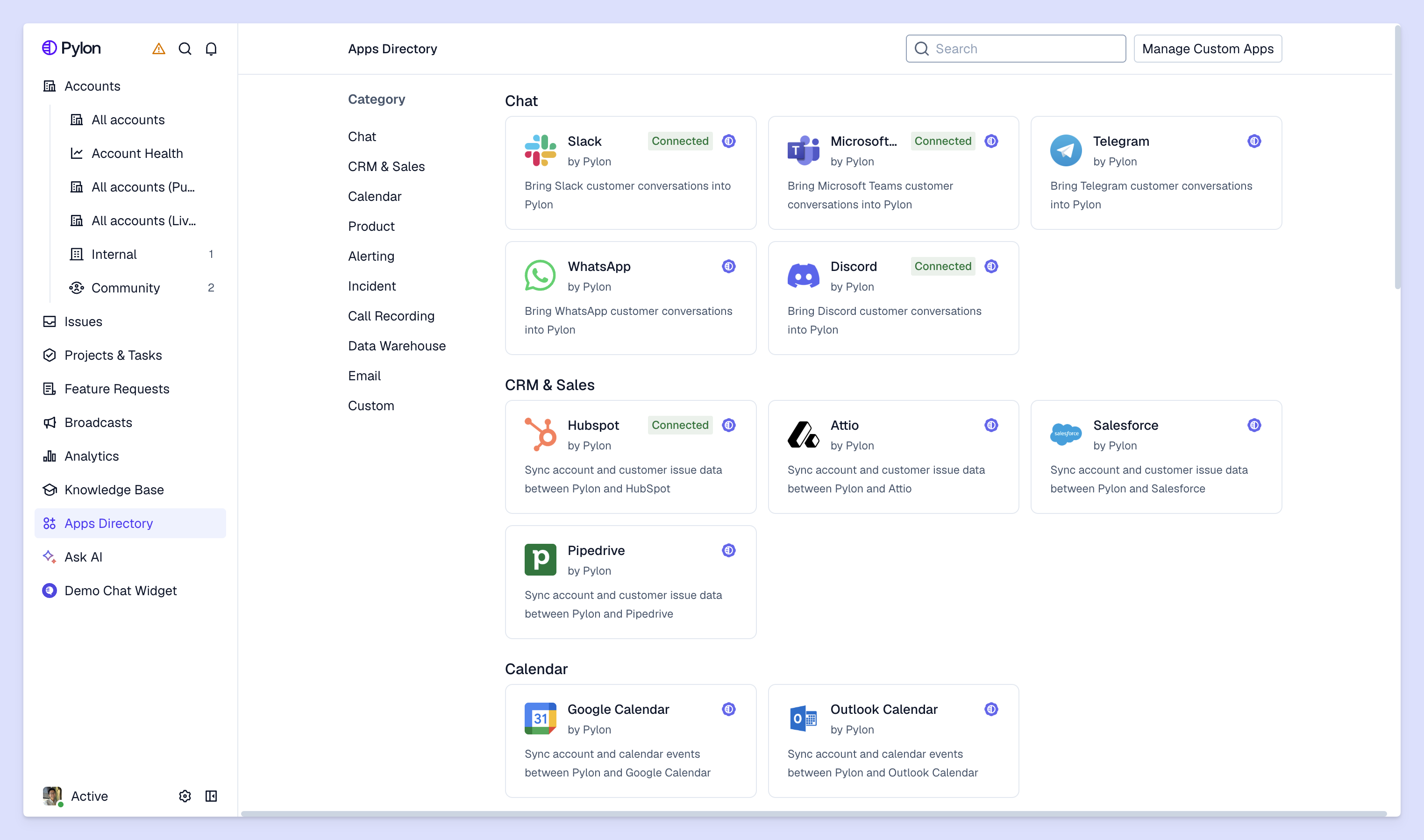
Many teams start with Help Scout, but outgrow it over time and move on to new platforms like Pylon. When that happens, it’s often because of Help Scout’s simplicity. This platform is designed to make support emails feel like personal messages from a friend. That design choice can work well for early-stage companies, but it creates structural limits for scaling teams.
Here are four common reasons B2B companies make the switch from Help Scout to an alternative like Pylon.
If you support enterprise accounts, your most critical conversations likely happen in shared Teams or Slack channels. Help Scout’s Slack integration is an add-on built for internal notifications. It alerts you when a new email arrives, but it doesn’t let you conduct in-depth support chats.
This limitation creates friction for enterprise customers who expect real-time collaboration, and it forces them back into email threads. Your team has to manually copy messages into your help desk to maintain clear records, which hurts productivity. An alternative like Pylon can offer built-in Slack and Teams support, avoiding the need for integrations entirely.
Help Scout organizes support around individual conversations. This limits flexibility if you manage multiple stakeholders per account. When a new ticket comes in, your team often needs to see the account’s health score and full interaction context across all parties.
Without that visibility, support has to operate in a vacuum, disconnected from your customer success and sales teams. Team members can’t easily see if a customer is up for renewal next month, or if an account recently filed three other critical bugs. What you may need is a platform like Pylon that provides account-level views, rather than treating each conversation like a one-time contact.
Help Scout’s AI capabilities are fairly modest, and they only support your team members’ manual work. Features like AI drafting and summarizing help you write emails faster, but they don’t handle work autonomously.
This model doesn’t scale well for teams that need AI agents to deal with routine tickets and route complex issues to the right people. True AI-powered customer support software should be able to trigger automated workflows and update information without your team’s input.
For small teams that rely entirely on email, Help Scout is a great tool. But once your team and customer base grow, the lack of advanced routing, SLA management, and omnichannel reporting become roadblocks. You’ll need more complex features and granular analytics than Help Scout can offer.
When your help desk software doesn’t offer detailed insights natively, support leaders spend their time sorting through data instead of perfecting customer experiences. Teams that rely on knowledge bases to deflect ticket volume could also find that Help Scout lacks the AI indexing needed for useful self-service at scale.
If you’re ready to move beyond Help Scout, it’s important to choose a tool that won’t force you to switch again. When you build your list of “must-haves,” focus on long-term scalability and B2B-specific needs.
These key factors should guide your choice:
Before diving into the details, here’s how these two platforms compare on the features that matter most to B2B teams.
| Feature | Pylon | Help Scout |
|---|---|---|
| Slack support | Yes, bi-directional sync | Limited, internal notifications only |
| Knowledge base | Yes | Yes |
| Teams support | Yes | No |
| Account-level context | Yes, built-in Account Intelligence | No, conversation-based histories |
| Key AI capabilities | AI Assistants and Agents, AI-powered Knowledge Base | Agent-assisted drafting and summarizing |
| Routing and workflows | Complex routing based on factors like team member schedules and skills, custom triggers and multi-step automated workflows | Basic conversation routing, automated workflows based on custom triggers |
| CRM integration | Deep, bi-directional sync | Basic data display |
| Best for | B2B teams managing multiple channels with complex account and automation needs | Small teams focused on email support |
Pylon combines an omnichannel inbox with deep account context. You can access details like health scores and churn signals easily when handling support conversations. Plus, this platform features native Slack Connect support and AI Agents that handle autonomous workflows.
That’s why Pylon is the alternative smart support teams move to when Help Scout stops scaling. As an example, check out how Writer migrated seamlessly from Help Scout to Pylon and saw immediate improvements.
Key features:
Drawbacks:
Best for: B2B teams managing enterprise accounts over channels like Slack, Teams, Discord, and email

The decision between Pylon versus Help Scout relies a lot on how you work with customers. If you run a small team that relies entirely on email, Help Scout delivers a clean, simple experience. But if you manage high-value B2B accounts, your customers expect real-time collaboration, and your team needs detail-rich context in all channels.
Pylon is the modern B2B support platform that offers true omnichannel support across Slack, Teams, email, chat, ticket forms, and more. Our AI Agents and Assistants automate busywork and reduce response times. Plus, with Account Intelligence that unifies scattered customer signals to calculate health scores and identify churn risk, we’re built for customer success at scale.
Migration from Help Scout is quick. Pylon's migrations team backfills your ticket history and knowledge base, and because Slack and Teams are net-new channels, you start there while your email data moves over. Most teams are fully migrated in one to two weeks with minimal disruption.
Pylon is built for B2B teams whose customers already work in Slack or Teams, or who manage multiple stakeholders per account. If support is still light and entirely email-based, Help Scout may be the simpler starting point. The signal to move to Pylon is when channels and account complexity start to outpace an email-first inbox, often around Series A to B. That’s why it’s the best customer support for startups.
Help Scout's AI drafts replies and summarizes threads to speed up agents. Pylon's AI goes further: its account-aware agents resolve routine tickets on their own, flag churn signals, and escalate with full account context, so teams handle more volume without adding headcount.
Pylon Workforce Management is available now. See it in action with a live demo.