












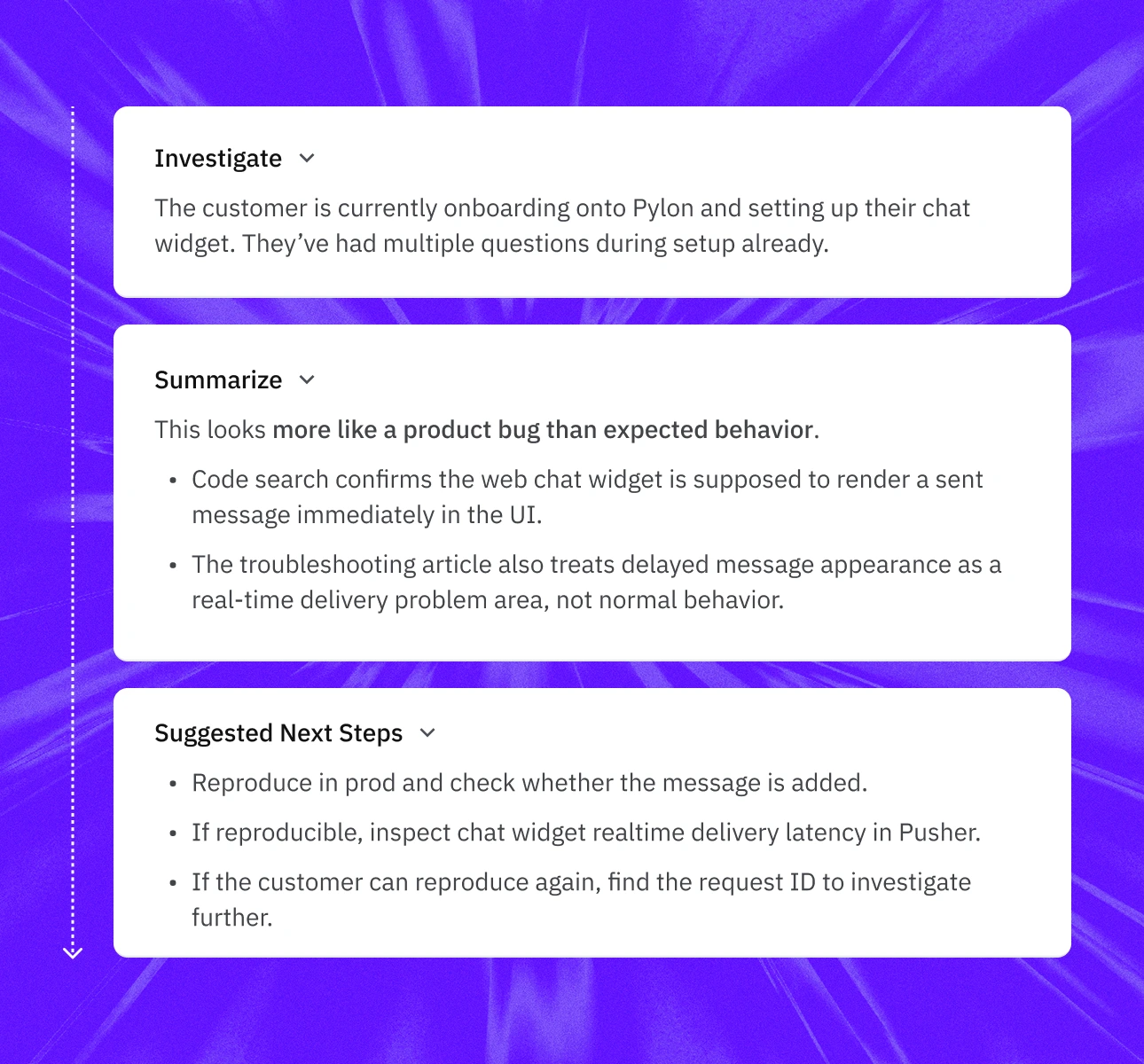
Jira Service Management has meaningful AI capabilities through Rovo and Virtual Service Agent. They are particularly strong for structured, repeatable requests and questions that can be answered from existing knowledge.
B2B customer issues are rarely that simple. Pylon’s agents work across conversations, account history, product context, related issues, and connected systems to investigate more complex customer problems.
Background Agents start before a human opens the issue, gathering context, investigating the problem, and running the right Skills. Your team starts with evidence and recommended next steps, not another request to research.
Support customers wherever they are — Slack shared channels, email, in-app chat, and Microsoft Teams — all in a single inbox with full conversation history. No more context switching.

Jira Service Management supports Slack and other channels. The difference is not whether a message can enter the system. It is what humans and agents understand about the customer when it does.
Pylon brings conversations from Slack, Microsoft Teams, email, and other channels together with account history, related issues, product context, and customer signals. Support works from an ongoing understanding of the customer instead of translating every conversation back into a service desk workflow.
Support customers wherever they are — Slack shared channels, email, in-app chat, and Microsoft Teams — all in a single inbox with full conversation history. No more context switching.
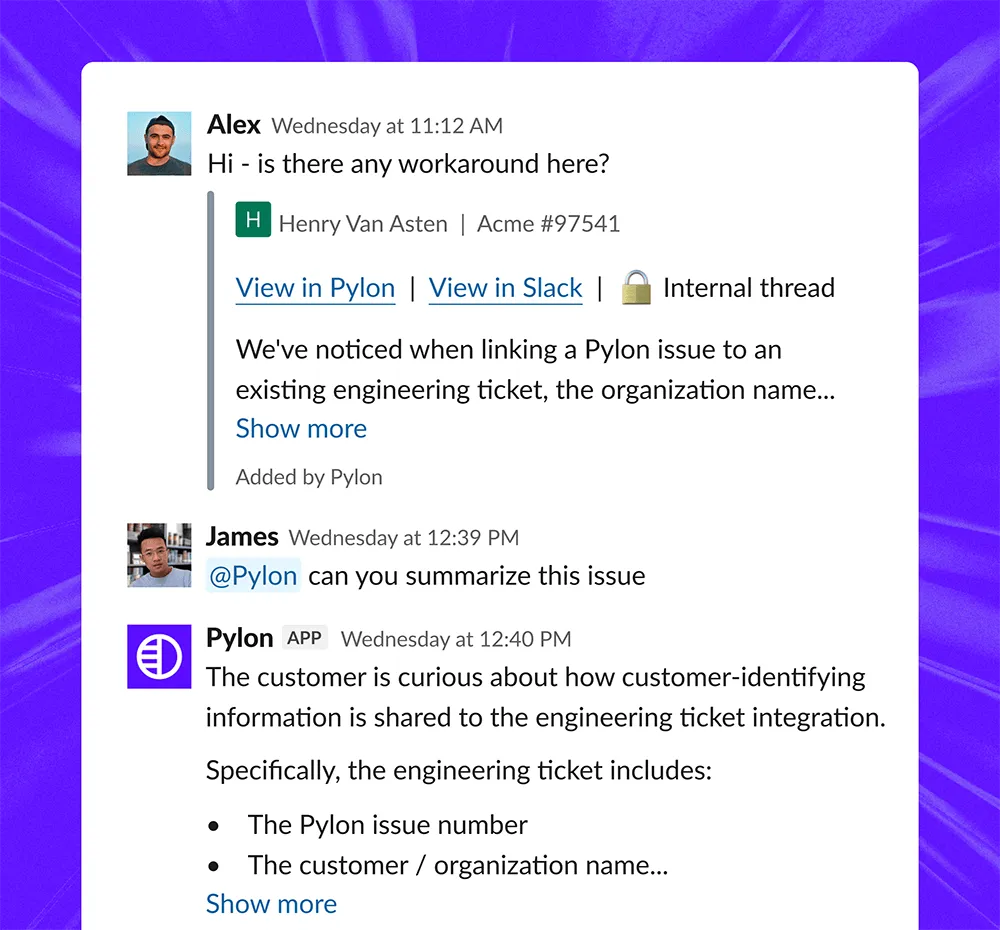
Jira Service Management can create a tight connection between Support and Engineering, especially when both teams already work in Jira. But that connection puts Support inside an engineering-centric system built around service requests and Jira workflows.
Pylon gives Support a workspace built around customers, conversations, and account context. When an issue needs Engineering, Pylon connects the work to Jira with the relevant customer context, so both teams can work in the system designed for them.
Support customers wherever they are — Slack shared channels, email, in-app chat, and Microsoft Teams — all in a single inbox with full conversation history. No more context switching.
Join 1,500+ B2B companies who have empraced the new way of working.


Jira Service Management is a broad service management platform with strong roots in ITSM and deep integration across Jira and Confluence. It is particularly strong for structured service workflows, internal IT, and organizations standardized on Atlassian.
Pylon is an agentic support platform purpose-built for B2B companies. It brings customer conversations, issues, signals, and account-level context together so humans and agents start with an understanding of the customer, not just the request.
Jira Service Management has meaningful agentic capabilities. Rovo Agents can reason and act inside Jira workflows, while Virtual Service Agent is particularly strong for structured, repeatable requests and knowledge-driven self-service.
Pylon is built for a different kind of work. Its agents are designed around high-touch B2B customer issues that require investigation across conversations, account history, product context, related issues, and connected systems.
The difference is not whether both platforms have agents. It is what those agents were built to work on.
No. In many cases, replacing Jira is not the goal.
Keep Engineering in Jira and move the customer-facing workflow to Pylon. Pylon connects Support and Engineering so each team can work in the system designed for its job.
Yes. Jira Service Management supports Slack and other channels.
Pylon’s advantage is not simply channel coverage. Pylon brings customer signals across channels together with the account, support, and product context humans and agents need to act. Customer conversations remain part of an ongoing B2B relationship instead of becoming isolated service requests.
Jira Service Management offers powerful automation for service workflows, and Rovo Agents can reason, act, and participate in Jira workflows.
Pylon Skills combine natural-language instructions, context, tools, permissions, and approval steps into reusable units of work. People and multiple types of agents can use the same Skill across interactive and automatic work.
Usually, it is not because Jira is a bad product. It is because the service desk model stops fitting the way a high-touch B2B support team works.
Customer work needs to be organized around accounts and ongoing context. Conversations happen in Slack, Teams, and email. Manual triage and repetitive Jira work create operational drag. And keeping Support and Engineering connected can mean forcing the customer-facing team to work like another Jira team.
Pylon gives Support a workspace organized around customers, conversations, and account context while keeping Engineering in Jira.
Pylon is the stronger fit for B2B support teams that need:
Jira Service Management is particularly strong for IT service management, structured internal service workflows, Atlassian-centric organizations, and companies looking to standardize multiple service functions on one broad platform.
It can be, especially for companies already standardized on Atlassian.
The bigger question is whether a low-cost service management layer is the right operating system for a high-touch B2B support team. Pylon is designed to create operational value through better customer context, automation, deeper investigation, and less manual work.
Timing depends on your channels, integrations, workflows, and historical data. Most Pylon migrations finish in under two months.
Pylon’s migrations team handles the data move and validates sample imports, field mappings, routing, and workflows before the final cutover.
Keep Engineering in Jira. Run customer support on Pylon, the agentic support platform purpose-built for B2B.
Book a demo