











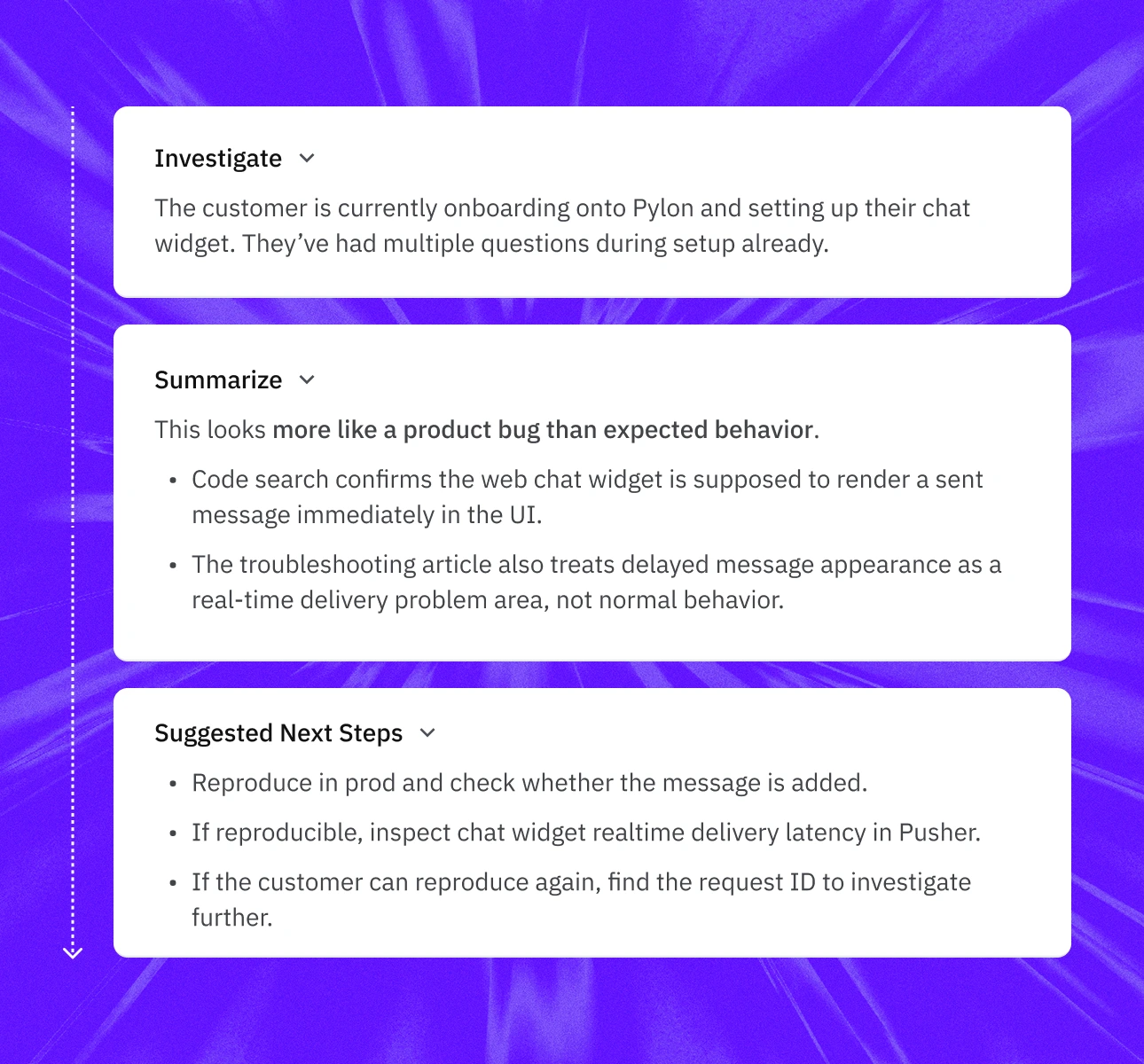
Agentforce Service Agent can process cases, answer questions, and take configured actions. Pylon’s Background Agents begin the internal investigation as soon as the right support signal occurs.
They gather account context, investigate connected systems, find related issues, and run the right Skills before a human opens the ticket. Your team starts with evidence and recommended next steps instead of another case to read and research.
Salesforce has deep CRM context. Companies with mature Salesforce data models can give Agentforce access to accounts, contracts, entitlements, case history, knowledge, and other connected records.
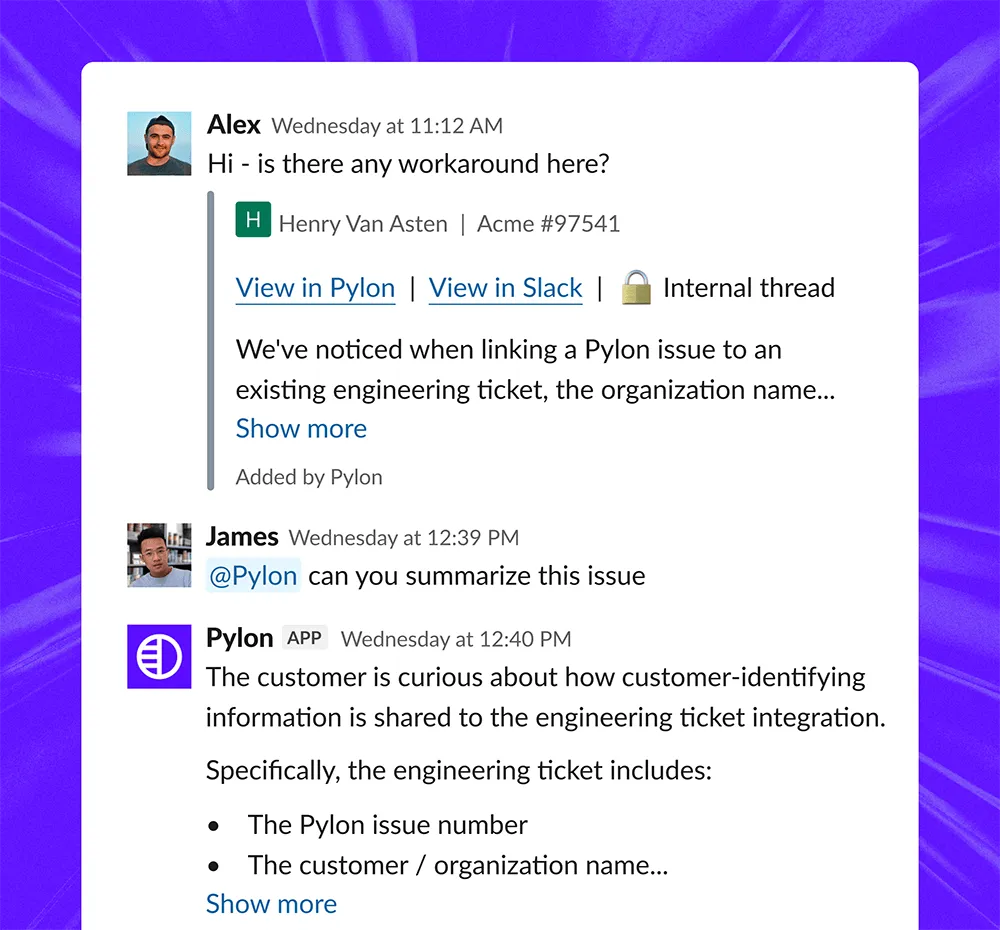
Pylon combines Salesforce data with conversations, Slack history, product usage, logs, engineering systems, and completed investigations. That raw data builds standing Account, Support, and Product Intelligence that agents use to investigate and act, not just generate a response.
Salesforce supports natural-language instructions alongside subagents, actions, Flow, Apex, permissions, and other platform controls. That flexibility is powerful, but production changes can depend on Salesforce admins, RevOps, IT, or developers.
Pylon Skills combine instructions, context, tools, permissions, and approval steps in plain language. The same Skill can be used by Assist Agent, Background Agents, Support Agent, or a person. The support team can run, review, and improve the process directly.

Join 1,500+ B2B companies who have empraced the new way of working.





Salesforce Service Cloud is an enterprise CRM extension that is powerful for teams already deep in the Salesforce ecosystem, but complex to configure, slow to implement, and not built around the channels B2B customers use today like Slack, Teams, and Discord. Pylon is a purpose-built agentic support platform that is live in weeks, not months.
Pylon is an agentic support platform built for complex B2B work. Its agents use Support, Account, and Product Intelligence to gather context, investigate issues, coordinate across systems, and act while humans direct and review the work.
Yes. Pylon can use Salesforce as the CRM and system of record while giving the support team a separate system for conversations, investigations, account context, and agent workflows.
Relevant Salesforce data becomes part of Account Intelligence alongside context from Slack, email, product usage, logs, engineering systems, and prior support work.
Both platforms offer customer-facing resolution, interactive assistance, natural-language configuration, testing, and connections to external tools.
The difference is the operating model and context behind the agents. Agentforce uses Salesforce data, knowledge, workflows, and configured actions. Pylon’s agents use standing B2B account, product, and support intelligence. Background Agents also begin investigating before a person opens the issue.
Yes. Salesforce can connect Agentforce to external data and tools through Data 360, integrations, APIs, MuleSoft, and MCP.
Pylon’s distinction is not simply access to external sources. It builds a persistent intelligence layer from data across the support operation, then gives every agent that context when it investigates and acts.
Salesforce uses subagents and actions to define what an agent can handle and do. Those actions can connect to Flow, Apex, APIs, MCP servers, and other Salesforce capabilities.
Pylon Skills are reusable units of work that combine natural-language instructions, context, tools, permissions, and approval steps. People and multiple types of agents can use the same Skill during interactive or automatic work.
Salesforce deploys employee-facing agents in Slack for internal workflows, CRM access, and record updates.
Pylon treats Slack as both an internal interface and a native B2B customer support channel. Customer conversations in Slack Connect become tracked issues with account context, while internal teams can investigate questions and take approved actions through Slack Agent.
Pylon is the stronger fit for B2B support teams that need:
Salesforce is a strong fit for organizations that prioritize a broad enterprise CRM and contact-center platform, have standardized their operations on Salesforce, or depend on Salesforce industry products and voice capabilities.
Timing depends on your channels, integrations, workflows, and historical data. Most migrations finish in under two months.
Pylon’s migrations team handles the data move and validates sample imports, field mappings, routing, and workflows before the final cutover. Salesforce can remain connected as your CRM after support moves to Pylon.
Yes. Pylon integrates natively with Salesforce, pulling account data like ARR, owner, tier, and health score directly into every ticket view, so your support team always has full account context without switching to the CRM.
For B2B support and customer success teams that do not need Salesforce’s full CRM, yes. Pylon consolidates in one platform, without the admin overhead or implementation complexity of Service Cloud. Teams that need deep Salesforce CRM integration can run both in parallel via Pylon’s native Salesforce sync.
Join hundreds of companies that have moved to Pylon for account-aware, agentic support.
Book a demo