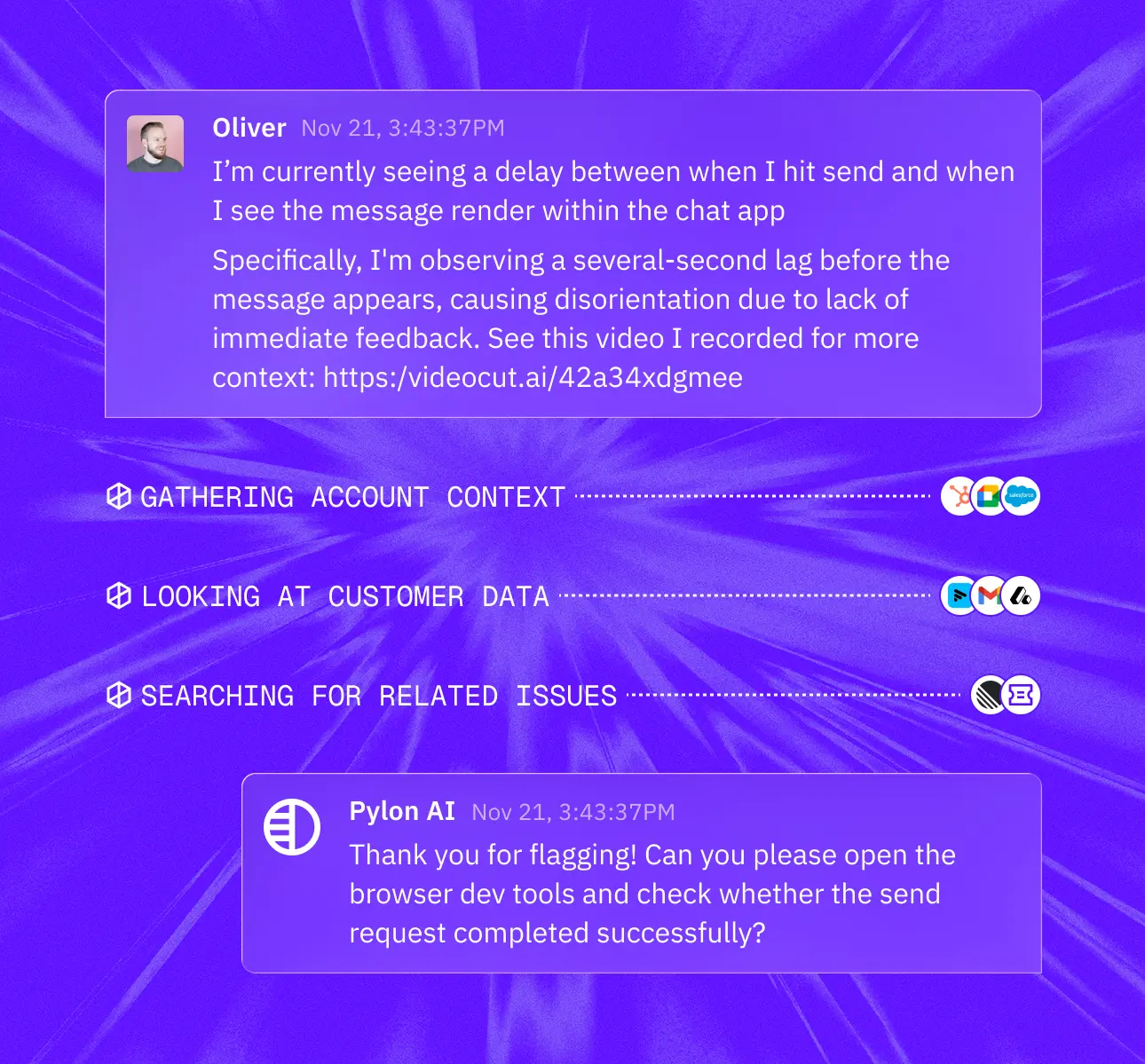












Support Agent loads account-level context automatically: ARR, health score, open issues, prior conversations, Slack channel history, and feature requests. It knows whether it's talking to a free-tier user or a $200K enterprise customer — and adjusts accordingly.

Skills are structured, repeatable behaviors your team defines once and both AI and human agents can run. Support Agent matches incoming issues to the right Skill automatically — no manual routing required. Skills encode your best practices: how to handle a sync error, how to enable a beta feature, how to triage a billing dispute.

Support Agent can read and act across any MCP-compatible tool: Linear, Notion, PostHog, and your internal APIs. It doesn't just answer questions — it creates tickets, fetches logs, checks system status, and takes action in the tools your team already uses.

Create Support Agent variations with different instructions, Skills, and escalation policies. Use rules by account tier, issue type, or custom conditions to control what each agent handles, then test against real historical issues to see how it responds, escalates, and improves before going live.

Track resolution rate, escalation frequency, and agent quality across every issue. Drill into detailed logs to see exactly why the agent escalated, what it tried, and where it got stuck. Get recommended improvements surfaced automatically — so every escalation makes the next version of your agent better.
A customer sends a message on Slack, email, or any other supported channel. Support Agent kicks in before any human is involved.
The agent identifies the customer and brings together the issue history, account context, product usage, internal conversations, and relevant product knowledge.
It checks the systems required to understand the issue, asks the customer for missing information, runs the right skills, and takes approved actions.
The agent resolves the issue directly when it can. When human judgment is required, it routes the issue with the investigation, recommended action, and customer context already prepared.
.png)


Support Agent is Pylon’s customer-facing AI agent. It resolves common issues using approved knowledge and routes complex issues using the full internal context available to your team.
Responses are generated from public, customer-agnostic knowledge approved by your team. Private account data, internal conversations, product logs, and other sensitive context are not exposed to the customer.
Assist Agent works privately alongside your team and can investigate internal systems, answer follow-up questions, and take instructed actions. Support Agent communicates directly with customers using a restricted set of approved knowledge.
It routes the issue to the right person with the relevant customer and account context attached. Your team starts with a clear reason for escalation instead of an unqualified ticket.
You define its approved knowledge, instructions, workflows, permissions, routing rules, and escalation policies. Customer-facing responses remain separate from the private context used for internal decision-making.