












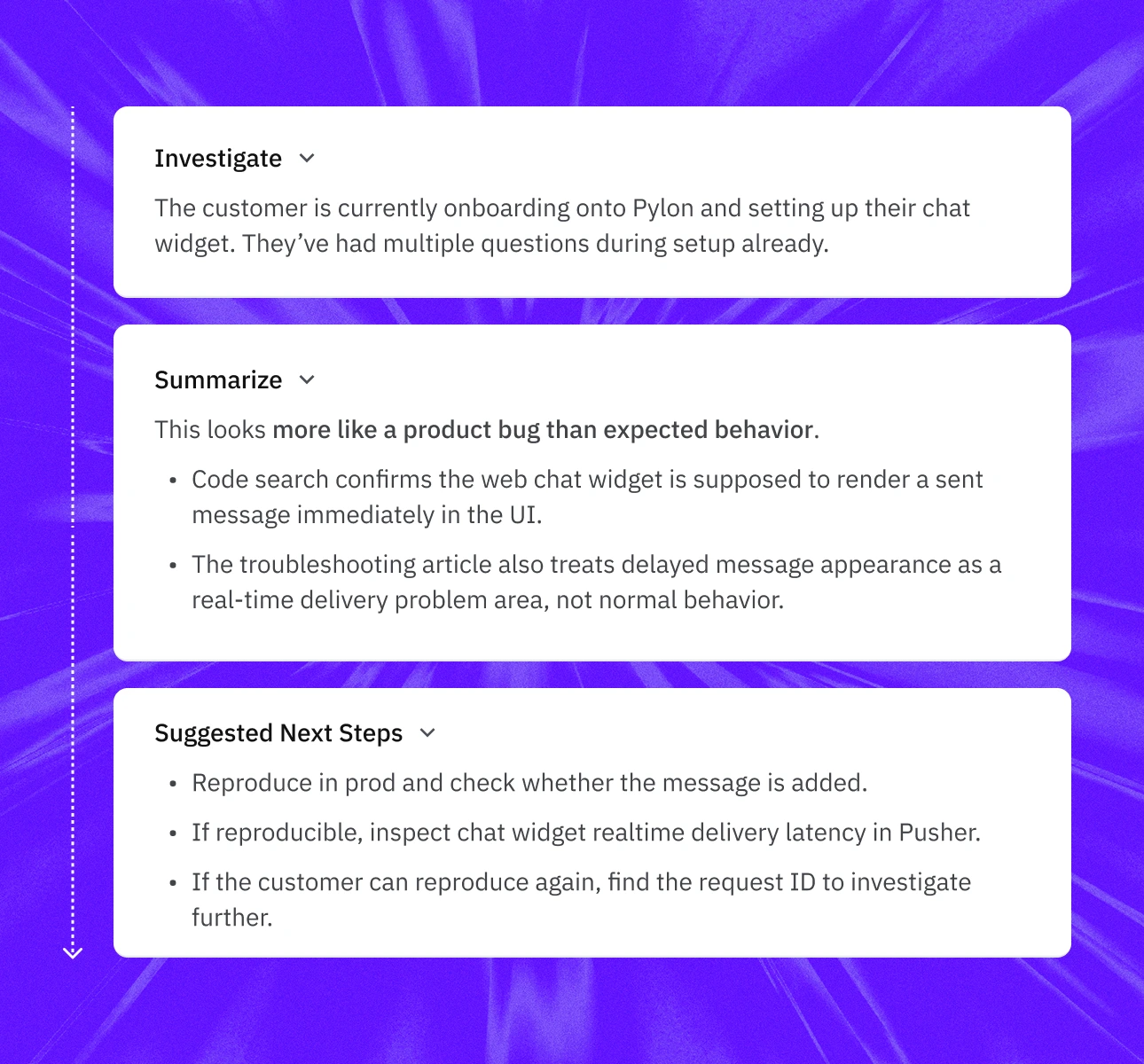
When an issue arrives, Background Agents gather context, check connected systems, and start investigating before anyone opens the ticket. Plain’s Sidekick investigates too, but only with whatever context your engineers wire up through custom MCP servers, so it still won’t know the account’s ARR or health score unless you build that yourself. Pylon’s context layer, including your codebase, is built in and reasoned over directly. Plain can surface code too, but as a lookup for a person to read, not something the agent investigates with. You can also backtest a new agent configuration against past issues before it touches a live ticket.
Support customers wherever they are — Slack shared channels, email, in-app chat, and Microsoft Teams — all in a single inbox with full conversation history. No more context switching.
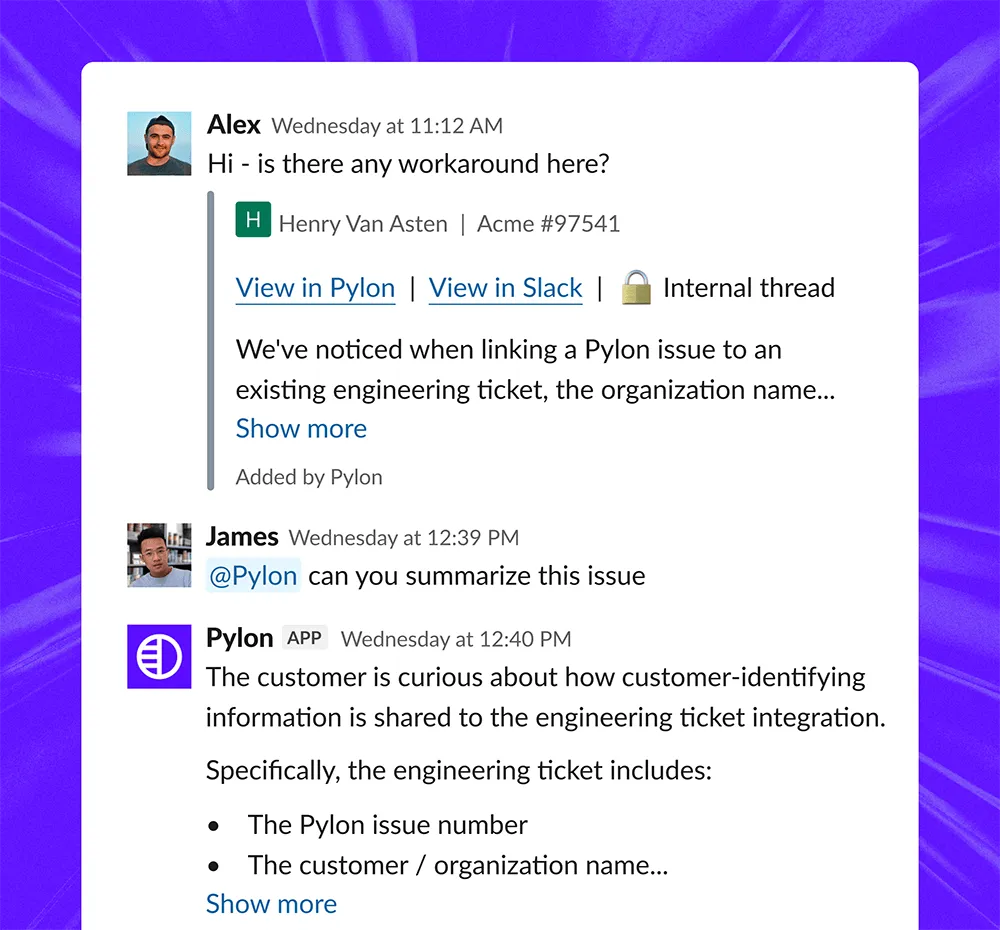
B2B support teams live in Slack. Pylon’s Slack Agent answers customer questions, drafts KB articles, and makes Pylon configuration changes, all without leaving Slack, backed by the account’s ARR, health score, and history. Plain’s Sidekick answers in Slack now too, but only from whatever your team has wired up, without native account context.
Support customers wherever they are — Slack shared channels, email, in-app chat, and Microsoft Teams — all in a single inbox with full conversation history. No more context switching.
Describe the work once in simple language. Agents follow those instructions to investigate issues and recommend what to do next. Plain shipped a similar idea recently. The difference is what the Skill already knows when it runs, a Pylon Skill pulls from the same account context layer as everything else here, before it acts.
Support customers wherever they are — Slack shared channels, email, in-app chat, and Microsoft Teams — all in a single inbox with full conversation history. No more context switching.

Join 1,500+ B2B companies who have empraced the new way of working.


Plain is an API-first, developer-focused support tool built for engineering-led teams that want to compose support into their stack. Pylon is a full-stack agentic support platform for B2B, built for support and customer success leaders who want AI agents, account intelligence, and omnichannel coverage without writing code.
Both support Slack and Microsoft Teams as customer channels. Pylon additionally supports email, in-app chat, WhatsApp, Discord, Telegram, SMS, and phone, all native and all tracked as issues in a unified inbox.
Yes. Pylon is built so any admin can configure agents, workflows, and Skills in plain English, with no code or engineering sprint required. It is designed for ops teams that want to configure and deploy without technical resources, making it accessible to support and customer success teams of any technical background.
Pylon's AI agents are built on account intelligence: they load ARR, health scores, and prior support history before every ticket. Plain's approach allows teams to bring their own AI model, which offers flexibility but requires more setup. For support leaders who want AI that works out of the box with full B2B context, Pylon is built for that use case.
Pylon is the stronger fit for B2B support and customer success teams that want agentic AI, account-level context, omnichannel coverage, and a platform their whole post-sales org can use without needing an engineering team to maintain it. Plain fits teams that prioritize API-first architecture and want to build custom support workflows from scratch.
Both platforms put an agent in Slack for your internal team now, not just customers. The difference is what it knows walking in. Pylon's Slack Agent answers with the account's ARR, health score, and history already loaded, and can make Pylon configuration changes directly. Plain's Sidekick answers with whatever your team has connected, without native account context.
Both platforms ship a customer-facing agent and an internal copilot: Plain's Ari and Sidekick, Pylon's Support Agent and Assist Agent. Sidekick can now investigate and act on connected tools too, so the real difference isn't whether Plain's agents can do the work, it's what they know walking in. Pylon's agents start every issue already knowing the account's ARR, health score, and history, because that context is built in, not assembled by your team.
Timing depends on channels, integrations, and historical records. Most teams migrate in under two months. Pylon's migrations team handles the data move, and most teams validate a sample import and field mapping before committing to a full cutover, catching issues like duplicate records early.
Join hundreds of companies that have moved to Pylon for account-aware, agentic support.
Book a demo