Register for our upcoming webinar → How Haus Analytics rebuilt its support automation



Help Scout can help launch a startup’s support team, but many companies outgrow its email-first approach. For B2B support teams, company growth comes with high volumes of customer conversations across multiple channels, like Slack and Microsoft Teams.
When those messages come from accounts with multiple points of contact who expect you to remember their context and take multiple actions that each have their own workflows to resolve their query, B2B support at scale can get stressful without the right tools.
In this article, we’ll look at five Help Scout alternatives for B2B teams looking for an omnichannel, cross-team support platform upgrade. We’ll explore the strengths of each option and the best criteria to use to evaluate them.
Here are common signs that it might be time to move on from Help Scout:
Here’s a comparison of the best Help Scout alternatives for growing B2B teams. We’ll look at when each one would be the best fit for a team migrating from Help Scout, and any major limitations they have.
Best for: B2B teams with complex support needs.
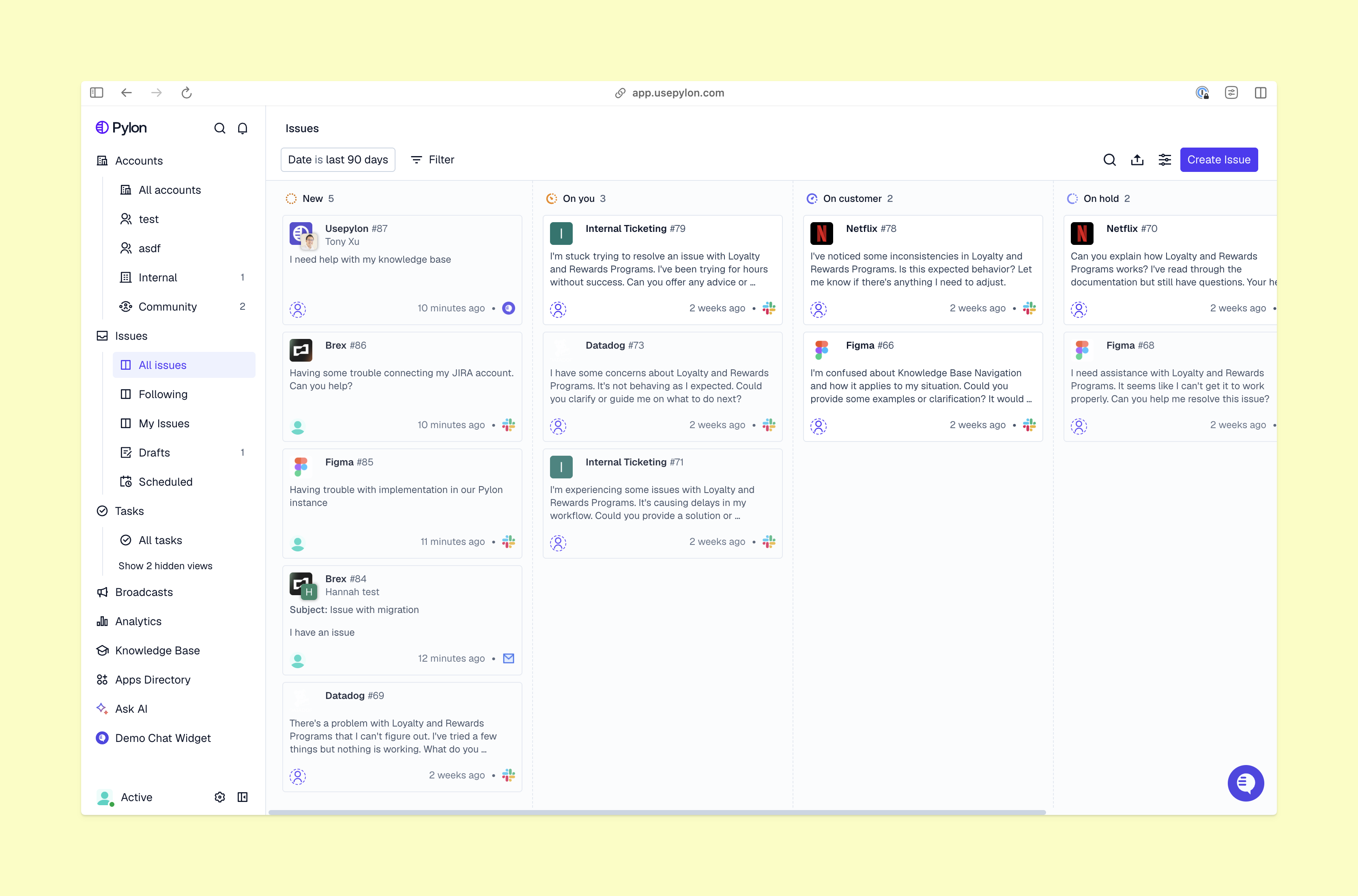
Pylon is an agentic support platform built specifically for complex B2B customer support. It pulls together omnichannel communication on every platform your customers use with automations and collaboration between team members and AI agents.
It comes with six kinds of AI Agents to help your support team resolve issues across every channel:
Together, all six create a strong agentic workflow that doesn’t require you to give up the control you need to care for enterprise relationships.
Pylon is a great solution for teams managing complex cross-team support issues and accounts with multiple stakeholders, and it has dedicated guidance on migrating from Help Scout. If your team mostly works through email and doesn’t need account context, agentic workflows, or omnichannel visibility, Help Scout’s simpler features may be a better fit.
Best for: Enterprise-forward teams that want to integrate multiple programs.
Zendesk is made for large companies looking for a flexible support platform that’s ready to scale with your team. It’s an established platform that also offers a marketplace with over 1,000 integrations and AI agents and copilots to speed up issue resolution (compared to Help Scout’s approximately 100 options and limited native automation).
However, Zendesk lacks native Slack support, so it’s not a great fit for B2B companies that need to combine insights from every channel. Zendesk also charges extra per-resolution and per-agent add-on fees for AI agents, so costs can climb quickly. That makes it less than ideal for B2B teams that center task automation in their scaling strategy.
Best for: Smaller teams with longstanding customer relationships.
Front can be a good fit for teams that like the email-first, conversation-based approach of Help Scout but are ready to take the next step toward automation. With internal notes, assignments, and shared customer context visibility, Front's AI can handle simple queries, and escalate to your team when it can’t pull from public knowledge.
Note, however, that important features like Front’s AI Copilot are limited to higher tiers of paid plans. It also charges separate fees every time its AI agent routes, hands off, or resolves a customer inquiry, which can make it expensive for B2B support that regularly collaborate and escalate across teams. If you’re just getting started with automating your support team, look into Front, but it isn’t a great fit for B2B teams with established AI workflows looking to scale.
Best for: Companies that work in B2B and B2C contexts.
If you want a like-for-like alternative to Help Scout, look into Freshdesk, Freshworks’ AI-powered customer support tool. It adds an AI agent to email inboxes to answer simple queries while consolidating the responses into one dashboard, an AI Copilot to run workflows, and AI Insights into key operational metrics.
Freshdesk’s pricing is more predictable than Help Scout’s. All its paid plans come with 500 free AI sessions, and additional sessions are bundled instead of charged per resolution. However, heavier AI users will still face higher costs if they need multiple bundles per month. It also doesn’t fit the needs of a complex B2B system because its AI Insights are relatively limited, and account context is sparse at lower paid tiers.
Best for: International companies that work in multiple languages.
Intercom includes an omnichannel inbox and a unified service hub with automated workflows powered by its Fin AI agent, which can resolve customer issues autonomously. Most importantly, it’s the only option on our list that can automatically translate messages in over 150 languages, so it’s a strong option for B2B companies expanding into international markets who aren’t ready to hire language specialists.
You may need to manually intercept the Fin AI, which doesn’t always automatically route queries to support teams when it doesn’t know an answer. While it’s meant to lift some of the manual workload off support teams, this extra step means your team may spend just as much time monitoring the AI agent as they did answering those queries in the first place, so it’s not a great fit for teams in the process of scaling.
Intercom is a relatively expensive option, and like several other platforms on this list, its per-outcome AI agent fees make costs difficult to predict.
Here’s what to look for as you evaluate Help Scout competitors and choose the best fit for your team:
If your team has run up against the limits of Help Scout, look for an alternative that’s built for the complexity of B2B customer support. A platform for scaling B2B SaaS companies should let you manage complex conversations on all the channels your customers use and make it easy for your teams to coordinate responses with full visibility into the account.
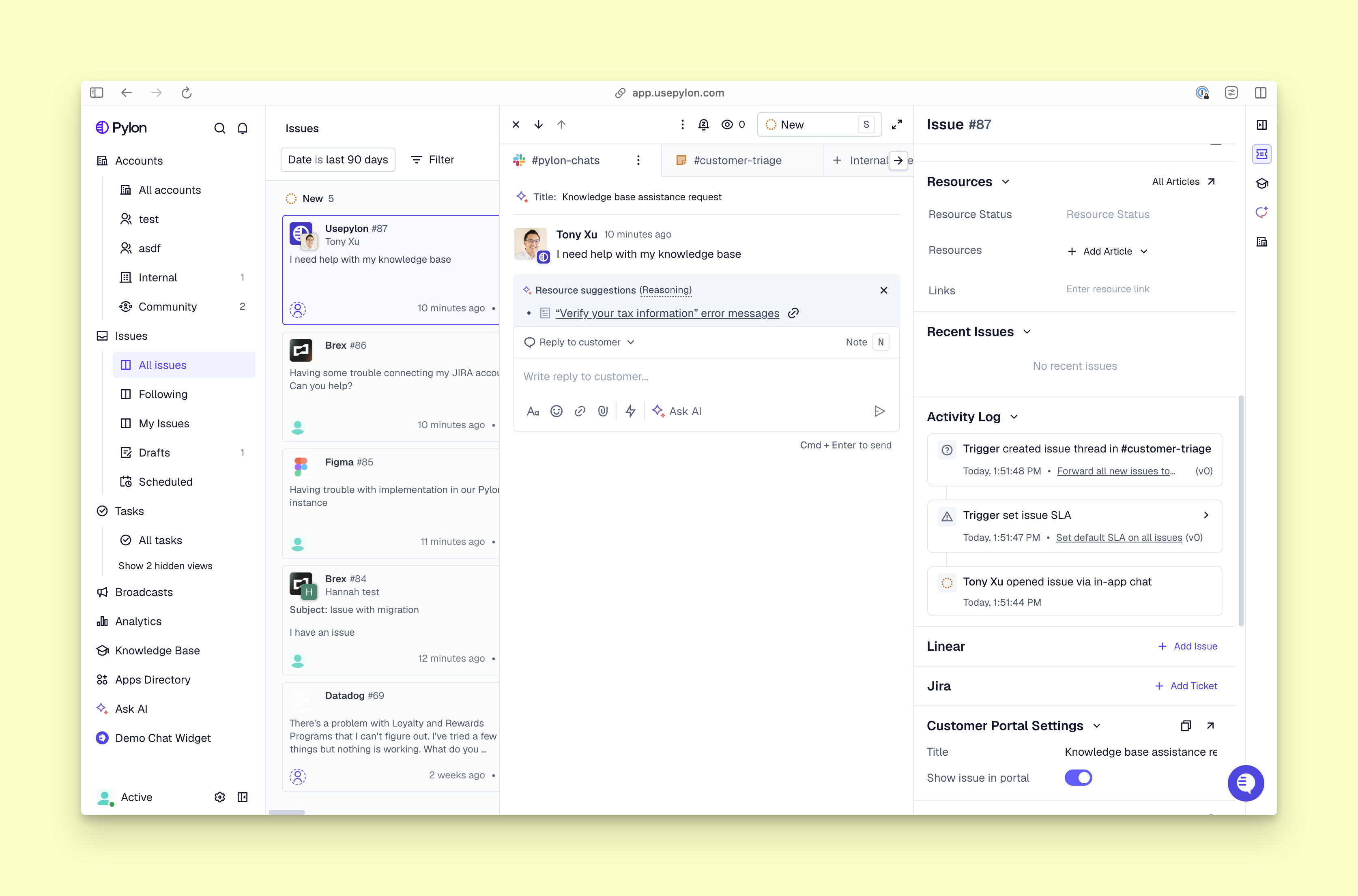
Pylon is the Agentic Support Platform built for B2B support teams. It brings conversations across Slack, Teams, email, chat, and other channels into one place, giving AI the context to help resolve customer issues and continuously improve your knowledge base. Pylon can identify missing or outdated documentation, generate new content from real support conversations, and help your team keep knowledge accurate as your product evolves.
All of the Help Scout competitors we’ve profiled in this article offer strong AI-powered tools for customer support. The best fit for your team depends on what exactly you need the AI tool to do and how much customer context you need to get that work done. Also, consider your growth plan: for many AI customer support tools, cost scales with usage. Scaling B2B teams that need to surface relevant customer context from a rich history while retaining a human touch to the support itself should consider Pylon.
Choose Help Scout if you have a small support team, most of your customer conversations are simple email inquiries, and you need a shared inbox, knowledge base, and ticketing system that’s easy for your team to set up and use.
Help Scout’s main limitations are its lack of true omnichannel support for B2B channels like Slack and Teams, its basic analytics, and its limited features for complex issues involving multiple steps and teams.
Yes. Help Scout provides APIs to help you export your conversation history, reporting data, customer list, and knowledge base articles. You can then import that data into a new tool, although you may need to do some customization to fit the new tool’s requirements.
Pylon Workforce Management is available now. See it in action with a live demo.