
Despite all the concerns about AI replacing humans, the pattern in most industries is more nuanced. In fields like software dev, healthcare, legal, and customer support, companies are using AI to improve how their people work, not to automate those roles completely.
At Pylon, we’ve seen this pattern with our own customers: Building strong B2B relationships calls for workflows that bring AI and human efforts together. An agentic AI platform can help support teams work faster by researching customer issues, accessing account context, suggesting responses, and taking autonomous actions. Meanwhile, your team keeps full control over one-on-one interactions and account-level management.
In this guide, we’ll explain what an agentic AI platform is and what capabilities you should look for. We’ll also cover the types of tools on the market and how to choose the best platform for B2B customer support.
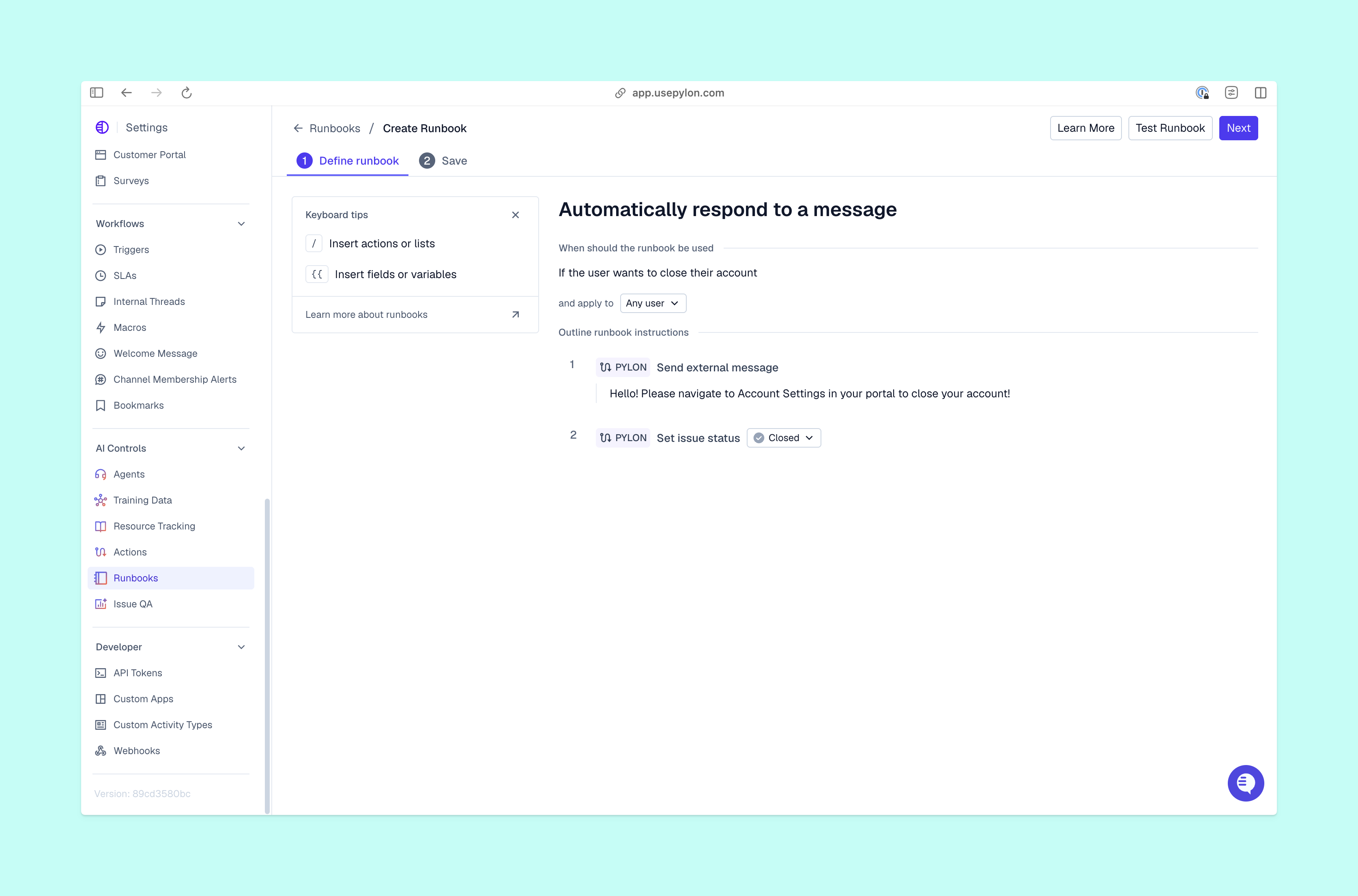
In a traditional support platform, your team works through customer requests one at a time. They research answers, coordinate with other teams, resolve issues, and respond to customers, maybe with the help of some basic automation and a chatbot.
With an agentic AI platform, your support team can direct AI agents to do some of that work independently. For example, if a B2B customer asks for help with a software integration, an AI agent can investigate the issue. The agent accesses connected context, like the company’s knowledge base and previous support tickets, to find a solution.
Then, it can present next steps to your team along with a draft response for the customer. At that point, your team can either accept the suggestions, direct the AI agent to investigate further, or take over personally if the issue is especially complex or delicate.
This shift from doing the work by hand to orchestrating repeatable workflows reflects how AI is used in software development. While devs used to write and review every line of code, they can now use LLMs like Claude Code to do much of the time-consuming work. This saves time and lets them focus on more high-level tasks, like deciding what the code should do and perfecting the AI outputs.
An agentic platform makes it possible to direct AI to perform complex workflows, even if no one on your team is a coding expert. You give instructions in natural language, and you get helpful context and suggestions the same way. And quality platforms also offer data access tools and other guardrails to help you set up AI agents safely.
Some of what you’ll need depends on your use cases, but here’s what any good agentic AI tool for B2B support should have:
Agentic AI includes a range of different technologies, from broad-use platforms to niche systems designed for specific tasks. These are the main categories:
General-purpose agentic AI tools work well for simple, large-scale task execution. But B2B customer support calls for a more purpose-built solution. Teams need to manage customer relationships with multiple stakeholders across various support channels. And they need to collaborate with other teams while drawing on deep account context from long-term relationships.
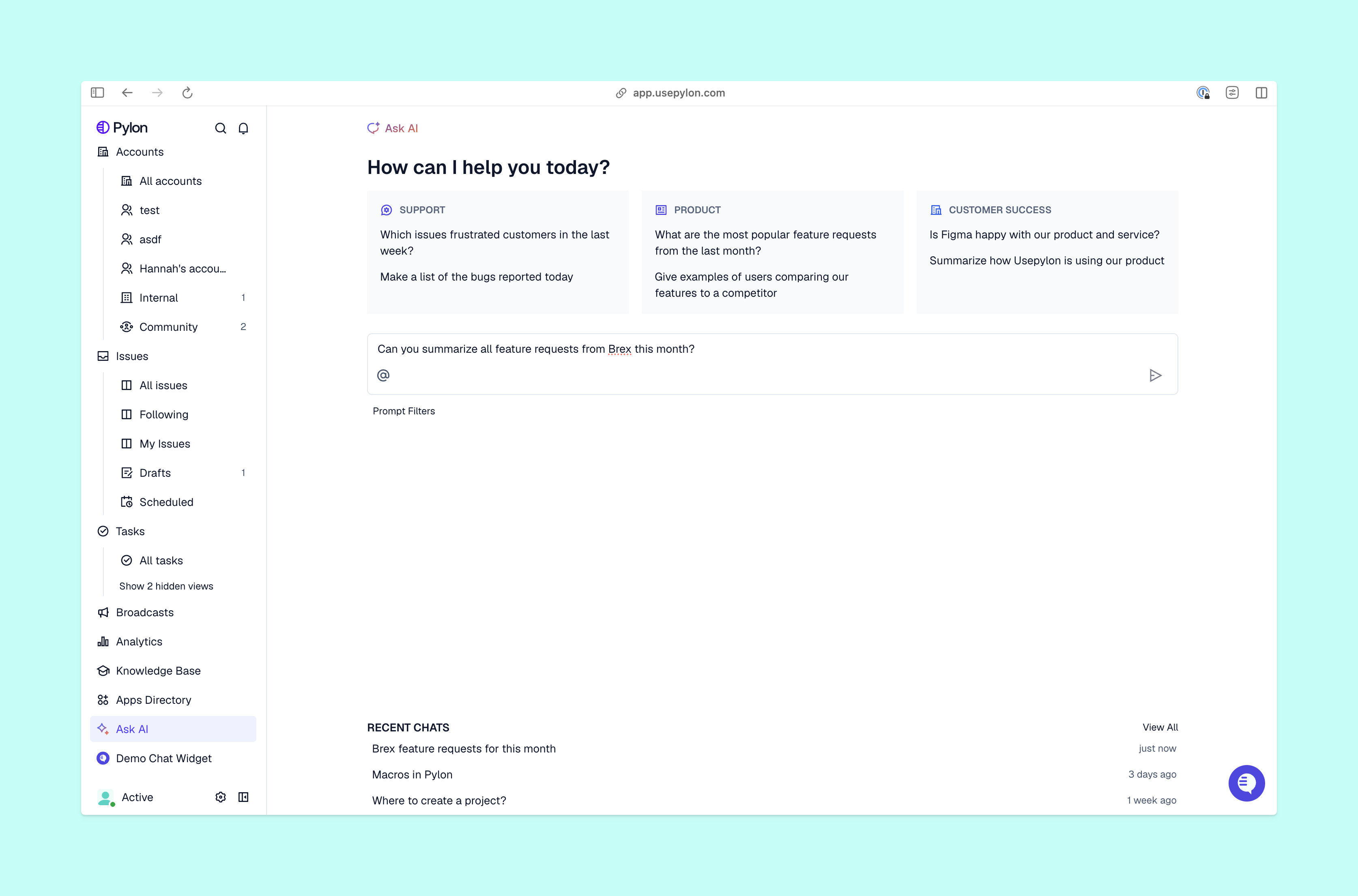
Pylon’s agentic support platform is designed to meet the specific needs of B2B customer support operations. It comes with AI agents built for different support workflows, allowing teams to stop investigating tickets and start overseeing accounts.
Here’s a look at how Pylon’s AI agents and features work together:
When you use an agentic AI platform, the most important decision is how much you’ll automate and how much you’ll keep under human direction. Pylon gives you the flexibility to specify exactly what AI agents should handle and where their limits should be.
Here at Pylon, we adopted agentic support earlier this year. Our median first response time fell 72%, and 62% of tickets now involve substantive work from AI agents, such as accepted drafts or back-and-forths during investigations. You can watch our webinar to see how the platform works and what it can do for your own team.
Pylon is the Agentic Support Platform built for B2B support teams. It brings conversations across Slack, Teams, email, chat, and other channels into one place, giving AI the context to help resolve customer issues and continuously improve your knowledge base. Pylon can identify missing or outdated documentation, generate new content from real support conversations, and help your team keep knowledge accurate as your product evolves.
You can use an agentic AI platform to define agent behavior in plain language, often as reusable Skills. Start with a single repetitive task, configure an AI agent to work on it, and expand the scope only after that single workflow is working reliably.
Yes. With an agentic AI platform, you can direct AI agents and customize workflows without needing a coding or technical background. Instead of diving into code, you simply need to understand your workflow well enough to hand the right piece to an agent, then test and iterate.
Generative AI creates content like text, images, or code in response to a prompt. Agentic AI goes a step further and takes actions like looking something up, updating a record, or completing a multi-step task.
Agentic AI is a form of artificial intelligence built around autonomous decision making and action. Instead of just responding to a command or analyzing data, agentic AI can set a goal, plan the steps to reach it, and carry those steps out with minimal human involvement.
Pylon Workforce Management is available now. See it in action with a live demo.