Updated January 23, 2026 | 9 min read
Customer churn can sometimes feel unexpected or sudden. But when you check their full account history and context, you often see warning signs that were there for weeks. Maybe it's dropping usage data, an increasing number of frustrated support tickets, or gradual disengagement.
Proactive customer service flips that script for B2B teams by identifying issues early enough for teams to act on them. We'll walk through how to build a strategy that actually prevents churn and actively increases customer satisfaction — instead of just responding to issues as they come up.
A lot of B2B support tends to be reactive: Customers run into issues or bugs, reach out to your team, and wait while you troubleshoot and make fixes.
Proactive customer support is different — it's reaching out to customers before they run into problems, identifying potential friction points in the customer journey and reaching out with guidance before customers get stuck.

When you reach out proactively before issues escalate, you improve account sentiment and satisfaction — customers feel that you're paying attention to their goals, looking out for their team, and acting like a partner that's truly invested in their success.
Teams who proactively support customers often see a business impact, too, with improved retention:
Support teams stop being a purely reactive function, and start protecting revenue and driving growth.
Support teams can build a proactive support strategy over time with planning, data, and repeatable processes that the whole team can follow.
Write down every stage of your customer's experience, from signing up until renewing their contract. Mark where customers typically get confused or stuck in the process.
Then, ask your support team which issues and questions are coming up repeatedly. Look at where customers stop using features or where onboarding stalls. Those moments are where you'll focus your proactive outreach.
Pull data across your support interactions and have AI help you analyze, cluster, and synthesize it. You're looking for patterns where the same issue is affecting several customers.
If 30 different accounts are asking, "How do I export my survey data?" that's a pattern worth addressing proactively. Create or improve knowledge resources about survey data exports, or surface the topic as user education during onboarding.
Write down exactly when to reach out, what to say, and what resources to share for each common scenario. Your playbooks make sure everyone on your team delivers consistent proactive outreach.
Each playbook covers one specific trigger. For example, customers who haven't connected any integrations within 30 days of signing their contract might get a check-in message and an invite to an onboarding meeting. Include the message template and what to do based on how the customer responds.
Track signals that show how customers are doing: login frequency, feature usage, support ticket activity, and engagement with your team. When multiple signals trend negative, that's your cue to reach out.
It can seem tricky to pull together data from different tools, but customer intelligence platforms help you combine support data, product analytics, and account context into one view — then calculate health scores for each account. This tells you which customers need the most attention and why.
Test your playbooks on one customer segment first, then expand once you find it what works and what doesn't. You'll catch issues without affecting your entire customer base.
As you continue to test new playbooks, ask both customers and your team for feedback on them. Refine your approach, then roll out the process to progressively more accounts.
Here are specific ways your team can reach out before customers need help. Each one works for different moments in the customer lifecycle.
Message customers at key milestones in their first 60 days. Reach out after their first login, when they finish setup, or when they hit their first week of usage. Share resources specific to what they're trying to accomplish instead of generic guides.
Send a quick note when customers hit meaningful achievements in your product. Maybe they set up their first 10 automated workflows, or resolved their first 100 support tickets. It reinforces the value they're getting and opens a natural conversation about what's working and what feedback they have.
When you notice customers manually doing something your product can automate or help with, reach out to show them those features and how to get value out of them. Use their support history or usage patterns to suggest the right features to the right accounts.
Set up quarterly check-ins with key accounts to talk about their goals, current challenges, and how your product is performing. You'll hear about concerns before they become reasons to leave.
Build automated workflows that alert your team when customer health scores drop. If an account suddenly stops logging in or a champion leaves your shared Slack channel, someone on your team gets notified to reach out that day.
Tell customers about bug fixes, new features, or changes that affect their workflows. This matters most when you ship something they requested — it closes the feedback loop and shows you're listening.
Start renewal conversations 60 to 90 days before contracts end. Share a summary of the value they've gotten and address any concerns while there's still time to fix issues.
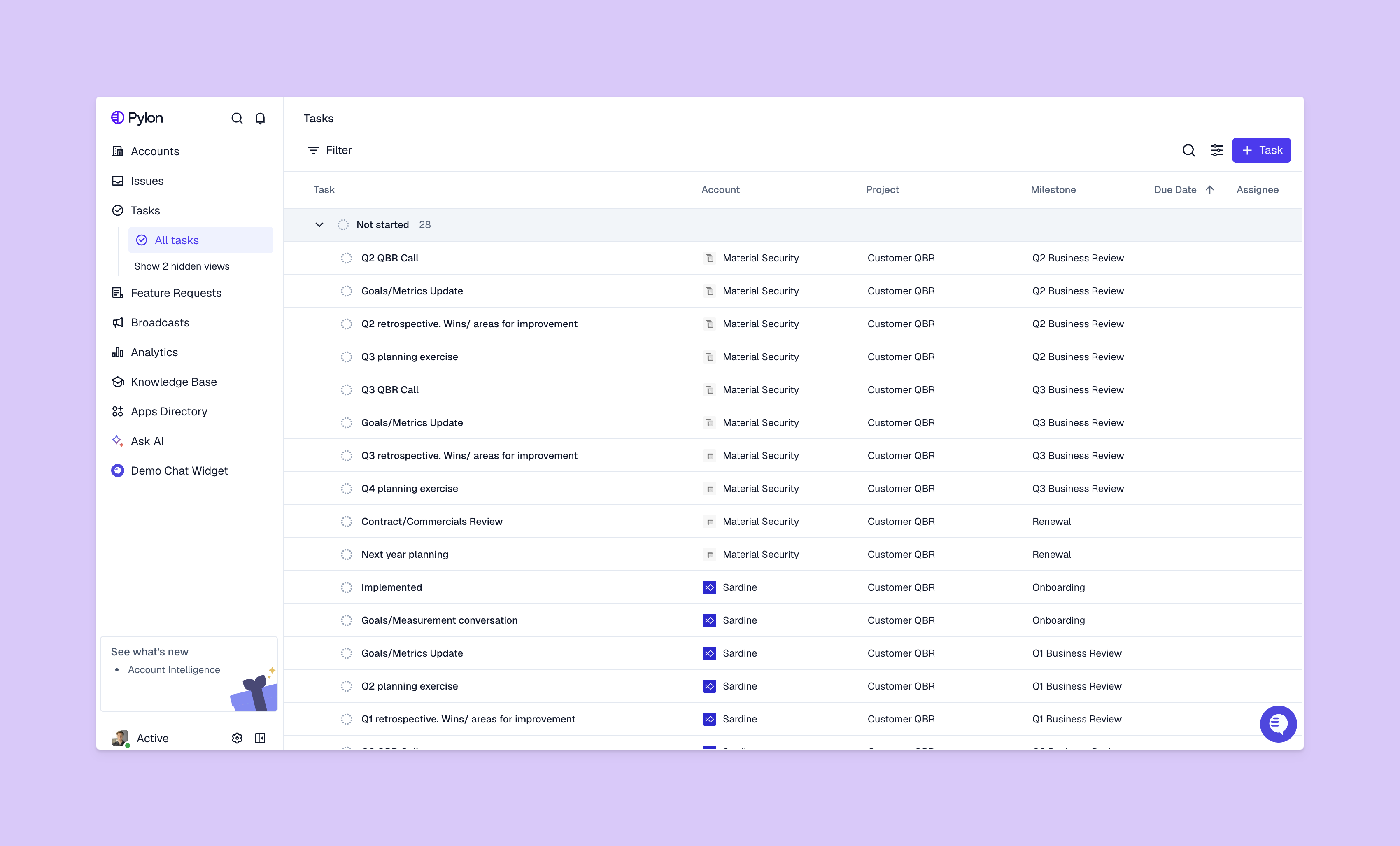
You can't manually check every account for important signals or milestones. Choose tools that can automatically help you identify when customers need proactive outreach and automate the repetitive work for you.
Your core support platform should connect to your customers' preferred channels: Slack, Microsoft Teams, WhatsApp, SMS, email, in-app chat, and more. Having a unified place to manage all your issues helps you easily spot patterns across customer conversations — and deploy AI that can help analyze every conversation for sentiment, feedback, and other critical account signals.
AI agents, AI assistants, and automated workflows can handle repetitive tasks like sending follow-ups after renewal discussions, or automatically sharing onboarding resources with new customers. Since they no longer have to manually do the busywork, this gives your team more time to focus on a proactive outreach strategy and building robust playbooks.
Tools like Pylon's Account Intelligence pull together scattered customers signals across support tickets and unstructured customer conversations — then turn these into custom health scores, AI sentiment analyses, and AI summaries to help you catch churn risks and upsell opportunities. Instead of manually monitoring accounts for proactive outreach signals, AI flags them for you based on support interactions and customer data.
To know whether your proactive support is working, track how metrics change before and after launching your playbooks. You'll use this data to show the impact and justify continued investment.
Once you scale to hundreds of customers, you'll need the right tools to help you grow a proactive outreach motion. With a shared system of record for all your customer interactions and data, you can easily spot opportunities to proactively support your customers.
Pylon is the modern B2B support platform that offers true omnichannel support across Slack, Teams, email, chat, ticket forms, and more. Our AI Agents & Assistants automate busywork and reduce response times. Plus, with Account Intelligence that unifies scattered customer signals to calculate health scores and identify churn risk, we're built for customer success at scale.
If you have a small, combined support and customer success team, try dedicating 20% to 30% of your team's capacity to proactive outreach. Focus on high-value accounts first. As you build efficient playbooks and automation, you can increase proactive work that in turn reduces your incoming ticket volume.
Proactive support reduces churn by addressing issues before customers consider leaving. It also decreases support costs by preventing escalations. The exact ROI depends on your customer lifetime value and current churn rate.
Use customer health scores that combine product usage, ticket frequency, and engagement signals. Focus on accounts with declining health scores or upcoming renewals — those are the accounts where proactive outreach has the biggest impact.
Small teams can start with simpler tactics like onboarding check-ins or renewal preparation. Test those, prove the impact, then expand. AI and automated workflows can help small teams scale proactive outreach without needing to proportionally grow headcount.
Pylon Workforce Management is available now. See it in action with a live demo.