AI can now handle many support tasks, leaving more room for your team to tackle complicated workflows and build long-lasting relationships. This change also means technical expertise plays a bigger role in how well your team investigates and resolves customer issues, both independently and with the help of AI agents.
In this guide, we’ll look at the most valuable hard skills for customer support, then explain how to develop them in a modern B2B team.
What are hard skills in customer support?
Hard skills are the practical abilities your customer support team learns through training and hands-on experience. This includes the technical knowledge your team needs to troubleshoot customer issues and follow support procedures.
These abilities differ from soft skills like communication, problem-solving, and empathy. Soft skills shape how your team approaches work and builds trust with customers. Hard skills are more concrete, so they’re usually easier to assess and measure against established standards.
Good customer support relies on both hard skills and soft skills. Consider an upset customer who contacts your team through Slack about a bug disrupting a project. An experienced team can use empathy and active listening to understand the customer’s frustration and build trust, then draw on technical skills to diagnose the issue and quickly find a resolution.
Fundamental hard skills for B2B customer support
Every company has its preferred customer support tools, but many of the technical abilities transfer from one platform to another. Mastering these fundamental hard skills gives support reps a strong base:
- Customer relationship management (CRM) software proficiency: Know how to use a CRM to understand a customer’s account context before responding to a ticket, then update records.
- Ticketing systems and help desk software: Navigate support queues, track issues against SLA deadlines, manage escalations, and make routing decisions.
- Live chat and email support: Use live chat and email platforms to manage conversations via saved replies and accurate records.
- Documentation and knowledge base management: Write clear, technically accurate troubleshooting guides and maintain versions.
- Basic reporting: Analyze customer support metrics to find performance bottlenecks and track process improvements.
When hiring for your customer support team, look for resumes that demonstrate how applicants applied these skills in practice. Someone calling themselves an “experienced technical writer” doesn’t tell you much, but “added 25 troubleshooting guides to the knowledge base and developed 15 automated workflows” offers a much clearer picture.
4 technical skills B2B support reps need more than ever
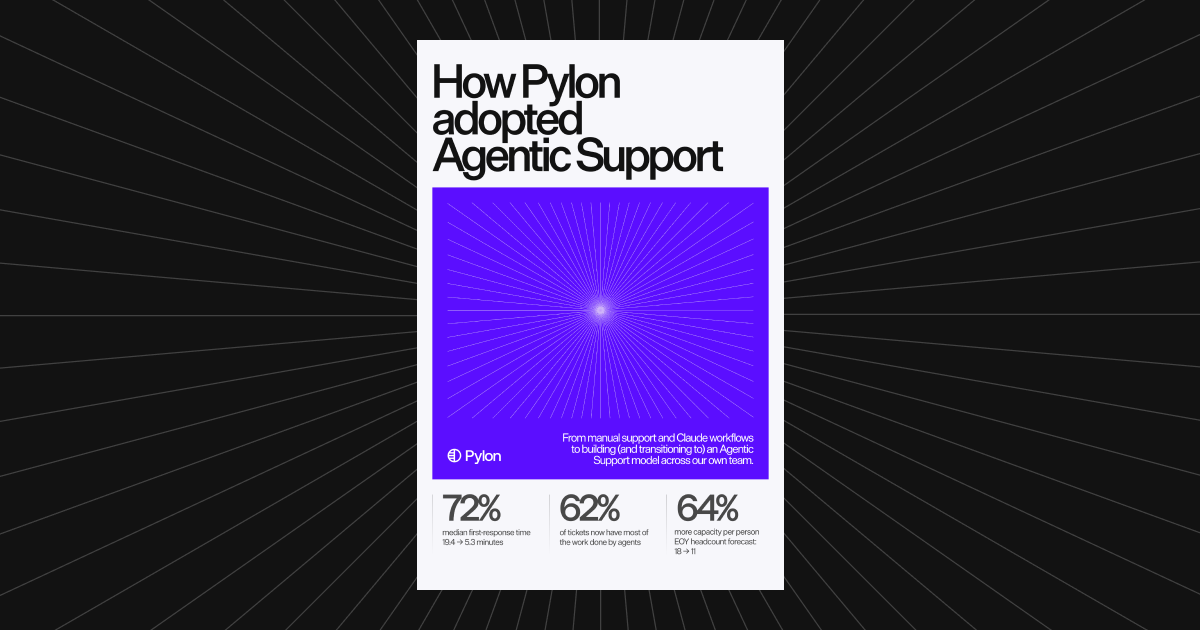
AI is changing how B2B customer support teams approach many technical problems. When we adopted agentic support here at Pylon, our reps started using AI to investigate issues that previously required help from engineering. In the four weeks after rollout, Support ran 773 codebase searches, and questions in our internal #product-helpdesk Slack channel dropped by about 50%.
Modern support reps need to rely on strong technical knowledge to manage more complex issues independently, and to work effectively with AI. Here are four examples of customer support hard skills that are increasingly important.
1. Product knowledge and system context
B2B support engineers have to understand how customers interact with their products. AI can retrieve relevant context from previous tickets and CRM records, but reps need the product knowledge to interpret that information and turn it into action. They should also know how to recognize software limitations and explain to customers what they can reasonably expect from the product.
2. Technical troubleshooting and bug reproduction
When a customer reports a technical issue, support team members may need to diagnose the cause. AI can investigate application logs and suggest possible issues, but reps still have to test and verify the findings. Strong troubleshooting skills can also help them fix issues independently.
3. Issue documentation and cross-team handoffs
Engineering teams can’t investigate a bug effectively without knowing how to reproduce it. Accurate ticket tagging and clear handoff notes give engineering and account management teams enough context to continue investigating without repeat work. A well-written report should explain what happened, what should have happened instead, and how the issue affects the customer.
4. AI workflow management
AI tools can do a lot, but they tend to struggle with ambiguity. Support teams need to provide relevant context and clear instructions that guide the AI’s investigations. Reps also need enough technical knowledge to evaluate an AI agent's work; they should be able to recognize inaccurate conclusions and decide how to act on recommendations.
How to build hard skills across your team
To build stronger hard skills with your existing support team, you’ll need a clear, step-by-step process and the right resources. Consider:
- Using QA reviews along with feedback from customers and managers to identify skill gaps.
- Building training around real support scenarios.
- Creating standard onboarding procedures so learning is consistent across the team.
- Having reps shadow experienced colleagues before practicing on their own.
- Running short drills on tasks like bug reproduction or integration troubleshooting.
- Hosting hands-on workshops to build skills, such as reviewing logs or writing escalation notes.
- Making self-assessments and skill development part of regular performance reviews.
Help your team work at a higher technical level with Pylon
New support reps don’t necessarily need years of experience to start investigating complex technical issues. And your existing team might not have to disrupt work for weeks of training on advanced hard skills. Experience matters, but the right tools can make the most of your support team’s abilities.
Pylon is an agentic support platform that’s purpose-built for B2B teams and trusted by 1,800+ B2B customers. Assist Agent helps reps investigate issues using context from account histories, past issues, and connected tools like your codebase. That way, newer team members can handle technical issues sooner, while experienced reps are able to review complex problems and make better decisions.
FAQ
What mistakes should candidates avoid when presenting customer support hard skills?
If you’re applying for a customer support position, avoid just listing software platforms and hard skills without explaining how you use them. Employers want to know how you apply your knowledge, so share specific accomplishments and measurable results.
Is customer support a hard skill or a soft skill?
Great customer support requires both hard and soft skills. Technical proficiency lets reps investigate and fix problems, while interpersonal skills shape how well they communicate with customers throughout the process.
How do support reps work alongside AI agents?
Support reps can guide AI agents by providing context and clear instructions for investigating customer tickets. Human support teams should also review AI’s findings, examine possible solutions, and step in when a problem requires complex problem-solving.
How do product knowledge and technical troubleshooting help support reps?
Product knowledge tells support team members how software should behave, while troubleshooting skills help them figure out why something went wrong. Together, these abilities allow reps to resolve more technical issues without escalations.
How does Pylon help support reps with technical issues?
Pylon’s Assist Agent can help support reps investigate technical issues and draft replies. This AI agent can also take autonomous actions using account history, past issues, and connected tools as context, or propose actions for your team to review.