Register for our upcoming webinar → How Haus Analytics rebuilt its support automation



Your B2B support team already does the work: They answer tickets, jump into Slack threads, and handle escalations. But if you don’t have a system that helps them find what’s broken and fix problems fast, that team can’t perform at its best. To boost retention and strengthen customer relationships, you’ll need to improve support speed and quality as you scale.
In this guide, you’ll get a repeatable, reliable framework for customer service process improvement. You’ll learn how to create a good customer service process, prioritize what to fix, make changes safely, and track what works.
A process framework is a repeatable way to improve how your team delivers support. This system covers responsiveness, quality, and customer outcomes across the full B2B support journey. The goal is to turn ad hoc fixes into a structured cycle: identify a gap, design a change, test that change, measure it, and either keep it in place or try something else.
To improve support, your process should include:
It’s much harder to offer quality support when your team works from fragmented data. If support conversations live in Slack, account data stays in Salesforce, and product usage details are recorded in a separate analytics tool, no one has the full picture.
So the first step in any strong process improvement plan is to find a platform that supports unified customer views across teams. Pylon’s Account Intelligence pulls scattered signals into one place, so your team can see health scores, conversations, context, and churn risk without switching tabs. That visibility makes it possible to prioritize the right fixes and spot problems before they escalate.

Once you have a broad framework and the right tools, here's how to build a customer service improvement strategy.
Start by figuring out where customers get stuck. Look for patterns in your ticket data, CSAT scores, and escalation logs. The most common friction points in B2B support include:
Once you have a list of broken processes, you need a way to rank them. The simplest framework is impact versus effort, but in B2B support you also need to think about churn risk. A process that frustrates your top-tier accounts is more urgent than one that slows down low-touch customers, even if that second issue affects more tickets.
So use account data to understand which breakdowns hit your highest-value customers hardest. Then, review B2B support best practices to see where you can improve.
You don’t want to find out about process gaps from a churned customer’s exit survey. Collecting customer feedback helps you prioritize fixes based on what customers actually experience.
So build proactive feedback loops that catch friction early, using:
Once you’ve identified a gap and designed a fix, you need to roll it out without breaking what already works. To do that, focus on:
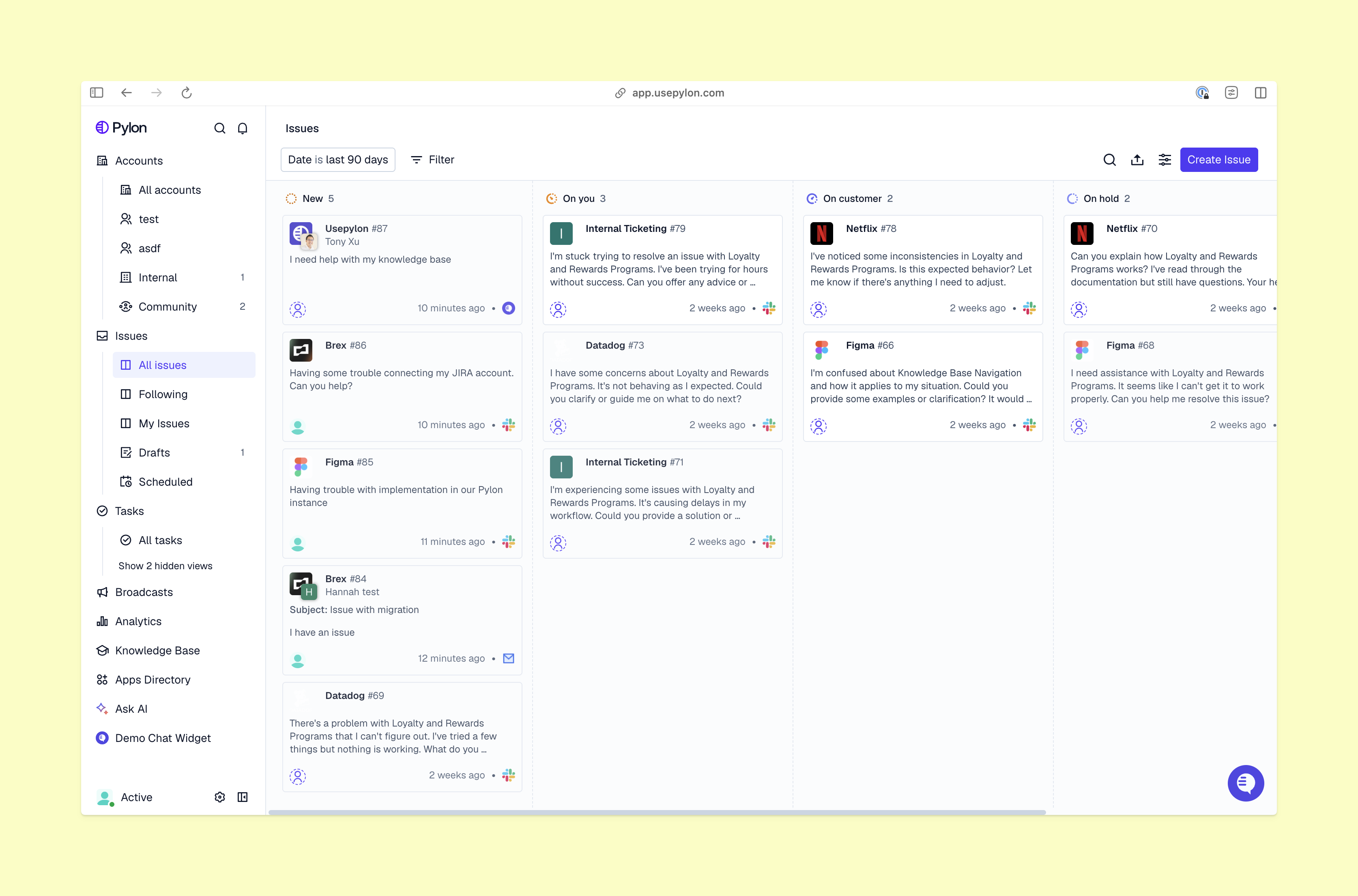
You can’t measure everything and expect clarity, so focus on support metrics that directly connect to the problem you set out to solve. Let’s look at a few examples.
These three KPIs are a great starting point:
Layer in these signals in to get a more complete picture:
Improving your support workflows is an ongoing cycle: find friction, try to fix it, measure the results, decide what to do next, then repeat. When you build that cycle into your team’s daily work, you solve today’s problems and build a foundation for stronger support over time. The challenge is keeping that cycle running as you add more team members, channels, and customers.
Pylon is the modern B2B support platform that offers true omnichannel support across Slack, Teams, email, chat, ticket forms, and more. Our AI Agents and Assistants automate busywork and reduce response times. Plus, with Account Intelligence that unifies scattered customer signals to calculate health scores and identify churn risk, we’re built for customer success at scale.
A customer service process improvement framework is a repeatable system for identifying gaps, making changes, and measuring outcomes across the support journey. Key strategies include actively seeking customer feedback, improving employee training, optimizing processes, integrating technology, and benchmarking against best practices.
Start by mapping the full customer journey to surface where expectations and actual experiences diverge. The most effective methods include customer surveys, auditing service processes against established standards, analyzing support data like call logs and complaint records, and gathering feedback from frontline agents who interact with customers daily.
While no single metric defines success, leaders should focus on a primary triad of CSAT, first response time, and churn. To measure resolution efficiency, track first contact resolution (FCR), average resolution time, and ticket backlog as your most actionable operational signals. Finally, layer in NPS and customer effort score (CES) to gauge long-term sentiment and the overall ease of the customer journey.
To safeguard live support stability, effective change management requires a structured approach that prioritizes minimal disruption through continuous monitoring and visible leadership commitment. The most successful strategy is a phased rollout: segmenting the team into manageable pilot groups to allow for real-time performance adjustments and feedback loops, before expanding deployment to the full team.
Inconsistent response quality is one of the most widespread issues, because when teams lack shared standards or ongoing training, agents have to improvise and create variation in tone, accuracy, and resolution quality. Other common structural problems include unclear tools, inconsistent workflows, and misaligned expectations, and they typically surface as slow response times, missed messages, and siloed handoffs as volume scales.
Pylon Workforce Management is available now. See it in action with a live demo.