
Many customer problems move between teams — a ticket that starts with an AI help desk might move to customer support individuals, and then to engineering for troubleshooting help.
When issues escalate and move around, effective cross-functional collaboration reduces delays and mistakes. It’s the day-to-day practice of support, success, and account teams working with the same customer information, from the first ticket through follow-up and renewal. That shared view reduces customer frustration because they don’t need to repeat themselves as often, and helps teams resolve issues faster since they have all the context they need.
The following guide shows what this looks like in real support settings, where it tends to fall apart, and how to improve cross-functional collaboration without overcomplicating your processes.
.png)
For post-sales teams, cross-functional partnerships mean support, success, and account teams are working toward the same customer outcomes. Each team might have individual goals and metrics, but in the end, they’re all trying to retain accounts and keep customers happy. To accomplish this, these teams will:
Most teams coordinate with other teams when they have to. For example, a support employee might need a success manager’s help to resolve a ticket. That’s working cross-functionally: You involve other teams as the need arises, without a pre-defined plan for collaborating with said team.
Collaboration starts earlier. Instead of waiting for issues to need another team’s attention, teams operate within a unified framework that makes cross-functional teamwork the default, not the exception. When collaboration is baked into your workflows, teams naturally sync up before problems necessitate escalation.
So for example, support, success, and product teams might share an omnichannel support platform that gives them a single source of truth they can work from. They’d schedule regular huddles to discuss account insights they can use to improve all levels of support. And they’d chat frequently about how support services impact product usage and vice versa — how product updates affect how often customers require support help, for example.
Here are a few common cross-functional team examples that show how collaboration improves communication, speed, and the customer experience.
When teams have access to the same information, account details are less likely to fall through the cracks. Support can see account priorities before responding, and customer success can recognize patterns in recurring issues.
Account teams also stay informed without chasing updates in back channels. For example, if a customer reports the same integration issue for the third time in a month, the shared record gives every team immediate context:
This way, teams can always pick up where the last conversation left off. That consistency and lack of repetition makes customers feel heard and understood, and they enjoy having their problems solved more quickly.
Issues move faster when ownership is clear and information is in one place. Teams spend their time addressing the problem, not sorting out the basics.
When a ticket needs engineering input, for instance, support can escalate it with logs, timelines, and customer impact already attached. Engineering can review the issue right away, see how it affects the account, and start investigating without asking for additional clarification.
Support conversations often show early warning signs and include product feedback. Frequent check-ins and using a shared insight platform means that that data is more visible to other teams, like customer success and dev.
So, if several accounts raise the same question about a new feature — like a change in omnichannel chat behavior, for example — support sees that pattern first. When that signal is shared, customer success can act on it during check-ins, and account teams can adjust how they frame upcoming renewal or expansion chats. They might mention that that tool had some frustrating flaws, but that those are being worked out.
Collaboration creates consistency. Using a shared customer support platform means all teams follow consistent messaging protocols and workflows. Customers respect that consistency since they have a better understanding of how they’ll be treated and what expectations are.
As requests arrive with the right information and get moved to the right team or employee, you generally see less backtracking or wasted work and fewer unnecessary escalations.
For example, with a proper customer escalation management process in place (a key part of building collaborative teams), a support request about an API error can be routed to engineering with the relevant details attached. Another issue about billing access can go directly to the account team. There’s no need to transfer the ticket between support and success while someone else is trying to figure out ownership.
Even teams that understand the importance of cross-functional collaboration can still run into challenges as they grow. Here are a few common ones.
Context leakage is when important customer information is lost during a handoff. For example, if messages live in various places — like inboxes, chats, or third-party platforms — parts of the conversation can easily get lost. Some communication details might not make it to a support ticket, like if they only live in a DM. When that happens, teams escalate issues without seeing the full picture, which can slow resolution and cause frustration for the account.
Support teams typically focus on immediate resolution, while customer success employees focus more on building long-term relationships with accounts. That difference can lead to disagreements about when to escalate an issue or what earlier conversations need to be shared.
Without shared goals, those priorities can clash even when everyone is trying to help the customer.
Collaboration stalls when it’s not obvious who’s responsible for what. People pause to avoid stepping on toes, and questions can get rerouted instead of answered. The same work ends up happening in more than one place, and time gets lost while teams figure out who owns the next step.
New processes only succeed when they fit into how teams already operate. When collaboration feels impractical or like added work, people tend to fall back on familiar habits.
A new escalation workflow that creates more steps or requires duplicate updates often doesn’t get used. Instead, support may tag someone in chat because it’s faster, and customer success might keep notes in separate documents to save time.
Remote and hybrid teams rely heavily on written communication to stay aligned. When shared systems aren’t used consistently, important directions and decisions are often missed.
One crucial detail for an account might live in a chat message while the ticket only has a general summary of the issue. Someone joining later doesn’t know earlier context, which leads to repeated questions or delayed follow-ups.
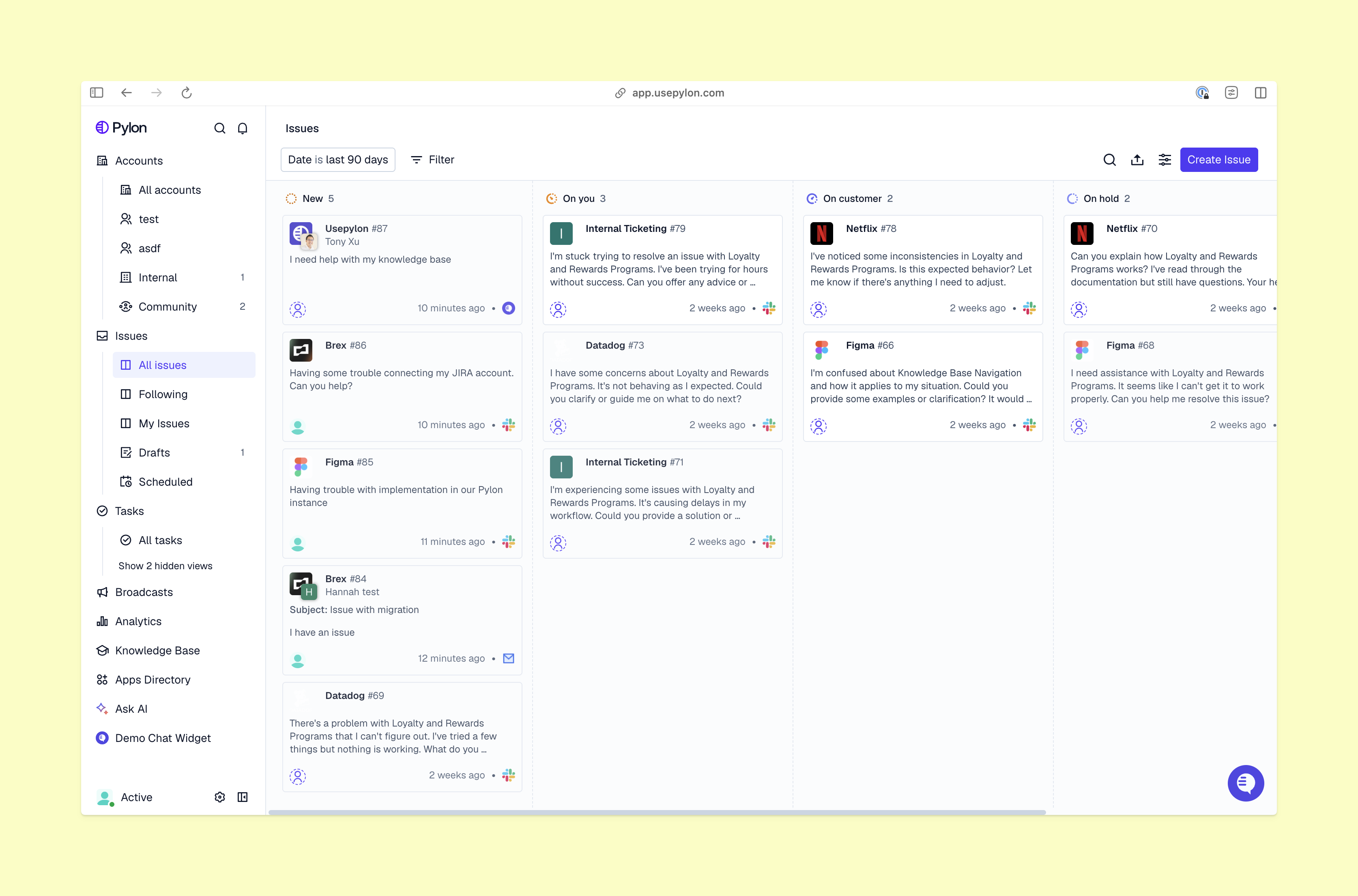
Effective collaboration benefits from a few consistent practices:
As support needs grow, collaboration becomes harder to maintain without a set structure. Clear workflows and shared access help post-sales teams stay aligned while volume and complexity increase.
Pylon is the modern B2B support platform that offers true omnichannel support across Slack, Teams, email, chat, ticket forms, and more. Our AI Agents and Assistants automate busywork and reduce response times. Plus, with Account Intelligence that unifies scattered customer signals to calculate health scores and identify churn risk, we're built for customer success at scale.
In B2B support, engagement is measured by meeting customers where they work. According to 2025 benchmarks, Strategic accounts in Slack expect a response in under five minutes, while Enterprise accounts on email expect a reply within two to four hours. Maintaining these speeds is a primary indicator of account health and renewal probability.
“Context leakage” occurs when critical customer information is lost during a handoff — for example, when a success manager tells an engineer about a bug but forgets the specific browser version or user ID. Great cross-functional collaboration is built on artifact sharing. By using tools that automatically capture and sync customer metadata across platforms, teams can ensure that everyone has the same 360-degree view of the customer’s problem without needing a status update meeting.
Pylon Workforce Management is available now. See it in action with a live demo.