
Today’s AI agents have moved beyond basic chatbots and ticket deflection to autonomously complete multi-step tasks, answer customers’ questions across multiple channels, and route requests to the right team.
In this guide, we’ll explore what else AI agents in customer service can do, their benefits for B2B support teams, and how to make the most of them.
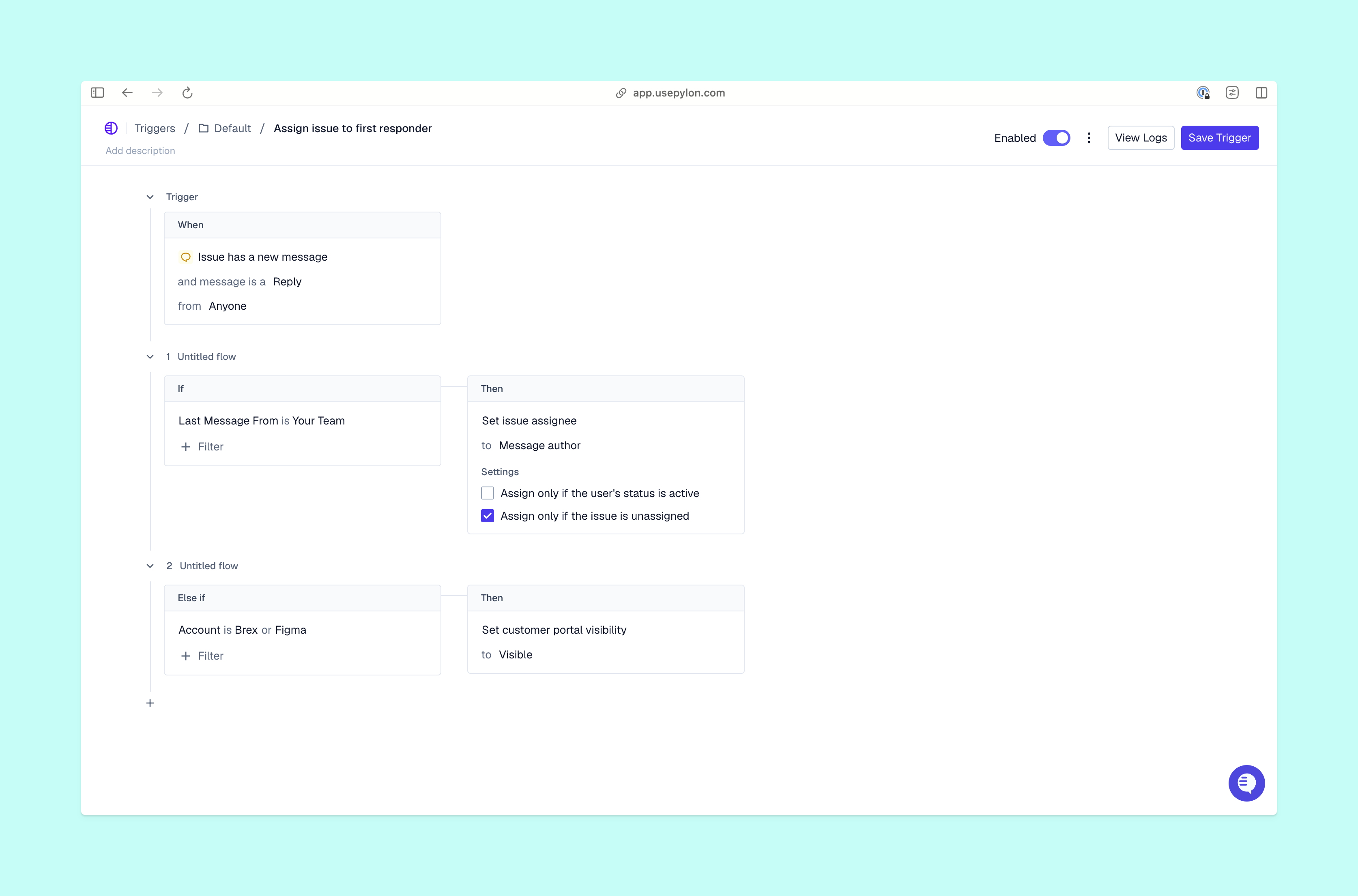
An AI customer service agent is software that can natively understand customer requests and take actions with limited human involvement. In customer service, AI agents and chatbots work differently: Chatbots can answer simple questions with pre-scripted logic. Agents can support and augment your team to pull account context, autonomously complete simple tasks for customers, or investigate questions on your teams’ behalf.
Let’s say a customer sees an error message in your B2B SaaS platform whenever they try to export data from the analytics dashboard. A traditional chatbot could suggest general solutions based on scripted answers before escalating to a support team member, but an AI agent could:
With the help of AI agents, B2B support teams can offload significant amounts of labor to better focus on complex tickets without sacrificing customer relationships.
Here are the most common ways you’ll see an AI agent used for customer support:
AI agents are already creating measurable improvements in operational efficiency and customer experience metrics for B2B support teams.
Response and resolution times are one of the biggest metrics that AI agents can support. Because they can give instant answers to repetitive, high-volume requests, AI agents can reduce ticket volume and help teams to clear backlogs in the ticket queue for faster responses to new tickets.
AI agents give your team access to more context and help them research queries more quickly. They can act as a copilot that summarizes issues and drafts responses, which frees up even more of your support team’s time for future tickets.
AI agents also open 24/7 coverage for customers in different time zones or who work without hiring more team members to cover night shifts and weekends.
The customer experience improves with AI agents because customers receive faster answers, more consistent service, and fewer unnecessary handoffs. Faster, more accurate responses create a better customer experience, which you can track through metrics like customer satisfaction score (CSAT) and customer effort score (CES).
AI agents don’t only work in a chat interface. When they’re part of an omnichannel support platform, they can handle customer requests across every channel your team members and customers interact, like chat, email, and platforms like Slack and Microsoft Teams.
In B2B support, it’s common to see stakeholders from the same account ask questions on different channels. When you implement AI agents in customer service, integrate them with your customer relationship management (CRM) system so that they connect tickets across different channels and pull in all the relevant account context.
Using the SaaS dashboard example we looked at earlier, the customer’s data analyst might send a Slack message, and an executive might follow up with an email about the same issue. When you connect your AI agent to their account context, it can treat those issues as a single request instead of processing them as separate tickets. Your team avoids duplicate work, and customers don’t have to repeat themselves.
Some AI-powered customer support platforms also include AI agents that work in Slack and Teams, without needing a channel switch. Pylon’s Slack Agent gives every team self-service access to Pylon information by tagging @Pylon, for example, so teams can get instant answers and take action without ever leaving Slack. Other agents in Pylon can investigate customer issues and resolve simple ones on its own in the channels you deploy it to.
Although AI agents can resolve many issues automatically, complex or sensitive tasks still need human judgement. Choose a tool that allows human teams and AI agents to work together instead of aiming for full automation.
Today’s AI-powered tools allow your support team to stop investigating tickets and start directing AI agents to investigate for them. AI agents work across multiple channels like Slack and Teams to resolve issues autonomously, and you can set escalation rules to make sure they pass complex requests on to human agents with all the necessary context. Pylon recently adopted agentic customer support and cut its median first response time by 72%, with 62% of tickets involving substantive work from AI agents.
Pylon is the Agentic Support Platform built for B2B support teams. It brings conversations across Slack, Teams, email, chat, and other channels into one place, giving AI the context to help resolve customer issues and continuously improve your knowledge base. Pylon can identify missing or outdated documentation, generate new content from real support conversations, and help your team keep knowledge accurate as your product evolves.
AI platforms are automating a growing share of support work, but human agents are still critical for B2B teams. They can handle more complex tickets and manage multi-stakeholder enterprise relationships with empathy. The future of AI in customer support is more likely to look like a team effort between traditional team members and AI agents.
There are many examples of AI agents in customer service to choose from, and the best platform depends on your team’s needs. Consider their automation needs and how an AI agent (or multiple) would fit into the channels and workflows they already use. Growing B2B customer support teams with strong enterprise relationships and complex ticket needs will likely find success with Pylon, but other common options include Fin, Zendesk AI, and Salesforce Agentforce.
It depends on the accuracy of the AI agent’s source data and accessible information. Test and monitor the system regularly to get reliable responses, and make sure that knowledge bases and internal data are updated whenever there’s a process change.
The average security depends on the platform and how you implement an agent. Check the data privacy and access control procedures of your chosen platform before deployment, and set up guardrails to limit how the AI agent can access and use sensitive customer data.
Some AI agents come ready to use immediately after installation, while others can take weeks to onboard. Implementation time varies based on complexity and scope of the initial deployment, including necessary integrations, knowledge-base readiness, and testing requirements.
Pylon Workforce Management is available now. See it in action with a live demo.