
The traditional math of B2B support breaks down as your operation grows. Your team collects thousands of data points every week across email, Slack, and Microsoft Teams. That information stays trapped inside individual tickets, which prevents early intervention.
By the time a dashboard turns red or a renewal conversation stalls, the customer is already frustrated. Forward-thinking support leaders shift from reactive ticket resolution to proactive customer data intelligence. They treat every support interaction as a data point. When you aggregate those signals, you can spot churn risks before they escalate and identify expansion opportunities.
In this guide, you’ll learn how to build a customer intelligence system that turns your support inbox into your company’s most valuable data asset.
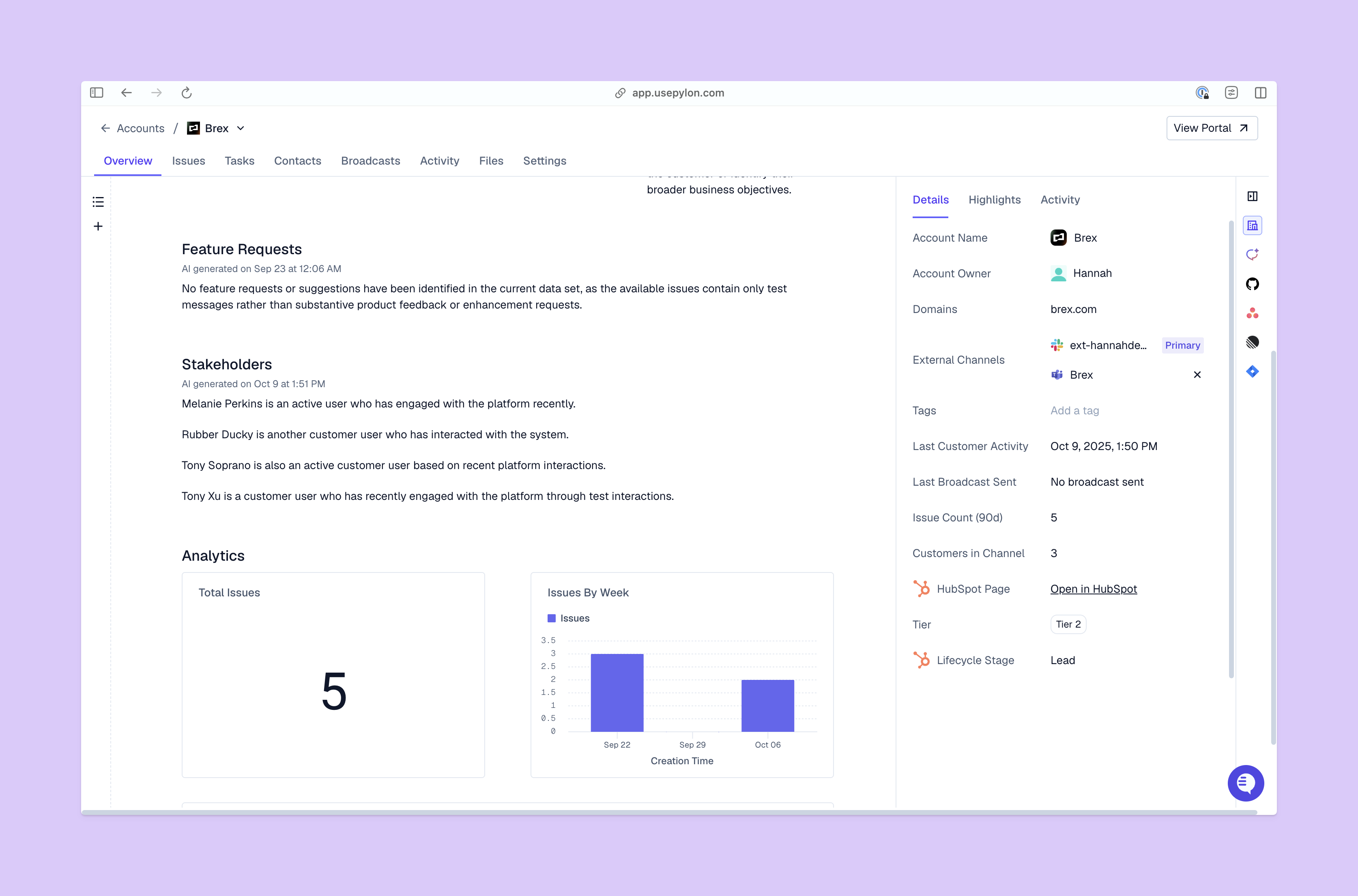
In B2B environments, customer intelligence captures and analyzes every customer interaction to understand account health and predict future behavior. It tracks how fast your team closes tickets and how many macros they use. It also gives your team a complete view of the customer journey, from onboarding through renewal.
It’s easy to confuse customer intelligence with business intelligence. Business intelligence focuses on internal operations. It tracks metrics like first response time (FRT), ticket volume, and support capacity. These metrics help manage staffing, but they reveal little about the actual customer experience.
Customer intelligence analyzes conversation content to tell you how your customers actually feel about your product. This surfaces the context behind the numbers. A true customer data intelligence strategy relies on three components:
You can’t fix what you can’t see. Customer feedback tools and insights platforms are the transition layer between raw support conversations and strategic company decisions. They connect your support, success, and product teams.
Effective customer data analysis requires signals from surveys, support conversations, and product usage. Traditional surveys like net promoter score and customer satisfaction score are helpful, but they only capture a snapshot in time from the vocal minority. The most valuable feedback comes from organic support interactions and actual product usage signals.
For example, when a user asks a question in a shared Slack channel, they’re giving you unfiltered feedback about your user experience. When you centralize these inputs into a customer insights platform, you get access to four major operational advantages.
Manual ticket tagging is prone to human error and inconsistency. An intelligent platform automatically groups related conversations to surface hidden product gaps before they become widespread problems.
If 30 different accounts ask the same question about a new integration, your system should flag that trend. That visibility prevents engineering teams from wasting sprints on features that don’t solve the actual underlying user confusion.
Product teams often struggle to prioritize feature requests because they lack context. Customer intelligence connects each request directly to account revenue, which enables your product team to make data-backed decisions.
Instead of telling your product manager that “several customers want this feature,” you can show them that “$2.5M in annual recurring revenue is blocked by this missing integration.” This alignment ensures that engineering resources support retention and growth.
When your customer support and customer success teams have access to historical data, they can personalize every interaction. If a team member sees that a customer has struggled with the same billing issue three times in the past six months, they can escalate the conversation immediately instead of sending another generic help article.
The right context prevents customers from having to repeat themselves. And that will drastically improve your customer experience in B2B relationships.
Once you deploy a new feature, you need to understand how customers use it. Customer intelligence platforms track ticket volume and sentiment related to a specific release.
If a highly anticipated integration launches and immediately generates a spike in confused questions, your intelligence system flags the anomaly. Your product team can then review the actual recordings of those conversations to see where customers struggle. The real-time feedback loop allows your engineering team to push a targeted UX fix or documentation update within days.

The primary goal of customer intelligence software is revenue protection. When you unify customer success, support, and product data into a single customer view, you give your team the context needed to prevent churn.
Here are the features your customer intelligence software should have to help you prevent churn.
Traditional, static health scores based solely on login frequency are outdated. Modern customer intelligence solutions calculate dynamic health scores by combining product usage data with support sentiment analysis.
By using AI to analyze and tag your support conversations, you can detect tone changes. If a customer’s usage is slowly declining and they’ve submitted two support tickets in the last month, your customer success team can intervene.
Churn rarely happens overnight. A series of subtle warning signs come first, but they’re easy to miss without the right tools. Customer intelligence software monitors these behavioral signals — like a sudden drop in feature adoption — and flags the accounts that are at risk of churning. This gives your team the runway to intervene and save the relationship before the customer starts evaluating alternative vendors.
B2B SaaS teams support entire accounts. Your customer intelligence platform needs to aggregate data at the account level. When a new point of contact takes over at a company, your success team can review the complete history of every interaction, bug, and feature request. This helps them understand long-term patterns and supports smoother transitions during staffing changes.
The most valuable intelligence is actionable. When your platform unifies support and product data, you can build automated triggers for your customer success team based on specific behavioral conditions.
You can easily find potential expansion opportunities, like when users hit usage limits and submit support tickets asking about advanced capabilities. On the other hand, if a high-value account suddenly drops its daily active users by 40%, timely alerts ensure your success team intervenes before the renewal conversation begins.
When you scale your B2B support operations, you need to find tools that allow you to resolve tickets faster. But you also need a new approach to customer data. A strong customer data intelligence strategy unifies your support channels, analyzes sentiment, and turns raw conversations into proactive account management.
When your team is equipped with the right tools, they can stop reacting to problems and start anticipating needs. You become a strategic partner instead of a vendor. To do that, you need the right omnichannel B2B customer intelligence platform.
Pylon is the modern B2B support platform that offers true omnichannel support across Slack, Teams, email, chat, ticket forms, and more. Our AI Agents and Assistants automate busywork and reduce response times. Plus, with Account Intelligence that unifies scattered customer signals to calculate health scores and identify churn risk, we're built for customer success at scale.
B2B customer intelligence is the collection and analysis of customer data to understand behavior and pain points. This enables companies to build stronger, more profitable relationships.
In a B2B context, CI stands for “customer intelligence.” It refers to the systematic gathering of account insights to improve decision-making and personalize the customer experience effectively.
B2B analytics includes descriptive, diagnostic, predictive, and prescriptive types. These models help companies analyze historical data to anticipate and influence future customer outcomes.
A customer intelligence platform unifies data to provide a 360-degree view of customers. Pylon delivers this by integrating B2B support and communication directly into Slack and Microsoft Teams.
Pylon Workforce Management is available now. See it in action with a live demo.