
Your B2B support team probably tracks support metrics consistently. You review dashboards regularly, monitor customer satisfaction score (CSAT) and net promoter score (NPS), and celebrate the high scores — yet you still lose accounts to poor service experiences.
This disconnect happens because numbers tell you how customers rate interactions, but they don’t show what customers expected from the start. That space between expectation and reality is where churn lives for most B2B support teams.
When you run a satisfaction gap analysis, you eliminate guesswork. You systematically measure the difference between what your customers need and what they actually get, which lets you uncover hidden weaknesses before they trigger an executive escalation.
Discover how to use customer service satisfaction gap analysis to strengthen operations before small flaws cost you accounts.
A satisfaction gap analysis measures the difference between customer expectations and the actual service experience. The foundation for this approach is the SERVQUAL gaps model, a service quality framework. This identifies five distinct points where delivery breaks down:
When you map your support operation against this gaps model, you can pinpoint exactly where the customer experience fails. B2B churn is rarely a volume problem. It’s almost always a relationship problem. A satisfaction gap analysis surfaces specific relationship failures — like missed SLAs or inconsistent communication — so you can act on them before they become attrition.
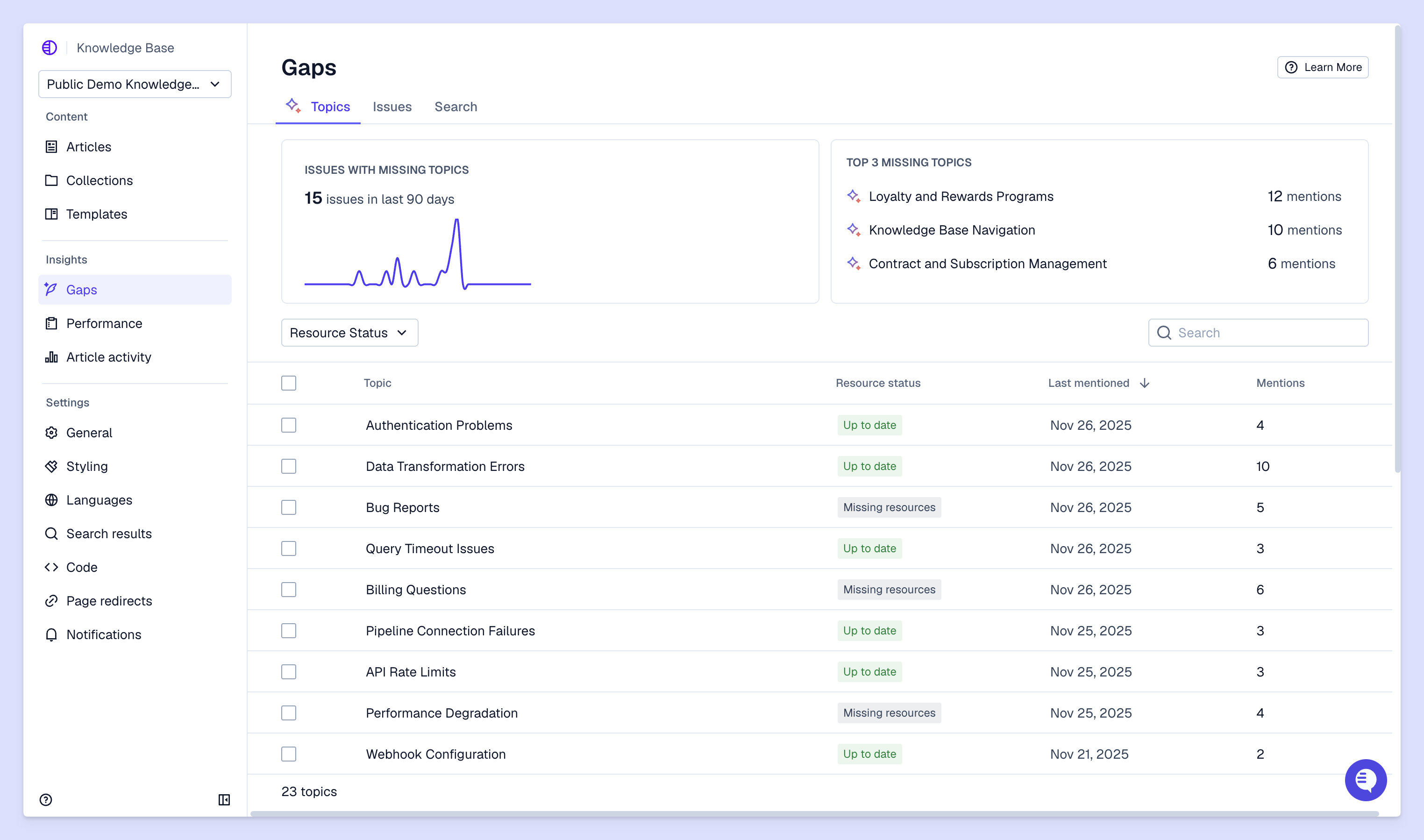
To close a gap, you first have to identify them. B2B support teams typically encounter five distinct customer support gaps — let’s take a look.
Knowledge gaps occur when you don't know what customers need. For example, your team might prioritize fast first-response times, while enterprise customers actually prefer an in-depth technical resolution, even if it takes longer. If you don’t understand their true priorities, your knowledge base articles and support playbooks will solve the wrong problems.
This happens when you know what customers want, but you fail to translate those expectations into clear support policies. While you might know enterprise accounts expect high-touch onboarding, if you haven’t defined what “high-touch” means in your internal SLAs, the execution may miss the mark.
This usually means policies exist, but your team doesn’t execute them consistently. Say you have a documented escalation process for critical bugs, though team members regularly bypass it because they don’t understand the full hierarchy. Delivery issues are common as teams scale. Growth patterns like new route paths and increased ticket volumes cause some people to forget or skim over guidelines.
These gaps are the misalignment between what you promise and what you deliver. If your sales team promises 24/7 dedicated support, but you regularly fall short in the evening, you create an immediate communication gap that erodes trust.
Sometimes, you deliver excellent service, and the customer doesn’t recognize it. Say your team resolves a complex backend issue that prevents downtime, but fails to communicate that win to the customer. The customer’s perception of your value remains low despite the high quality of your work.
A gap analysis needs a structured approach to organize and measure the metrics you already have. Here’s how to run the process.
Build a clear customer profile for each tier of your user base. Document specific needs around response times, channel preferences, and technical depth. For instance, an enterprise account may expect faster resolution time versus a low-tier user.
Document how customers currently interact with your team. Trace the journey from the moment they encounter an issue to resolution. Note every touchpoint across Slack, email, and ticket forms.
Compare the expectations from step one against the reality of step two. Look at your CSAT scores, reopen rates, and qualitative feedback for each specific interaction point to measure the distance between the two. For instance, when a customer opens a high-priority ticket, they may expect a personalized greeting and immediate escalation. If your step two doesn’t include those items, there’s a gap.
You will find multiple gaps. Focus on the ones that impact your highest-value accounts or occur with the highest frequency. If a delivery gap affects your top ten enterprise accounts, take immediate action. A minor perception gap on a low-tier feature can wait. However, it’s best to resolve communication gaps that occur consistently, even if it’s small.
Assign ownership to close the prioritized gaps. Determine the right fixes for each issue — for instance, a delivery gap caused by poor routes needs automated, pre-defined deflection. After you execute your strategies, re-measure the specific touchpoint to confirm the gap has improved. As a general recommendation, check metrics every 30 days to monitor remediation.

Gap analysis is when teams organize current signals and data. Here’s how your tech stack helps you close satisfaction gaps.
Don’t send generic quarterly blasts — tie your CSAT and NPS surveys to specific ticket interactions. Use surveys immediately post-resolution to understand the customer experience while it’s fresh. For unstructured data, use AI ticket deflection tools to read the tone of requests and analyze sentiment.
Look at your account health scores and churn risk flags. If an account is marked “at risk” despite high CSAT scores, you might have a perception or knowledge gap. Cross-reference this with your team's performance data to see if specific shifts or individuals correlate with wider delivery gaps.
Pull customer voice data directly from quarterly business and executive account reviews. This is an excellent source of truth for customer expectations. Finally, use your AI customer support software to run conversation analytics across your Slack, email, and chat threads. This lets you reveal real communication gaps in real time. When you analyze these conversations, you can build your knowledge base to directly address the gaps your customers experience.
When you scale B2B customer support, you can’t fix every gap at once. Instead, use a simple prioritization framework: Plot each gap on a matrix of “impact on account health” versus “effort to fix it.”
For example, a knowledge gap that causes enterprise churn is high impact. If the fix is simply to update an outdated onboarding document, that’s low effort. That gap becomes your immediate priority. Assign a specific owner to the remediation plan, set a deadline, and establish the metric you’ll use to verify the gap is closed.
Your B2B customer support tool can also help. With Pylon’s Account Intelligence, you can surface churn risk signals and aggregate health data across your entire customer base. When you connect your support signals and retention data, your team can close a gap before it damages valuable accounts.
A satisfaction gap analysis gives you the clarity and context you need to strengthen relationships. When you close the gaps between expectations and reality, customer satisfaction and retention improves. If you want a tool that helps you capture and act on this information, reach out to Pylon.
Pylon is the modern B2B support platform that offers true omnichannel support across Slack, Teams, email, chat, ticket forms, and more. Our AI Agents and Assistants automate busywork and reduce response times. Plus, with Account Intelligence that unifies scattered customer signals to calculate health scores and identify churn risk, we’re built for customer success at scale.
A CSAT review tells companies how customers rated an interaction. Satisfaction gap analysis goes further, it compares those ratings against what customers expected before the interaction and reveals why scores are high or low.
Most B2B teams benefit from a formal gap analysis quarterly, with light, continuous checks in between. Major triggers should prompt an immediate ad-hoc review: a renewal in the 90-day window, a spike in negative CSAT across a single account, or a post-migration period where support experience has materially changed.
Yes, persistent gaps between customer expectations and experience are one of the strongest indicators of churn in B2B. When you catch and close those gaps, it gives customer support teams time to intervene before an account decides to leave.
Pylon Workforce Management is available now. See it in action with a live demo.