
One of the most common ways customer success teams learn how a customer feels about your company is through a net promoter score (NPS). When you run customer feedback surveys, this question signals how accounts feel about recommending your product.
An NPS is simple by design: Ask one question, get one number in response, and track how the result changes over time. That simplicity is why net promoter scores, sometimes called net advocacy scores, are so useful. It’s also why NPSs get misused: One score can’t explain what’s creating strong relationships by itself.
The following guide explains the meaning of NPS and when it’s useful, how to calculate the score, and how to follow up on responses for better customer relationships.
A net promoter score centers on one core question: how likely accounts are to recommend your company or its offering. Customers respond on a scale from zero to 10, where higher scores reflect a greater willingness to share your product with others.
Responses are grouped into one of three categories based on their score:
For a net promoter score calculation, take a group of respondents and their answers. Then, subtract the percentage of detractors from the percentage of promoters:
NPS = % of promoters - % of detractors
For example, if 55% of respondents are promoters and 20% are detractors, your NPS is 35.
An NPS can range from -100 to 100. B2B company NPS scores average between 25 and 35, but anything over 0 is a good sign — it means there are more promoters than detractors.
Your NPS reflects how customers feel about your product and how willing they are to recommend it to others. An NPS result captures a mix of experience, expectations, and trust built over many interactions.
Net promoter surveys ask a broad question, so think of the result like a directional signal. It can help you see if customer perception of your company is improving or declining, and how different segments feel compared to each other.
Teams typically use NPS in two ways. Some send NPS surveys after a specific interaction or milestone, like onboarding or a resolved support ticket. These transactional surveys give you a snapshot of how customers perceive a particular moment in their experience.
Other NPS surveys are sent on a regular basis, like quarterly or twice a year. These relational surveys reflect how customers feel about their overall relationship with your company. This helps you track broader shifts between respondents and segments.
NPS has its limits. A single score doesn’t explain why your customer gave their response, so follow-up context is important. Customers with strong opinions are more likely to respond to surveys, meaning the results are less representative of your full customer base. And because NPS measures big-picture satisfaction, customers can have smaller problems that compound and weaken trust long before the concerns appear in survey results.
For these reasons, NPS works best when you review it alongside other inputs, like support trends, account history, and qualitative feedback.
A well-designed NPS survey is intuitively structured, sent strategically, and followed up on.
Here are a few best practices to help your team collect useful feedback and plan next steps.
Start with the standard NPS question — “On a scale from zero to 10, how likely are you to recommend our organization/this product to a friend or colleague?” — then add a short follow-up question asking the customer to explain why they chose that score. Open-ended feedback gives you context the number can’t.
Only ask a few questions so accounts can respond quickly. Shorter questionnaires are more likely to have higher participation and more usable responses.
Send surveys after meaningful moments in the customer journey or on a regular schedule to check in on the overall relationship. Avoid sending them too often to keep participation strong.
Make sure feedback reaches all post-sales teams and leadership. Visibility can help your company understand how customer sentiment connects to decision-making.
Look for patterns in the responses, like setup confusion or support delays. Use those themes to decide what to improve first.
Look at how scores and themes shift over repeated measurements. Patterns by segment usually tell you more than any individual score.
.png)
Here are 4 changes your team can make to improve NPSs without redoing their entire workflow.
Start by scanning feedback for common problems that seem to slow customers down or confuse them. These often show up as comments about setup, missing information, or struggling to get help.
Look for problems you can address with small changes like better documentation or clearer handoffs between teams. Removing a single point of friction can change how accounts feel about your entire process.
Negative responses are most useful when teams follow up while the ticket is still fresh. A timely reply shows customers their feedback was seen and taken seriously.
Keep outreach focused. Acknowledge the concern, confirm what went wrong, and explain what will happen next. Even if the fix doesn’t happen immediately, that kind of clarity can quickly rebuild trust.
Customers notice when support teams resolve issues without too many delays. Make sure frontline teams have access to account information, conversation history, and clear guidance on what they can handle themselves.
When teams spend less time searching for details or waiting on approvals, customers spend less time repeating themselves. That improvement often gets mentioned in follow-up survey responses and strengthens relationships long term.
Promoters already feel good about your product, and their feedback matters just as much as negative comments. See what they mention to learn which parts of the experience are already strong.
You can then invite promoters to actually promote your company by doing things like sharing a review or providing a testimonial for your website. These actions reinforce their positive feelings and build a deeper bond.
NPSs give teams a better sense of how accounts feel about your product. Patterns in scores and comments can point to retention risk, highlight where support experience influences perception, and show which changes have the biggest effect on customer sentiment.
When teams survey regularly and connect NPS to account context, it’s easier to prioritize what needs to get done and make consistent decisions between post-sales teams.
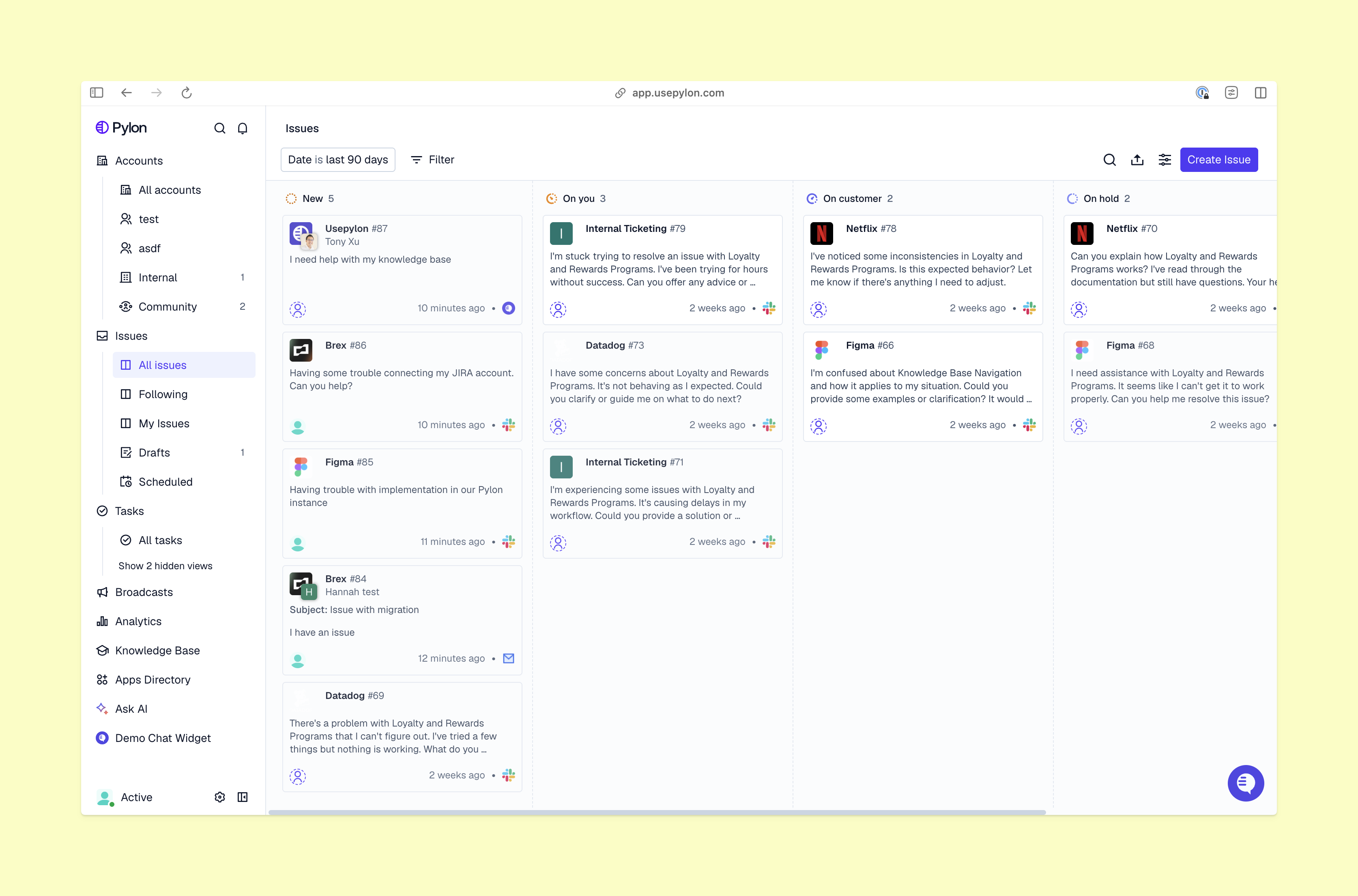
Pylon lets teams automatically create and send NPS surveys, then track results through built-in analytics dashboards for faster follow-up.
We’re the modern B2B support platform that offers true omnichannel support across Slack, Teams, email, chat, ticket forms, and more. Our AI Agents and Assistants automate busywork and reduce response times. Plus, with Account Intelligence that unifies scattered customer signals to calculate health scores and identify churn risk, we're built for customer success at scale.
Pylon Workforce Management is available now. See it in action with a live demo.