Your customers are starting to bring their own agents to your support queue, and that changes what lands on your team's desk.
For most of support's history, a person wrote the ticket and a person answered it. About two years ago, vendors started putting agents on their side. In the last few months, customers started getting agents too. Next, we think most conversations will be one agent talking to another, with people stepping in where judgment matters.
It's early. This is our view of where support is heading, not something most teams see in their queue yet. But it's worth preparing for now, because the shift doesn't just change who answers. It changes which tickets reach you at all.
Four phases of the support conversation
Here's the shape of it, from the customer's side and the vendor's side:
| When | Customer side | Business side |
|---|---|---|
| Before | Human | Human |
| About 2 years ago | Human | Agent |
| The last few months | Agent | Human |
| Looking forward | Agent | Agent |
Human to human. A customer writes in, and a person on your team works the ticket from start to finish.
Human to business agent. Vendors put agents in front of the queue to answer common questions, so people could focus on the rest.
Customer agent to human. Customers started using their own AI to research, troubleshoot, and even write the ticket. ChatGPT, Claude, and Muse are writing tickets for people. What reaches your team is often the output of the customer's agent, handed to a person.
Agent to agent. The customer's agent talks to your agent. People on both sides set the rules, review sensitive actions, and take over when a conversation needs a person.
Fewer tickets, and harder ones
Today, most queues have three layers: Tier 1 how-to questions at the bottom, then Tier 2, then Tier 3.
As your customers' own AI gets better at answering how-to questions from your docs, a lot of Tier 1 gets resolved before it ever becomes a ticket. What's left for you is Tier 2 and Tier 3: account-specific bugs, integration problems, configuration questions, and anything that depends on what changed in your product last week.
So your knowledge base is now your first line of support, and it's being read by machines. When an article is missing or out of date, the customer's agent can't answer from it, and the question lands in your queue.
That's our view of where support is heading, not a measured industry number. But it lines up with what we saw on our own team. At the start of 2026, simple, routine questions made up around half of our incoming tickets and accounted for about 10% of our support team's time, according to our write-up on how Pylon adopted Agentic Support. The hard half is where the time goes, and that's the half that stays.
A few things follow from that:
- Ticket volume becomes a weaker signal of workload. Ten hard tickets can take more time than 100 easy ones.
- Every remaining ticket needs more context: the account, the contract, the product's recent changes, and what's been promised.
- In B2B, the questions are hardest, because the answer usually depends on one specific customer's setup.
Why vendors need an agentic support system
If the easy tickets disappear and the hard ones stay, you can't keep answering them by hand from a blank screen. The context for one B2B ticket is scattered across a CRM, an issue tracker, call recordings, the codebase, logs, Slack, and more.
That takes an agentic support system: not a chatbot that deflects FAQs, but agents that can work the hard tickets. It brings that context to every ticket. Agents gather it, investigate, and draft a response. People review the work, make the judgment calls, and own the relationship. That's what we built Pylon to be: the agentic support platform for B2B teams.
What full context looks like on one ticket
Here's an illustrative example. A customer writes in:
"SSO login broke after yesterday's update. Half our team is locked out."
Without context, someone on your team opens five tools before they can write a useful reply. With an agentic support system, the context is already on the ticket when a person opens it:
- Pylon: related tickets. Other customers have reported the same thing. Agents can use past issues as context, and your team can group related issues into an issue group, then send one bulk reply to every child issue when it's fixed.
- Linear: a known bug. There's already an engineering ticket for an SSO redirect loop. Pylon links customer issues to Linear issues, syncs comments as internal notes, and notifies the Pylon issue when the Linear issue is completed.
- GitHub: what shipped. An auth change went out yesterday. Agents can reach code and engineering tools you connect, through coding-agent connectors or connectors built on MCP or a custom API.
- Salesforce: what's at stake. The customer is on an Enterprise plan that renews next month. With the Salesforce integration, account details show up in the issue sidebar while you work the ticket.
- Gong: what was promised. SSO was a must-have on the sales call. Gong calls are ingested into Pylon and associated with the right account.
Put together, that's a different ticket. It's not "someone can't log in." It's a known bug, tied to yesterday's release, affecting several customers, at an account that renews next month and bought partly because of SSO.
From there, an agent can draft a reply that acknowledges the known issue, suggest linking the ticket to the existing Linear bug, and flag the account context for your team. Assist Agent proposes drafts and suggests actions for a teammate to review, and Automations can run that investigation as soon as a new issue arrives. A person decides what to send and who else needs to know.
People and agents, working the hard tickets together
The goal isn't fewer people. It's people spending their time on the parts that need a person.
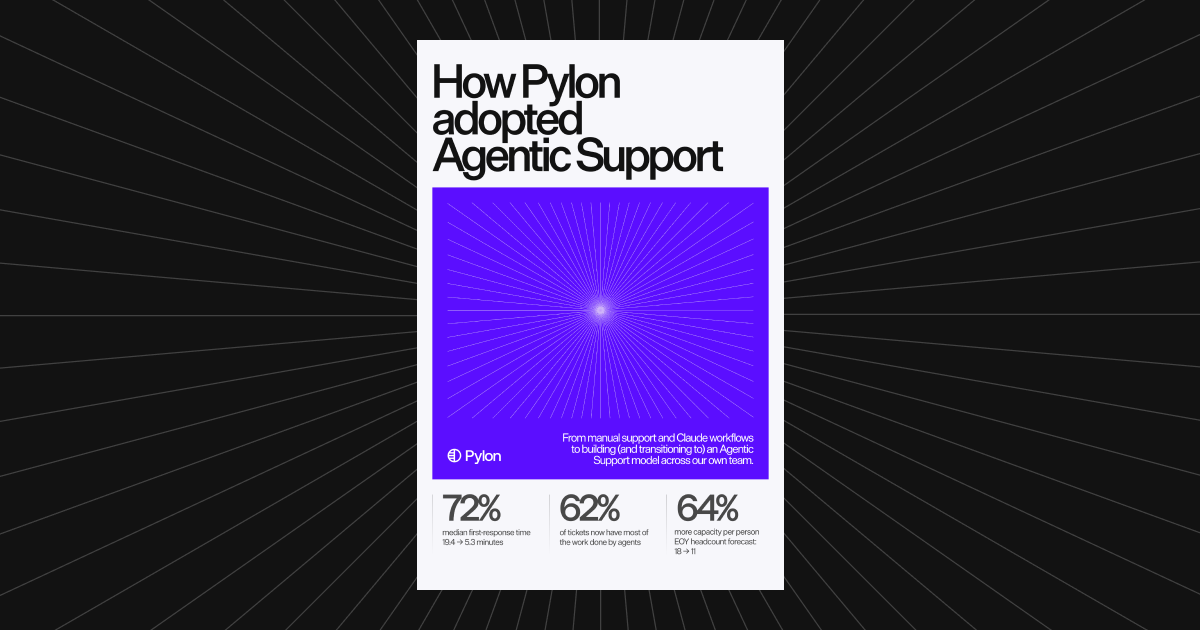
On our own team, tickets now arrive pre-investigated. In our example, what used to be a 30-minute investigation now takes about 2 minutes to review and approve. Median first-response time fell 72%, from 19.4 to 5.3 minutes, comparing the 4 weeks before rollout with the 4 weeks after. You can read the full breakdown in how Pylon adopted Agentic Support.
How to get ready for agent-to-agent support
Here's where we'd start:
- Connect the systems where context lives. Your CRM, issue tracker, call recordings, and codebase matter more as tickets get harder.
- Treat your knowledge base as your first line of support. Customers' agents read it before they write in, so keep it accurate, specific, and current.
- Turn your best investigations into Skills. Skills are reusable instructions that teach agents how your team investigates, resolves, and acts.
- Decide what agents can do on their own. Keep approval on anything consequential, and expand from there. The four stages of an agentic support function show what that looks like.
- Rethink your metrics. Track resolution time and complexity, not just ticket counts. Here's how to measure ROI from AI agents.
Pylon is the agentic support platform trusted by 1,800+ B2B customers. If you want to see what full context on every ticket looks like for your team, Schedule a demo.
Frequently asked questions
What's the difference between a customer agent and a business agent?
A customer agent is AI working for your customer. It researches, troubleshoots, and contacts vendors on their behalf. A business agent is AI working for you, the vendor. It answers, investigates, and takes action inside your support system.
What does agent-to-agent support mean?
It's when a customer's agent contacts your agent directly. People on both sides still set the rules, review sensitive actions, and step in when a conversation needs judgment.
Why would support tickets get fewer but harder?
As customers' own AI answers how-to questions before they reach you, more of what's left is Tier 2 and Tier 3 work: account-specific bugs, integration problems, and configuration questions that need real investigation.
What is an agentic support system?
It's a support system where agents gather context, investigate, draft replies, and take approved actions across your tools, while people review the work, make judgment calls, and own the customer relationship. Pylon is the agentic support platform for B2B teams.
What context does an agent need for a B2B ticket?
Usually related tickets, known bugs in your issue tracker, recent product changes, the account's plan and renewal details from your CRM, and what was promised on sales calls. In Pylon, agents can use integrations like Linear, Salesforce, and Gong, plus connectors to other tools through MCP or a custom API.
Does an agentic support system replace my support team?
No. Agents take on context gathering, investigation, and first drafts. Your team reviews the work, handles the judgment calls, and owns customer relationships.