Updated December 30, 2025 | 10 min read
Signing is only the first part of the customer journey. Keeping them engaged is what drives retention and helps SaaS companies continue to scale.
Customer engagement is an entire practice and set of strategies that directly impacts your churn rate, expansion revenue, and customer lifetime value.
This guide covers what engagement actually means in B2B SaaS, which metrics matter for post-sales teams, and how to build a strategy that turns new customers into advocates.
SaaS customer engagement is how you manage interactions with customers so they get the most value out of your software. It measures both how deeply customers use your product and the quality of your relationship across support conversations, success check-ins, and product adoption.
Engagement isn't about one-time, transactional conversations. You're building ongoing relationships that turn new users into advocates who renew, expand, and refer others.
In SaaS, your business model mostly likely relies on subscriptions or contracts. This means your revenue depends on customers staying and growing with you over time.
Engagement directly impacts 3 outcomes that determine whether your company scales or stalls.
Customers who regularly use your product and continue to find value are much less likely to churn or cancel — that drives better customer retention. When your software becomes part of customers' daily workflows, it costs more for them to switch platforms: They've built processes, trained their team, and integrated your product into how they work.
Customers who stay engaged stick around longer and spend more over time. They're open to upsells, additional seats, and new features because they already trust that your product delivers good results for them.
Highly engaged customers become one of your best sales channels. They refer new business, provide testimonials, and expand to higher-tier plans without heavy sales involvement.
Here are 3 categories of metrics to help you track customer engagement.
These metrics show how customers interact with your product day to day.
Track these across daily, weekly, and monthly windows to spot any patterns early.
Your support tickets and chat conversations contain engagement signals that most teams ignore. Frequent support requests might indicate confusion or friction points that are slowing down product adoption. Meanwhile, proactive questions about advanced features might signal that customers are ready to go deeper.
When you unify support data with product usage, you get a better picture of engagement.
Engagement metrics mean nothing if they don't connect to business outcomes. Track renewal rates, expansion revenue, net revenue retention, and customer health scores to see whether engagement is translating to financial results.
In just a second, we'll cover best practices for improving customer engagement. But first, let's take a look at what you shouldn't do.
Your enterprise customers need dedicated onboarding and regular executive check-ins. Your small business customers want self-service resources and quick answers. Generic outreach ignores where customers are in their journey and what they're trying to accomplish — so it falls flat.
Support conversations contain some of your richest customer intelligence: feature requests, friction points, sentiment shifts, and expansion opportunities. When support operates separately from customer success, these insights never reach the teams who can act on them.
Shipping new capabilities doesn't automatically increase engagement. Customers need education, context, and clear reasons to adopt new features. Otherwise, they stick with what they already know.
When your support, success, and account management teams don't share customer context, you create fragmented experiences. Customers repeat themselves across conversations, issues fall through the cracks, and opportunities get missed because no one has the complete picture.
High login counts and click rates look impressive but don't tell you whether customers are actually achieving their goals with your product. Focus on monitoring the outcomes your customers are achieving and the problems you're helping them solve.
You don't need a massive team or complex tools to start improving engagement. Follow this framework to build your strategy from scratch.
Identify every interaction point from signup through renewal: onboarding emails, product tours, support conversations, check-in calls with customer success, and renewal discussions. Create a visual map showing where engagement happens and where there currently are gaps.
This gives you a clear view of where customers might drop off or disengage.
Group customers by characteristics like company size, industry, product tier, or usage patterns. Your highest-value enterprise accounts will need more white-glove treatment, while smaller accounts might do well with automated touchpoints and self-service resources.
Different segments need different engagement approaches and resource allocation.
Build repeatable workflows that trigger based on customer behavior. You can set up automated sequences like welcome messages for new users, re-engagement campaigns for inactive accounts, and expansion plays for power users.
Automation will you stay consistent across your book of business without overwhelming your team.
Set benchmarks for your engagement metrics, monitor them over time, and run experiments to improve results. The teams who win treat engagement as an ongoing practice.
Here are a few strategies customer success and customer experience teams use to improve their engagement.
Create different onboarding experiences based on customer goals, role, or use case. A marketing team, for example, needs to see different features and use cases than an engineering team. Personalization increases time-to-value and early engagement.
Every support conversation is a chance to educate customers, suggest relevant features, and deepen product adoption. When your support and success teams have access to full customer context (past conversations, product usage, account health), they can provide proactive guidance instead of just reactive fixes.
Platforms like Pylon that unify support and success data in one place make this approach possible at scale.
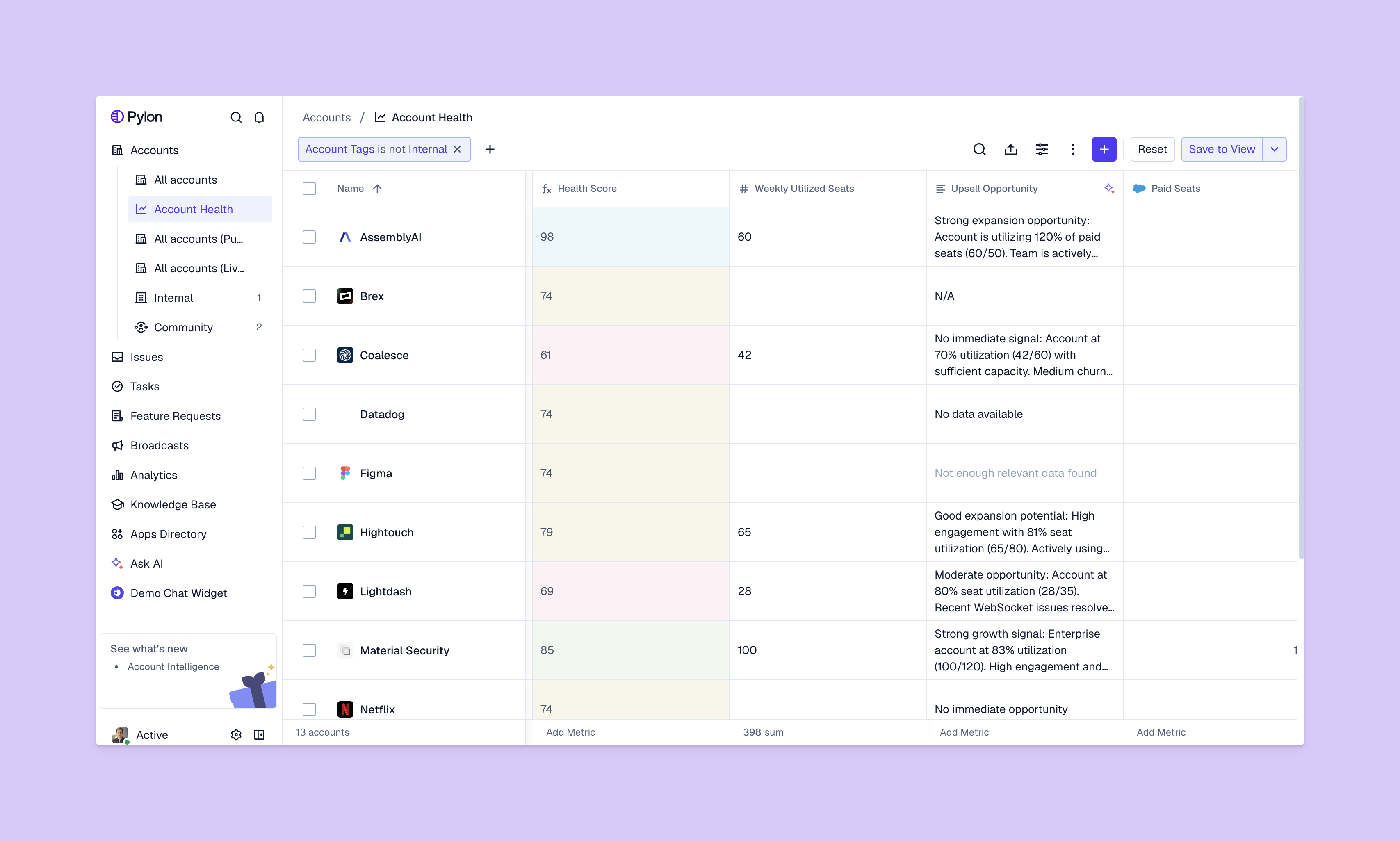
Build health scores that combine product usage, support sentiment, and account signals into a single metric. Use these scores to trigger outreach before customers fully disengage.
| Health score component | What it measures |
|---|---|
| Product usage frequency | How often customers log in and use core features |
| Feature adoption breadth | Number of features actively used |
| Support ticket sentiment | Tone and resolution of recent support interactions |
| Relationship strength | Engagement with success team and response rates |
Systematically collect feedback through surveys, feature requests, and conversations, then close the loop by showing customers how their input shaped your product. This makes customers feel heard and invested in your success, which naturally deepens engagement.
Bring education into your product instead of requiring customers to leave it. Tooltips, guided tours, help centers, and contextual messaging reduce friction by teaching customers where they're already working.
Design campaigns tailored to specific customer segments:
Targeted campaigns perform better than generic broadcasts.
Recognize customer achievements, like their first completed project, new team members added to the platform, or usage milestones. And schedule regular check-ins based on their lifecycle stage.
Once again, automating some of these processes helps you make sure you don't miss an account's big milestones — especially when you're managing a large book.
Manual engagement efforts don't scale past a few dozen customers. You need tools that unify customer data across your entire post-sales organization.
Here are a few things to look for:
Modern platforms like Pylon bring support and success together in a shared system of record. When support tickets inform your retention strategies and customer success calls inform how you provide personalized support, you can be proactive about customer engagement.
Book a demo to see how Pylon unifies customer intelligence across your post-sales team.

Customer engagement isn't a one-time project you complete and move on from. It's an ongoing practice that compounds over time. Engaged customers renew, expand, and refer others, creating a flywheel effect that accelerates your growth.
The best teams treat engagement as a strategic priority across their entire post-sales organization. When you unify customer data and break down silos between support and customer success teams, you can drive engagement and turn customers into advocates.
Pylon is the modern B2B support platform that offers true omnichannel support across Slack, Teams, email, chat, ticket forms, and more. Our AI Agents & Assistants automate busywork and reduce response times. Plus, with Account Intelligence that unifies scattered customer signals to calculate health scores and identify churn risk, we're built for customer success at scale.
Most teams see initial improvements in engagement metrics within 30 to 60 days of implementing a structured strategy. Building deeply engaged customer relationships typically takes 3 to 6 months of consistent effort, though the timeline varies based on your customer lifecycle length.
Product adoption measures whether customers use your product and specific features; it's focused on in-app behavior. Customer engagement encompasses the broader relationship including support interactions, feedback participation, success touchpoints, and overall investment in your platform's success.
Small teams can scale engagement through 3 approaches: automation (triggered workflows and playbooks), segmentation (focusing high-touch efforts on high-value accounts), and self-service resources (help centers and in-app guidance that reduce the need for manual outreach).
Yes, engagement strategies are different for different segments. Enterprise customers typically need dedicated success managers, custom onboarding, and regular executive check-ins. Smaller accounts benefit from automated touchpoints, community resources, and product-led engagement that scales without heavy human involvement.
Pylon Workforce Management is available now. See it in action with a live demo.