
When you offer consistent, personalized support over time, you build trust and long-term relationships that help you stand out from competitors. Research shows that 76% of customers would go out of their way to switch to a company known for outstanding customer support.
In this guide, you’ll find customer relations techniques for B2B support teams, along with the skills your team needs to put them into practice and metrics to track their success.
These five techniques help you connect with customers to build long-term relationships and turn accounts into brand advocates.
When you encounter problems or customer complaints, use the HEARD technique to show them you’re listening and empathize with them. It was designed for in-person and phone conversations, but you can still use it for responding over email and messaging apps.
Each letter in HEARD stands for a step:
In B2B settings, it’s particularly important to pay attention to the conversation and confirm you’re on the same page. Misunderstandings happen more easily when there are multiple stakeholders to communicate with.
When a customer reaches out with a problem, whoever interacts with the customer needs to take full ownership and explain how they’ll fix it, even if it’s user error.
Let’s say a customer experiences a glitch with your app that redirects them back to the login page. The support team member could reply: “I’m sorry that’s happening. I’ll investigate this with our dev team and update you this afternoon.”
B2B accounts often run into complex issues that span several teams, vendors, and systems. Your customers need honest communication and clear expectations of when a problem will be resolved. They have to plan their own operations and manage commitments to their customers, so they depend on you for accurate information.
Give them clear deadlines and outline the next steps up front. You don’t have to promise that everything will go smoothly, but you do have to explain what customers can expect from you. For example: “The implementation will take four weeks. We’ll provide progress updates every Friday, and we’ll tell you immediately if anything changes.”
Empathy is important in customer relations, but B2B customers also expect fast actions. The best approach is to empathize and acknowledge the situation, then show a strong commitment to resolving it through practical solutions and follow-through.
For instance, if your reporting dashboard isn’t working, you could say: “I understand the reporting dashboard outage affects your team’s ability to prepare your quarterly performance review. I’ve escalated this to the dev team, and in the meantime, here’s a manual data export so you can access the metrics you need.”
While you have to enforce your policies, you can preserve customer relations by doing so fairly and with full explanations.
Suppose a customer exceeds their API usage. You can explain the situation to them and let them know you can’t add more integrations for free. Then, show usage logs and suggest a different solution like investing in a higher tier of your software or a meeting to help them optimize integrations. Honest communication can preserve customer trust even as you enforce the policies necessary to keep your company’s operations running smoothly.
Here are some essential support skills and strategies your team will need to successfully build relationships with customers.
Encourage your team to go off-script with personalized communication. Teach them to address customers by name and mention context the customer previously shared to show they understand both the customer’s history and current concern.
Your team members also need to know how to ask high-signal questions to discover root causes (“What changed this week to trigger this?”). After starting with open-ended questions to gather information, they can brainstorm a solution.
When customers are frustrated, your team needs to de-escalate quickly and professionally. Acknowledge the situation, take ownership, and offer solutions. It’s important to keep a calm, confident tone throughout, and translate technical fixes into plain-language outcomes so the customer understands how you’re helping.
When multiple teams need to work on an issue, keep full accountability with your customer through every escalation and handoff. Your team needs to keep the customer updated at each stage and explain the next steps clearly. When the issue is resolved, they should confirm it with the customer to avoid confusion and make sure your fix actually solves the problem.
Good customer relations aren’t just about resolving issues. Your team also needs to anticipate customer needs before issues arise. Have them follow up after a new account finishes onboarding and after major resolutions to see how things are working. Monitor risk and churn signals, and schedule check-ins with key accounts during major product changes.
When customers fully understand how to use your product, they’ll likely experience fewer issues. Offer regular education and training opportunities, and set up workflows to collect customer feedback and act on it. Use your customer support platform to manage the feedback loop and maintain each account’s context and continuity for every team.
.png)
Scale your customer relations strategies and measure their success using these tools and metrics.
Important customer information often ends up spread across multiple teams. Consistent documentation of every customer interaction ensures this context is all captured in a central location where every team can access it. Whoever helps the customer can easily understand customer needs, product configurations, and past issues and resolutions, and pick up where the previous team member left off.
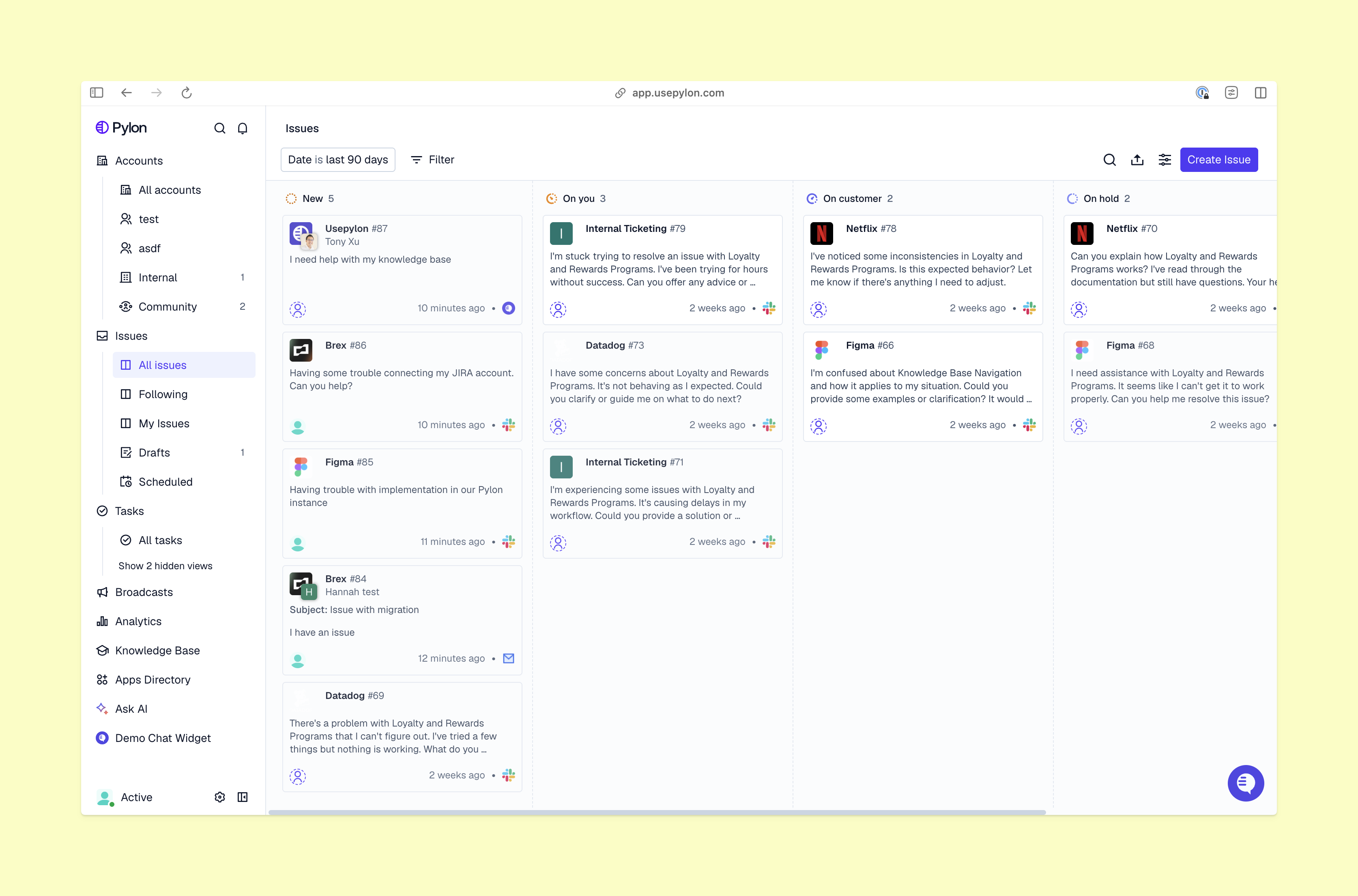
Use a customer success platform to record all your interactions, letting you build a history of service requests and follow-ups in one place for full-team context. These systems help B2B teams build customer relationships at scale with automated reminders, defined workflows, and standardized escalation procedures. They also support collaboration and clear task ownership, so customer interactions are more predictable and reliable.
Use automation tools to scale customer relations, but don’t automate everything. They exist to enhance the customer experience, so focus on automating repetitive tasks with AI support software and offering AI agents and other self-service options. When routine work is taken care of, your team can put more time and energy into enhancing customer relationships through personal interactions and support that exceeds expectations.
Use these customer support metrics to measure the success of your customer relations techniques from your customers’ perspective.
| Metric | What it shows | What it doesn’t show |
|---|---|---|
| Customer satisfaction score (CSAT) | Satisfaction with a recent interaction | Long-term trust levels |
| Net promoter score (NPS) | Likelihood to recommend you to peers | Why they’d recommend you |
| Customer effort score (CES) | Ease of issue resolution | Trust and relationship depth |
| Retention and churn | Percentage of customers who leave or stay | What’s causing relationship growth or contraction |
| Repeat contact rate | How many issues need follow-up | Issue severity or reasons for follow-up |
| Complaint rate | Complaints per 100 interactions | Silent dissatisfaction and churn risk |
These metrics can help you understand how your team’s actions make a difference in those relationships.
| Metric | What it shows | What it doesn’t show |
|---|---|---|
| First response time | How quickly you respond to customer issues | Quality and depth of responses |
| Time to resolution | How quickly you resolve issues | Whether the resolution addressed root causes |
| Reopen rate | How often tickets are reopened | Reasons for reopening: dissatisfaction or just related questions |
| Escalation rate | How often issues are escalated to managers or higher support tiers | Whether escalations were appropriate or helpful |
With so many metrics to choose from, make mindful choices about what you pick and avoid over-optimizing. For example, your team could have excellent response and resolution times but still undermine customer trust if they prioritize speed over response quality.
Always pay attention to qualitative indicators as well as numbers. Even if you’re resolving issues quickly, subtle shifts in how a customer talks to you can give you a clearer picture of the relationship’s strength. For example, if they stop saying “thank you” after fixes or use a more formal tone, they might be feeling frustrated, so you should prioritize rebuilding trust to avoid churn. Annual or biannual customer feedback surveys can also help you understand the context behind numbers-based metrics.
Good customer relations are built on empathetic communication and reliability. When B2B support teams give accounts clear information about when they can expect fixes and follow through, they establish your company’s trustworthiness. But to effectively build customer relationships in a scaling company, you need to use the right tools and platforms to support your team and measure their progress.
Pylon is the modern B2B support platform that offers true omnichannel support across Slack, Teams, email, chat, ticket forms, and more. Our AI Agents and Assistants automate busywork and reduce response times. Plus, with Account Intelligence that unifies scattered customer signals to calculate health scores and identify churn risk, we're built for customer success at scale.
Examples include personalized follow-ups, proactive communication about updates, responding thoughtfully to feedback, educating customers, and maintaining consistent contact across channels.
Customer relations is a shared responsibility across support, sales, success, marketing, and leadership. Every interaction shapes the relationship.
They build trust, reduce frustration, improve clarity, and increase perceived effort. When customers feel understood and supported, they’re less likely to leave.
Customer relations focuses on ongoing trust-building through interactions, while customer experience encompasses the full journey, including product, marketing, and support touchpoints.
Pylon Workforce Management is available now. See it in action with a live demo.