
If your customer support team struggles, you’re not alone. Research shows 77% of customer support reps report increased workloads and greater complexity in customer issues since the previous years.
Virtual support agents reduce that pressure. They handle routine tasks more efficiently and give customers faster responses and more consistent interactions.
Let’s look at what a virtual agent is, how it works, and how it helps you offer better B2B customer support.
Virtual agents — also known as AI agents or intelligent virtual agents (IVA) — are AI-powered systems that combine natural language processing (NLP), intelligent search, and automation to handle customer or employee requests. Here’s how they differ from other tools.
Virtual agents are often confused with chatbots and virtual assistants, but each serves a different purpose. Chatbots rely on simple rules and scripted responses, so they can only answer questions they’re programmed to handle.
AI virtual agents understand complex questions and can take multi-step actions to resolve customer issues. They can also automate tasks across connected systems. This makes them far more effective in technical B2B support environments and highlights the differences between chatbots and conversational AI.
Virtual assistants are typically humans who provide online administrative support. The terminology confuses some because tools like Siri and Alexa are thought of as virtual assistant technology. You also see the term “intelligent virtual assistants” in some platforms, even though these systems function more like advanced virtual agents.
These are the core technical components that power a virtual agent.
NLP is the foundation of conversational AI. NLP-powered virtual agents interpret free-form text and understand what customers want, even when people use different terminology. It breaks a customer’s question into parts, called tokens, and uses large language models to work out the intent.
For example, if a customer asks, “How do I export all invoices from last quarter?”, the virtual agent uses NLP to break the question into intent (export) and data (invoices, last quarter). If the customer uses different phrases, like “I can’t see where to export last quarter’s invoices,” the AI agent still recognizes it’s the same query.
Once the virtual agent understands the request, it uses those key terms to search your company’s knowledge base, documentation, and internal systems. It focuses on definition rather than exact phrase, which helps it surface accurate answers even when the terminology differs.
The interactive virtual agent then generates an answer in plain language to guide the user through the workflow. So it might respond with: “Go to Billing > Reports, select ‘Invoices’, and choose the date range. Then click ‘Export CSV.’”
When connected to internal systems, a virtual agent does more than just answer questions. It automates tasks that reduce manual work. For example, if it has access to billing information, it can export last quarter’s invoices and provide the file directly to a customer.
You can also integrate a virtual AI agent with your help desk ticketing system so it automatically creates tickets and routes them to the appropriate team member. You can also give it access to your CRM so it updates the customer’s records after every interaction.
These are the main types of virtual agents that a B2B customer support team can use:

These are the main benefits to expect from virtual AI agents in a B2B support team:
Here are some examples of how B2B SaaS teams deploy virtual agents:
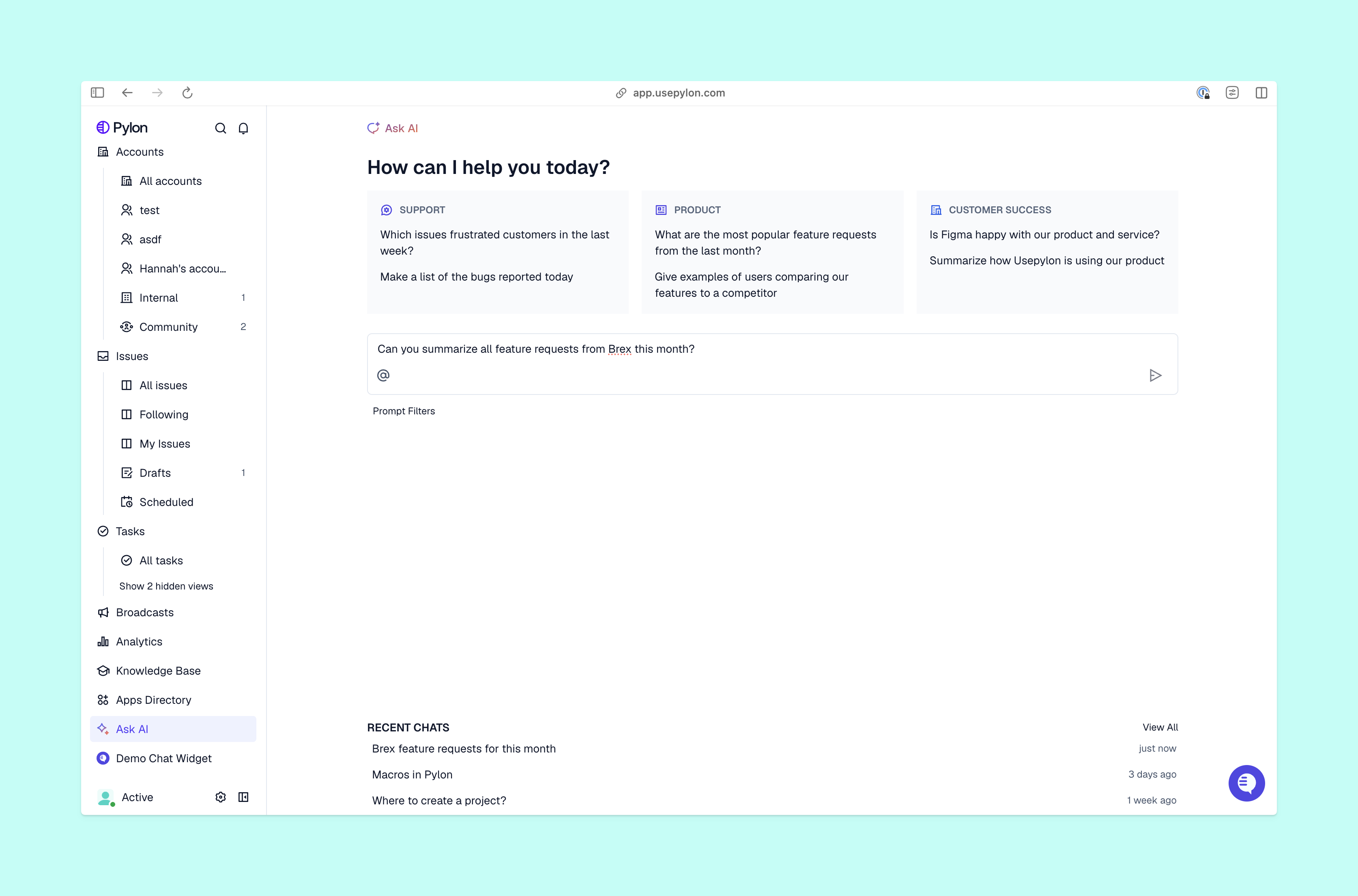
A virtual agent is an essential tool for a modern B2B support team. It allows you to offer better customer experiences, with faster resolution and lower wait times. Virtual agents also deflect repetitive tickets and free up your team to work on more important issues. The simplest way to incorporate a virtual agent into your support workflow is to use a B2B support platform that comes with sophisticated AI agents already built in.
Pylon is the modern B2B support platform that offers true omnichannel support across Slack, Teams, email, chat, ticket forms, and more. Our AI Agents and Assistants automate busywork and reduce response times. Plus, with Account Intelligence that unifies scattered customer signals to calculate health scores and identify churn risk, we're built for customer success at scale.
A chatbot follows scripted, rule-based logic and can only respond to pre-programmed inputs. A virtual agent uses AI and NLP to understand freeform requests, take multi-step actions, and integrate with enterprise systems to resolve issues end-to-end.
B2B virtual agents reduce the workload of support teams and improve response consistency. They commonly handle:
Virtual agents rely on NLP to interpret user intent, machine learning to improve over time, and automation to execute tasks within connected systems — without the need for human involvement in each interaction.
Virtual agents handle repetitive, high-volume requests at scale, but they work best alongside support teams. They take on tier 1 deflection and free people to focus on complex, high-value interactions.
Pylon Workforce Management is available now. See it in action with a live demo.