Updated December 3, 2025 | 12 min read
Customer success platforms integrate support tickets, product usage data, and context from customer conversations into unified dashboards that predict churn and drive retention.
This guide covers which platforms offer 360-degree customer views and how they transform support interactions into retention strategies.
Your support tickets contain critical signals about customer health. But most teams treat them as isolated incidents rather than data that can help drive retention.
Support data reveals:
When support and success teams operate in silos, they miss crucial context. Integrated platforms create 360-degree customer views by combining support tickets, product usage, and CRM data in one place.
Best For: B2B teams who want to manage support and customer success in one place
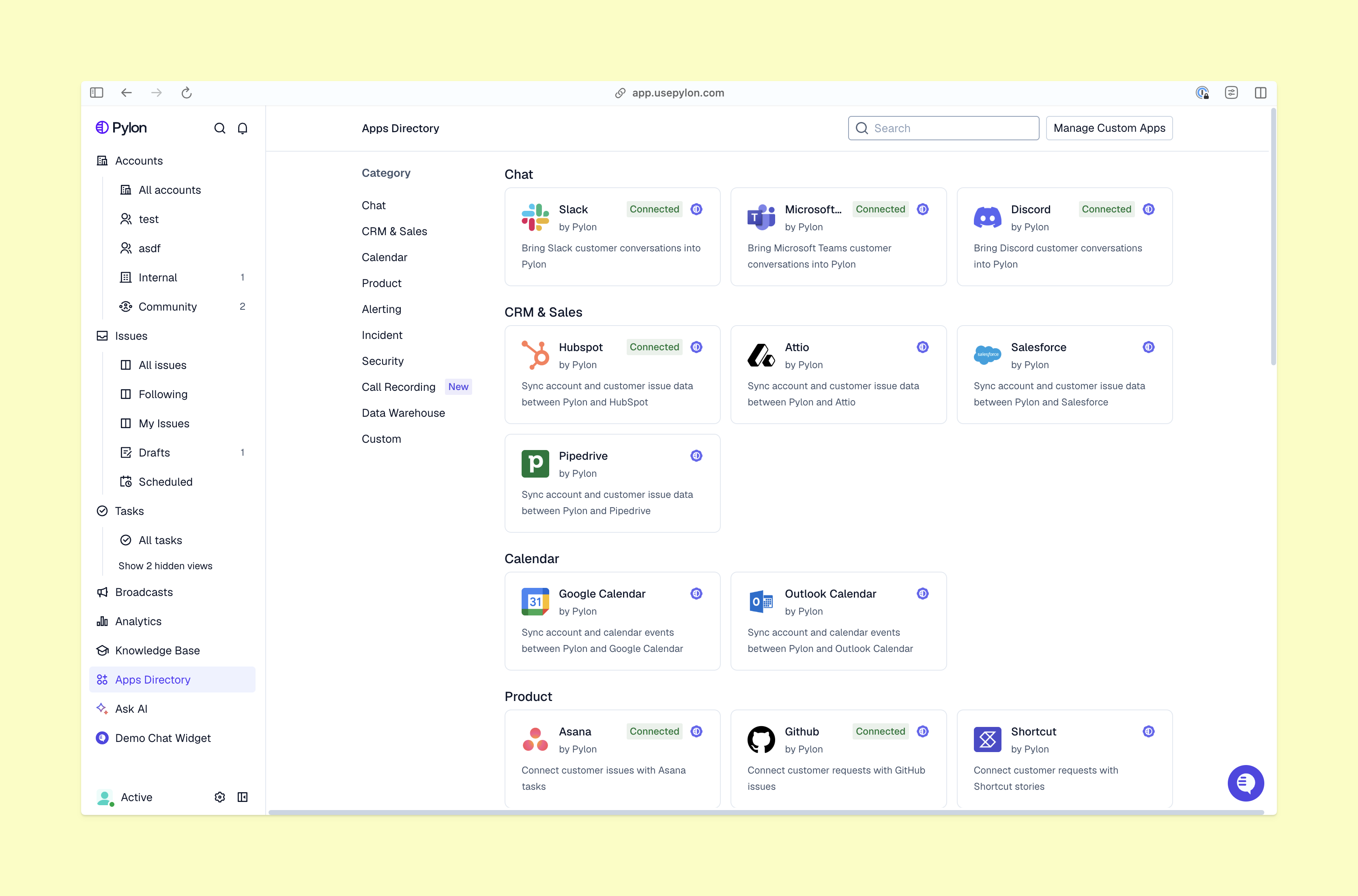
Pylon is built for modern B2B companies who handle support through communication channels like Slack, Teams, or Discord. But instead of treating support as separate from customer success, Pylon houses the tools and data for your whole post-sales team in one platform.
Account Intelligence
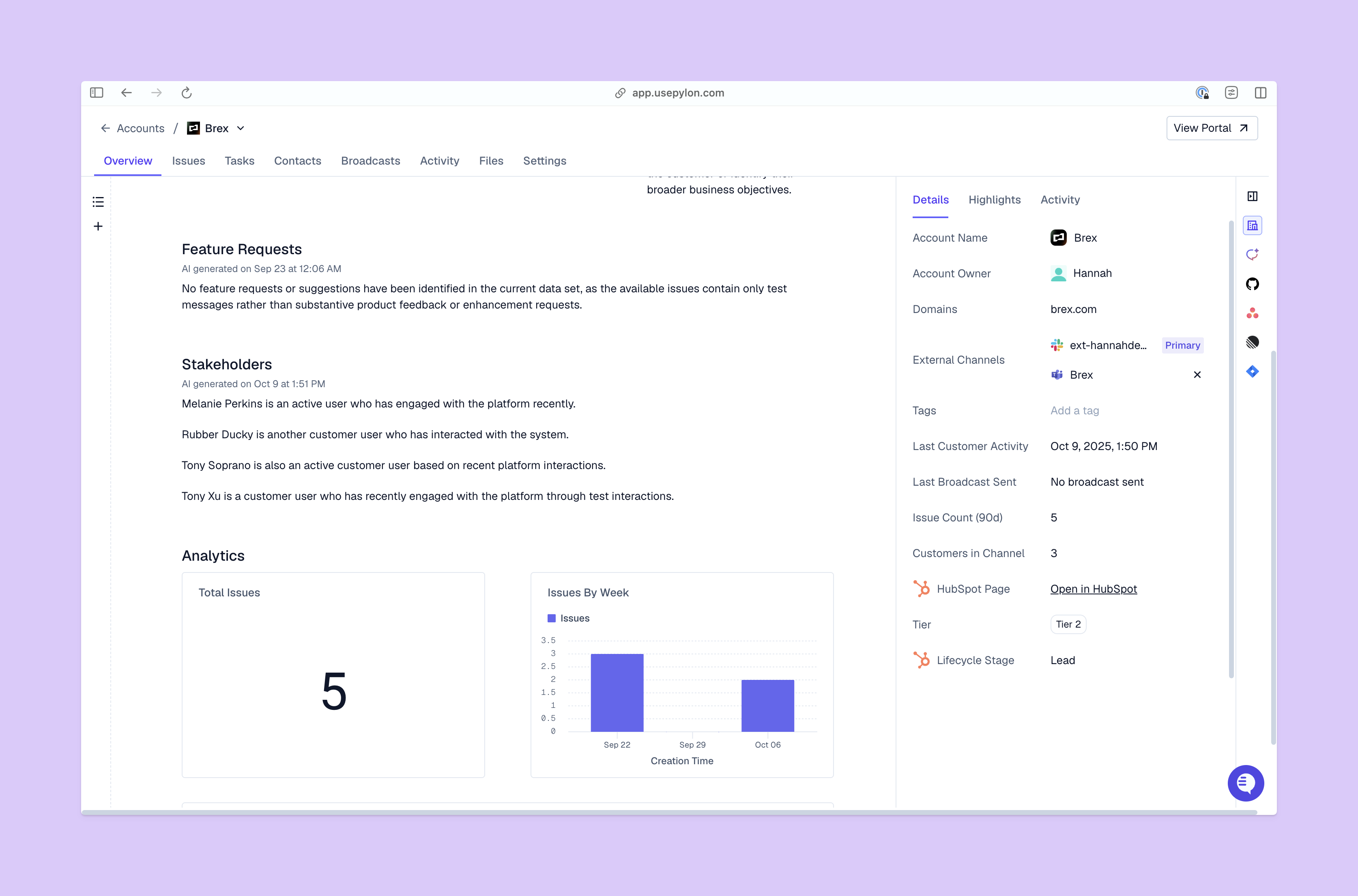
Pylon’s Account Intelligence automatically surfaces critical signals from your customer conversations—across support tickets, call recordings, chat messages, and more. You can customize AI notebooks to summarize and view full account context, or use AI fields and custom formulas to flag signals you care about.
You can create notebooks for specific use cases, like viewing account overviews or managing renewals. In each notebooks, you can pull together AI summaries, external data, analytics, and conversation context without manual data gathering.
What You Get:
Why It Works for B2B Teams:
Traditional platforms were built around scheduled check-ins and quarterly business reviews. Pylon recognizes that B2B teams get customer signals from all kinds of support conversations—even bug reports, feature requests, or implementation questions.
Best For: Mid-market companies who manage customer subscriptions
Custify gives subscription businesses a 360-degree view combining product usage, adoption, health scores, and lifecycle data in one dashboard. Unlike competitors that weigh all features equally, Custify tracks separate health scores for each feature, then calculates a weighted Global Health Score.
Integrations:
Key Features:
For B2B companies managing complex relationships, Custify provides contextual intelligence to intervene before issues become churn.
Best For: Complex, multi-stakeholder relationships
Gainsight centralizes customer data for understanding from every angle. Particularly valuable for complex clients with multiple contacts that need extensive onboarding and change management.
Support Integration:
Advanced Features:
Best For: Teams who want templated best practices
Totango offers SuccessBLOCS, customizable templates with industry best practices for each customer journey stage. Pre-loaded workflows streamline implementation while allowing customization.
Support Intelligence:
Platforms analyze support patterns to identify early warnings:
By incorporating support into predictive models, platforms flag at-risk accounts weeks before churn, so your team has time to intervene.
Modern platforms incorporate support as critical health indicators:
Pylon's Account Intelligence analyzes conversational data and customer sentiment. AI summaries can surface patterns and nuances that ticket volume alone will miss.
Trigger-Based Outreach:
Contextual Communications:
Automated Playbooks:
Create workflows based on specific signals captured through conversations:
For companies using Slack for support, integrating your Slack support data with customer success workflows can help you detect customer signals in real-time.
Shared Context: Both teams access identical customer information, eliminating knowledge gaps and redundant questions.
Unified Metrics: Health scores incorporate support data, creating shared ownership rather than competing metrics.
Collaborative Playbooks: Support and CSMs follow coordinated workflows for consistent experiences.
Joint Analysis: Together, teams can identify product issues that require engineering help or customer education.
Before integrating systems:
Poor data quality undermines even sophisticated platforms.
Create transparent methodology for incorporating support:
Example Weights:
Adjust based on your business model. PLG companies might prioritize usage; high-touch enterprise might weigh engagement and support more heavily.
Document your methodology so all teams understand how scores work.
Example: High-value customer submits critical ticket
This prevents conflicting information and demonstrates alignment.
Organizations building collaborative workflows should review B2B support platform best practices.
Treat integration as ongoing, not one-time implementation.
High adoption requires significant change management investment.
Retention:
Operational Efficiency:
Team Productivity:
Customer Experience:
Problem: Support, usage, and customer success live in separate systems that create fragmented views.
Solution:
Review omnichannel B2B support practices to address integration challenges.
Problem: Support and success teams historically operated independently with separate goals.
Solution:
Leadership commitment to breaking silos is essential.
Problem: Automated alerts for every health change can overwhelm teams, which causes them to ignore signals.
Solution:
Start conservative, adding alerts as teams demonstrate capacity.
Problem: Incomplete or inaccurate data leads to wrong health scores and misguided interventions.
Solution:
Data quality requires ongoing attention and ownership.
Problem: Executives question the platform investment.
Solution:
Build business case with both quantitative metrics and qualitative examples.
Early-Stage (Pre-Series A):
Growth-Stage (Series A-C):
Enterprise:
Product-Led Growth:
Modern B2B Teams:
Platforms like Pylon are designed for this segment. They recognize that many B2B customers like to communicate through ongoing conversations in shared channels.
High-Touch Enterprise:
Hybrid Models:
Limited Technical Team:
Robust Technical Capabilities:
If you plan to use Slack as a ticketing system, make sure to choose a platform that natively integrates with Slack.
A 360-degree view consolidates all your customer information (support tickets, product usage, CRM records, engagement metrics) into one platform. This way teams can understand customer health and needs without switching between systems.
Platforms analyze patterns including ticket volume, frequency, escalation rates, resolution time, and sentiment to identify early warnings. Sudden support increases, repeated escalations, or negative sentiment often precede churn. These patterns can help you flag at-risk accounts weeks before they churn.
CRM focuses on sales: tracking leads, managing pipelines, closing deals. Customer success platforms monitor post-sale health and engagement, emphasizing retention, expansion, and long-term value. CRMs ask "how do we close deals?" Customer success asks "how do we keep customers successful?"
Pylon, HubSpot Service Hub, or Custify are great for B2B SaaS. Pylon gives you all the tools you need for post-sales in one platform. HubSpot focuses on integrating with its CRM. Custify targets straightforward implementation and SaaS-specific metrics. All scale with companies as they grow.
Most organizations see results within 6-12 months. Quick wins include improved visibility (1-2 months) and basic automation (2-3 months). Measurable retention improvements typically appear after 6 months once teams adapt workflows. Full ROI, like significant churn reduction and expansion revenue increases, generally materializes around 12-18 months. Clean data and strong leadership will accelerate those timelines.
Leading platforms implement enterprise-grade security including data encryption (in transit and at rest), SOC 2 Type II compliance, GDPR compliance, role-based access controls, and audit logging. They typically sign Business Associate Agreements (BAAs) for HIPAA when required and offer data residency options. Always review security documentation before selecting a platform.
Yes, when it’s properly implemented. AI can help you with predictive churn modeling, sentiment analysis, next-best-action recommendations, and automated health scoring. That means teams can identify at-risk customers earlier and prioritize interventions.
Platforms like Pylon go beyond basic automation by analyzing your unstructured conversation data. For example, Pylon’s AI can automatically generate summaries from support interactions that would otherwise require hours of manual review.
When you integrate your support data with your customer success strategy, your entire post-sales team can collaborate better and faster. Choose a platform that aligns with where you provide customer support, the account-level context that matters to you, and your team’s workflows.
Pylon is the modern B2B support platform that offers true omnichannel support across Slack, Teams, email, chat, ticket forms, and more. Our AI Agents & Assistants automate busywork and reduce response times. Plus, with Account Intelligence that unifies scattered customer signals to calculate health scores and identify churn risk, we're built for customer success at scale.
Pylon Workforce Management is available now. See it in action with a live demo.