
Your support team handles a steady flow of conversations each week across many channels. Each of these interactions shapes the customer experience and influences how your product or service is judged.
The difference between a good customer experience and a frustrating one often comes down to context. When your team responds to a new ticket without the right visibility, they waste time searching for basic details. That delay slows response time and increases the chances of an unsatisfactory answer.
Artificial intelligence and customer experience converge here. AI lets your team pull account history and customer health signals into every interaction without the need for manual searches. The result is faster responses that fit the customer’s situation and a support experience that feels coordinated.
AI’s most immediate impact on your customer support team revolves around handling volume. AI agents pull answers directly from your knowledge base to resolve routine questions, like “How do I connect my integration?” or “Where do I find my API key?” This frees your team to spend time on the conversations that actually need a team member.
But volume deflection is only the surface. The deeper shift happens when AI starts to connect signals across interactions. If a customer submits repeated tickets about the same feature gap, it shows a recurring problem that slows their work. AI detects that pattern and brings it to your team’s attention so you can step in with a proactive fix before frustration turns into churn.
Intelligent routing adds another layer of improvement. Instead of tickets being assigned round-robin, AI can route based on account tier, conversation history, and urgency.
For instance, a P1 issue from your largest account can hit your senior team member’s queue immediately, while a general how-to question from a trial user goes to your AI help desk for automated resolution. That kind of prioritization is hard to do manually at scale.
Lastly, AI performs real-time sentiment analysis. It can detect negative shifts in tone and pacing and escalate the conversation before the customer has to ask for a manager. For support teams that cover dozens of active conversations at once, that early warning system helps you catch problems before customers decide to churn.

Automation and personalization often pull in opposite directions. Scaling usually means standardization, and personalization usually means deeper context and more manual effort. Here’s how AI changes that trade-off for B2B support teams.
Customer experience automation in B2B support is more than a chatbot that asks “how can I help you today” on a marketing landing page. Instead, AI assistants draft responses to technical questions based on the customer’s conversation history, their account tier, and previous resolutions. Then support teams refine the draft and deliver a polished answer.
That workflow changes the economics of personalization. When you customize every message without AI, your team has to read through past conversations and check account notes. AI pulls that context automatically to help provide tailored guidance without adding delay or extra effort for your team.
AI can also improve your knowledge base. When your team resolves a complex issue, your AI can turn that resolution into a searchable article. Over time, your knowledge base grows from customer conversations instead of team members taking time to write documentation. That means your conversational AI gets smarter with every resolved ticket and helps customers find answers before they even open a ticket.
B2B personalization isn’t just knowing the name of your point of contact. A customer on an enterprise plan with 200 seats and a renewal in 60 days needs a vastly different support experience than an account with two seats on a basic plan. AI tools pull account metadata into every conversation, so your team always knows the stakes before they respond.
Generative AI also changes how you onboard new team members. A new team member doesn’t have to shadow for weeks to get up to speed on an account. Instead, they can rely on AI assistants to surface suggested responses, relevant past tickets, and account context in real time.
New members still make the judgment calls, but they do it with the same information a senior team member would have. This reduces ramp-up time and keeps your support quality consistent even as your team grows.
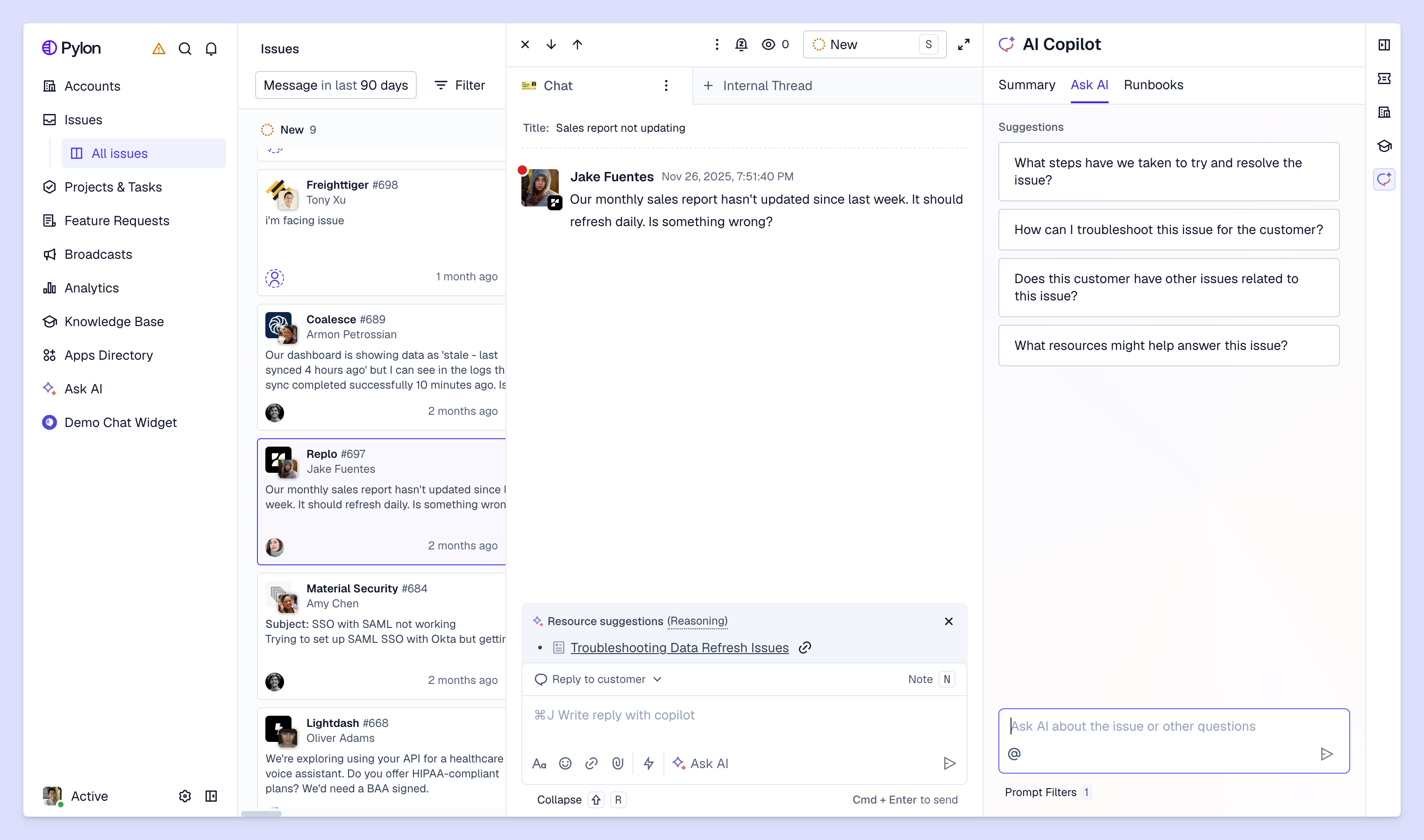
When your team grows, hiring moves slowly, training takes months, and every new team member needs time to build the product knowledge that makes them effective. AI compresses that timeline by giving everyone access to the same institutional knowledge from day one.
Here are core benefits of an AI customer experience.
There’s a ceiling to how many accounts a support team can cover well without AI. Once you pass a certain ratio of accounts to team members, response times increase and context gets lost between handoffs. AI raises that ceiling because the repetitive work — like drafting initial responses and pulling account context — happens automatically.
The shift in capacity has a direct impact on your response metrics. When AI handles triage and drafts responses with full account context attached, first-response times drop. Resolution improves because your team no longer spends the opening minutes of each conversation in search of background information.
When your support data feeds into account-level intelligence, you can see when ticket volume spikes or unresolved issues accumulate. Those signals connect support performance to churn risk in a way that’s hard to do manually.
If your support team can see a high-value account’s ticket volume has doubled in a month, they can coordinate with customer success before the renewal conversation becomes a cancellation. That cross-team visibility turns your support team and its data into a revenue-protection and growth tool.
AI handles the work that doesn’t need human judgment. That often includes repetitive categorization and routing decisions. But it can also mean pre-drafted responses for your customer support team if you use an agentic tool like Pylon. Your team handles the nuanced decisions, the relationship management, and the moments when a customer needs to feel heard by a person.
The review step is what keeps quality high while improving efficiency. Your customers always get a human-verified answer, even when AI did most of the legwork. And over time, as your knowledge base grows from resolved conversations, the drafts get more accurate and the reviews get faster.
For growing companies that want to build out their support system, this balance between automation and human judgment is what determines whether scaling feels sustainable or chaotic. And for teams that run conversations across multiple channels, an omnichannel support platform makes the whole system work. That’s because all of your conversations live in one place, and AI agents can access the full conversational history needed to deliver accurate recommendations.
AI changes what’s possible for B2B support teams, but only if the underlying platform connects your conversations, your account data, and your AI tools in one place. An AI that’s fast but uninformed answers questions without the context needed to deliver personalized and proactive support. Pylon changes that for growing modern B2B support teams.
Pylon is the modern B2B support platform that offers true omnichannel support across Slack, Teams, email, chat, ticket forms, and more. Our AI Agents and Assistants automate busywork and reduce response times. Plus, with Account Intelligence that unifies scattered customer signals to calculate health scores and identify churn risk, we're built for customer success at scale.
Pylon’s Account Intelligence analyzes omnichannel conversations to surface sentiment, churn risks, and feature requests. This turns unstructured data into actionable insights.
Pylon is the premier AI-native support platform built for B2B, unifying Slack, Teams, and email into one inbox with AI Agents and Assistants to automate routine tasks and triage.
AI transforms B2B CX by enabling true omnichannel support where context follows the customer across channels, allowing for instant, personalized responses through Pylon’s AI-driven platform.
The 30% rule suggests automating about 30% of repetitive, low-risk business tasks initially to preserve human judgment and oversight while scaling operations efficiently.
No, Pylon advocates a hybrid model in which AI Agents resolve routine inquiries. This frees human experts to focus on high-value strategy and complex, relationship-driven B2B issues.
Pylon Workforce Management is available now. See it in action with a live demo.