Updated April 6, 2026 | 10 min read
The best CSAT questions for B2B support teams are specific, brief, and tied directly to the interaction you're measuring. For most B2B teams, a three-question post-support CSAT survey outperforms lengthy feedback forms — and questions that ask about effort and outcome generate the most actionable data.
This guide covers 30 proven CSAT questions organized by use case. We’ll also cover B2B-specific benchmarks, the support KPIs that matter most alongside CSAT, and how to collect responses efficiently across the channels your customers already use.
When you’re measuring CSAT in B2B support, your respondents are busy professionals with specific, high-stakes expectations. This means vague questions (like "How was your experience?") often get ignored or produce noise.
On the other hand, the best B2B CSAT questions share four key traits:

These are your highest-volume CSAT questions and the ones that most directly reflect your support team's quality.
1. How satisfied were you with the resolution of your support request? (1–5 scale: 1 = Very dissatisfied, 5 = Very satisfied)
2. How quickly did our team resolve your issue? (1–5 scale: 1 = Much too slow, 5 = Very fast)
3. Did the support agent fully understand your issue? (Yes / No)
4. Was your issue resolved in the first interaction, without needing to follow up? (Yes / No / Partially)
5. How clearly did our team communicate throughout the process? (1–5 scale)
6. Overall, how would you rate your experience with our support team today? (1–5 scale)
7. Is there anything our team could have done better? (Open-ended)
When to send these questions: Within 30 minutes of ticket closure. Response rates drop significantly after 24 hours.
Onboarding CSAT is predictive of retention. Low scores at day 30 are a leading indicator ofchurn, so catching them early helps your CSMs intervene.
8. How satisfied are you with the onboarding process so far? (1–5 scale)
9. Do you feel confident using [product] for your core use cases? (Yes / Mostly / Not yet)
10. How helpful was the onboarding material we provided (documentation, training sessions, guides)? (1–5 scale)
11. Did onboarding meet your expectations based on what was discussed during the sales process? (Yes / Mostly / No)
12. What's one thing that would have made your onboarding experience better? (Open-ended)
When to send these questions: Day 30 as a check-in, with rating and open-ended questions. Day 60 focused on specific product area adoption. Day 90 for relationship health before the customer’s first QBR.
These questions are best deployed in-app or via email on a quarterly cadence, separate from support interactions.
13. How well does [product] meet your current needs? (1–5 scale)
14. How easy is [product] to use day-to-day? (1–5 scale: 1 = Very difficult, 5 = Very easy)
15. How often do you encounter issues that require you to contact support? (Multiple choice: Daily / Weekly / Monthly / Rarely / Never)
16. Which feature do you use most frequently? (Open-ended or feature dropdown)
17. What feature or capability would most improve your experience? (Open-ended)
18. How likely are you to renew your contract with us? (1–5 scale)
Account health CSAT gives you a renewal signal before it's too late to act on it.
19. How satisfied are you with the value [product] delivers to your team? (1–5 scale)
20. How would you rate your overall relationship with our team? (1–5 scale)
21. Do you feel your feedback is heard and acted on by our team? (Yes / Sometimes / No)
22. How well does [Product] fit into your team's existing workflow? (1–5 scale)
23. What would need to change for you to get significantly more value from [product]? (Open-ended)
24. How likely are you to expand your usage of [product] in the next 12 months? (Very likely / Likely / Neutral / Unlikely / Very unlikely)
For B2B teams supporting customers over Slack Connect, email, or in-app messaging, channel-specific questions help identify where friction lives.
25. How easy was it to get support through [channel: Slack / email / in-app chat]? (1–5 scale)
26. Did our response time via [channel] meet your expectations? (Yes / No)
27. Would you prefer to use a different channel for future support requests? (Multiple choice: Slack / Email / In-app / Phone / No preference)
28. How would you rate the quality of information in our knowledge base / help center? (1–5 scale)
Escalated tickets carry disproportionate churn risk. A separate CSAT touchpoint after resolutionsignals to customers that you take escalations seriously.
29. How satisfied were you with how we handled this escalation? (1–5 scale)
30. Do you feel the situation was fully resolved to your satisfaction? (Yes / Mostly / No — and if no, what's still outstanding?)
Knowing what "good" looks like is as important as asking the right questions.
| Metric | Good | Excellent | Action required |
|---|---|---|---|
| Post-support CSAT | 80%+ | 90%+ | Below 75% |
| Onboarding CSAT (day 30) | 78%+ | 88%+ | Below 70% |
| Product satisfaction | 75%+ | 85%+ | Below 65% |
| Escalation CSAT | 70%+ | 85%+ | Below 60% |
| Survey response rate (email) | 20–30% | 35%+ | Below 15% |
| Survey response rate (in-app) | 40–50% | 60%+ | Below 30% |
How to calculate your CSAT score: (Number of satisfied responses [4s and 5s on a 5-point scale] ÷ Total responses) × 100 = CSAT %
For example, if you get 72 satisfied responses out of 90 total survey, you have an 80% CSAT score.
B2B companies generally target 80%+ on post-support CSAT. If your scores are consistently below 75%, you might consider auditing your ticket routing, response times, and support team training process.
CSAT alone doesn't give you a complete picture. The highest-performing B2B support teams track CSAT alongside these metrics:
The percentage of tickets resolved without the customer needing to follow-up. FCR is one of the strongest predictors of CSAT, because customers who don't have to reach out twice are almost always more satisfied with their support experience.
Target: 70–80% FCR for B2B SaaS support.
How to improve FCR:
How quickly a customer gets an initial human response. For B2B SaaS, business-hours FRT under 1 hour is standard and under 30 minutes is excellent.
Total time from ticket open to close. Many teams track this by ticket type. For example, a billing question has a different expected resolution time than a complex API integration issue.
Monitoring where tickets come from (Slack, email, in-app, etc.) tells you where customers prefer to interact and where self-service is failing. A spike in Slack tickets often signals a gap in your knowledge base.
The percentage of tickets that get escalated. A rising escalation rate alongside stable CSAT usually means your first-tier team is handling escalations well but is under-resourced.
Aggregate CSAT hides variation. If you want to see more granular results, breaking CSAT down by individual support team members or teams reveals coaching opportunities. Breaking the score down by tier helps reveal structural problems in your support operations.
You can only measure CSAT if your customer actually answer survey questions. Response rates depend almost entirely on where and how you ask: here’s how to optimize them.
For B2B teams who support enterprise customers over Slack Connect or Teams channels, embedding CSAT surveys directly in those threads yields the highest response rates. Customers don't need to navigate to a separate survey tool and the rating appears inline in the channel they're already in.
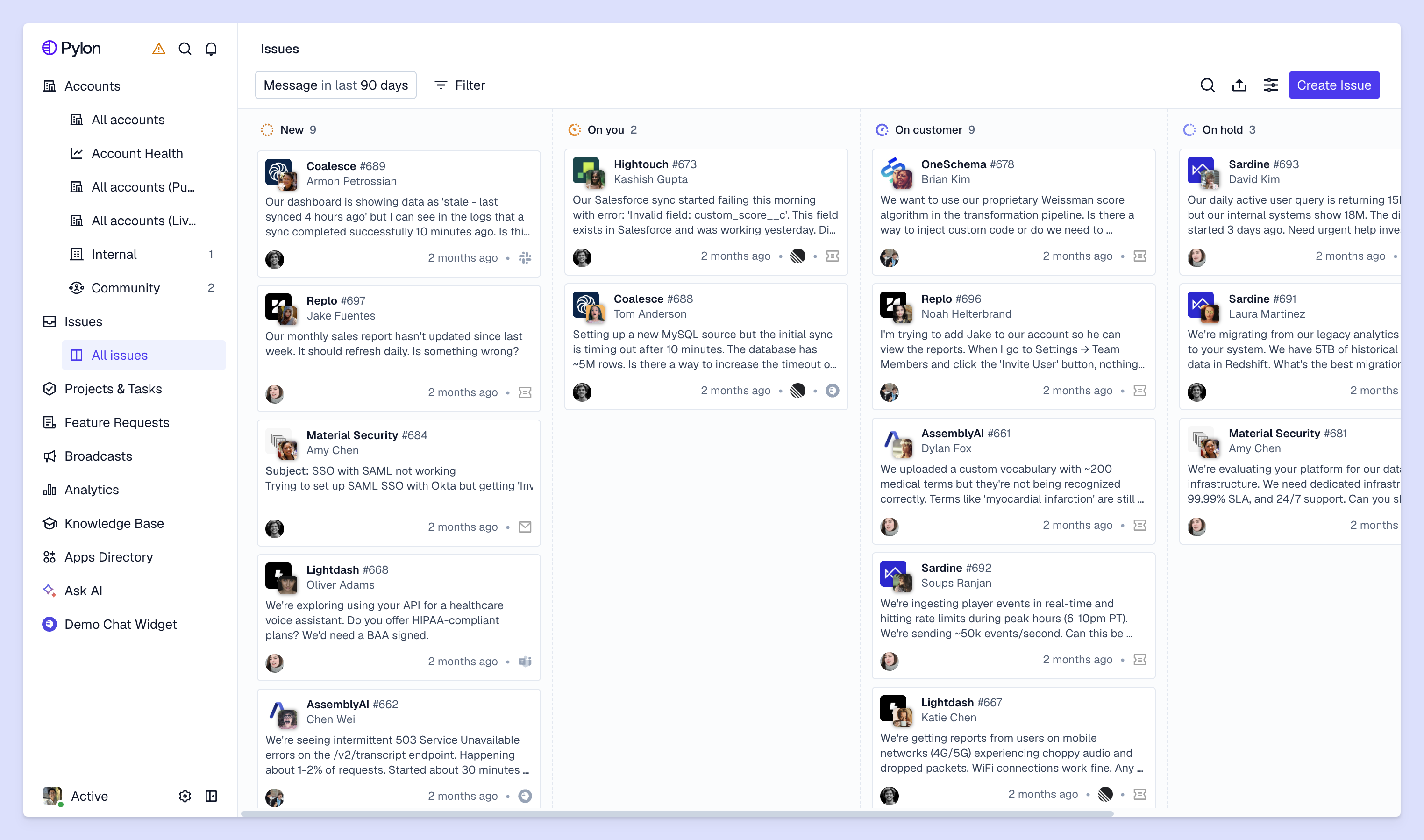
With Pylon, you can collect CSAT natively within Slack Connect and Teams channels. Configure triggers for surveys to go out as soon as ticket are closed.
For email-based support, a one-click CSAT embedded in the ticket closure email outperforms linked surveys by 2-3x in response rate. Keep it to one rating plus one optional open-ended question.
In-app surveys work well for product satisfaction and onboarding CSAT, delivered at specific events (completing setup, reaching a usage milestone, 30 days post-activation). Trigger them contextually: a survey fired when a user just had a frustrating experience will score differently than one fired after a successful task.
To run successful customer feedback campaigns, avoid these common mistakes.
Measuring CSAT without segmenting by account tier: A low CSAT from a trial user and a low CSAT from a $200K ARR enterprise account require very different responses. Always tag CSAT responses with account tier.
Only sending post-support CSAT: Support interaction CSAT tells you about your team; it doesn't tell you about product value or account health. Use onboarding and account health CSAT to get early churn signals.
Not closing the loop on negative responses: Any CSAT score of 1 or 2 should trigger animmediate follow-up from the account manager or CSM. Set up an automated alert in your support platform so no negative response goes unaddressed within 24 hours.
Using CSAT as your only quality metric: CSAT measures perceived satisfaction, not effort oroutcome. Pair it with Customer Effort Score (CES) surveys, which ask questions like "How easy was it to get your issue resolved?", to identify where friction lives even in the interactions customers rated positively.
What is a good CSAT score for B2B SaaS? For B2B SaaS support teams, 80%+ on post-support CSAT is a solid baseline. Top performers consistently hit 88–92%. If you’re consistently scoring below 75%, you might want to audit and investigate your support processes.
How many CSAT questions should I ask? Three questions maximum for post-support CSAT: one rating, one binary resolution question, and one open-ended. For account health surveys, five to seven questions can still work given the lower frequency.
What's the difference between CSAT, NPS, and CES? CSAT measures satisfaction with a specific interaction. NPS (Net Promoter Score) measures overall loyalty and likelihood to recommend; it's a relationship metric that’s best used quarterly. CES (Customer Effort Score) measures how easy an interaction was, and it’s a good predictor of repeat contact and churn at the interaction level.
When should I send a CSAT survey? For post-support: within 30 minutes of ticket closure. For onboarding: at day 30, 60, and 90. For account health: 60–90 days before renewal. For product satisfaction: quarterly, triggered by in-app usage events.
How do I improve my CSAT score? The most reliable lever is first contact resolution: customers who don't have to contact you twice are almost always more satisfied. After that, response time, communication clarity, and proactively following up on negative scores within 24 hours.
If your team is using CSAT to reduce churn and improve support quality, you’ll need to have the right survey and support infrastructure in place.
Pylon is the modern B2B support platform that offers true omnichannel support across Slack, Teams, email, chat, ticket forms, and more. Our AI Agents & Assistants automate busywork and reduce response times. Plus, with Account Intelligence that unifies scattered customer signals to calculate health scores and identify churn risk, we're built for customer success at scale.
Pylon Workforce Management is available now. See it in action with a live demo.