
Support becomes harder to manage as your company and customer base expand. A quick setup question and an integration problem need different levels of attention, but they’re competing for the same time.
Not every request can have the same priority, so you’ll need to define paths based on what’s necessary to resolve the issue. A multi-tiered support system, or MTSS, helps support teams scale with their company’s changing needs. Simple questions get taken care of quickly, while more technical problems are sent to the right people faster.
Learn more about how tiered support can have a measurable impact and how to structure each tier so you can create a system that scales alongside your customer support.

Tiered system support organizes tickets into groups based on their complexity. Most models include the following tiers, each responsible for a specific type of issue:
In B2B customer support, you’ll likely use automated issue routing, so queries make it to the right team/individual quickly. Without it, specialists get tagged for routine work, while frontline teams try to chase down more intricate details (with plenty of room for errors).
The best tiered support models share these traits:
A tiered customer service approach is more effective than a traditional support model once a few patterns start to emerge:
Most tiered models use the following structure, with each level responsible for a distinct type of customer support.
Tier 0 uses your knowledge base and help center to support customers who are experiencing common problems, without forcing them to open a ticket. Today, this tier is often automated.
For instance, if a customer runs into a common API authentication error, an AI chat widget in Slack might point the customer to self-service documentation that provides information about the cause and the exact steps to fix it.
The first human touchpoint happens in tier 1. This team handles intake, triage, and general issues like setup questions or known bugs with easy fixes.
A major responsibility at this level is correctly identifying the issue. When a customer reports a broken integration, for example, tier 1 needs to determine whether it’s a setup problem or something bigger that needs escalation. Effective support at this level should prevent unnecessary handoffs and speed up time to resolution.
Tier 2 addresses more complicated issues that need specialists. For a SaaS B2B team, this often involves looking into integration problems and troubleshooting edge cases.
If data sync works for one account but doesn’t for another, for instance, a tier 2 specialist can compare configurations and then isolate the cause. Team members on this tier may also spend time identifying patterns that point to broader issues with the product.
Tier 3 covers incidents that need specialists and non-support team members. These cases often involve bugs or limitations in how the system behaves, or more major incidents like outages.
The highest tier level’s goal is to identify the root cause of and solve a serious issue. Because of its scope, resolving a tier 3 ticket takes longer than a typical support interaction.
A tiered support model should reflect actual ticket patterns and customer needs, then move work through your team accordingly.
Setup tends to follow these seven steps.
Review ticket volume, recurring ticket types, and overall resolution times. These and other customer support metrics can show how your team spends its time and where bottlenecks exist. A high volume of integration questions, for example, could point to gaps in self-service documentation or the need for stronger tier 2 coverage.
Define expectations based on customer contexts, including revenue impact and relationship length, to help you set realistic SLAs for each tier. Larger accounts may need faster responses and priority escalation, while smaller ones are more likely to rely on standard queues and self-service.
Once you know what your ideal support for each customer segment looks like, you’ll need to create a framework for the roles in each tier. Consider their responsibilities and how you’ll train them, including the following details:
Your knowledge base should reflect how your team solves problems. Start with high-frequency issues, like setup errors or configuration questions, then expand into more complex scenarios.
Internal documentation should go further than public-facing content. It can draw on patterns from past tickets to capture troubleshooting steps and context that doesn’t belong in public articles.
Escalations should follow clear triggers depending on severity and intervention response. An issue that blocks a customer’s major workflow, for example, should get escalated to tier 2 quickly with a summary of what they’ve tried.
At the same time, team members should avoid escalating too soon. Strong tier 1 support can resolve a lot of requests when the team is given accurate documentation and useful materials.
Your tools should support how your team works, so pick a system that fits into your day-to-day workflows. A B2B support platform should help your team interact with customers with omnichannel communication, a help desk, and ticket routing workflows. The fewer tools you introduce, the more likely your team will adopt them.
Focus on software with features that shape actual support outcomes, like SLA management and tagging. A thoughtful setup makes work both faster and easier to manage.
Before you launch, make sure your pilot plan not only defines scope and success criteria, but also covers what will be tested and how long the pilot will run before its first review. The plan should address how the workflow is introduced, how participants are trained, and how feedback is gathered.
Once the pilot is over, chat with relevant team members about what worked and what could be improved. Refresh protocols and run another pilot, if necessary, before starting the internal adoption process.
Metrics have different implications and uses at each tier. For example, tier 1 focuses on fast resolution of common issues, so time to resolution is an important metric. Tier 2 addresses more complex cases, so customer satisfaction score (CSAT) may be more relevant.
Performance reviews and system updates should use those metrics to find weak spots in the process and refine workflows accordingly. Balance team efficiency and the customer experience, so faster or less expensive alternatives don’t come at the expense of quality or long-term sustainability.
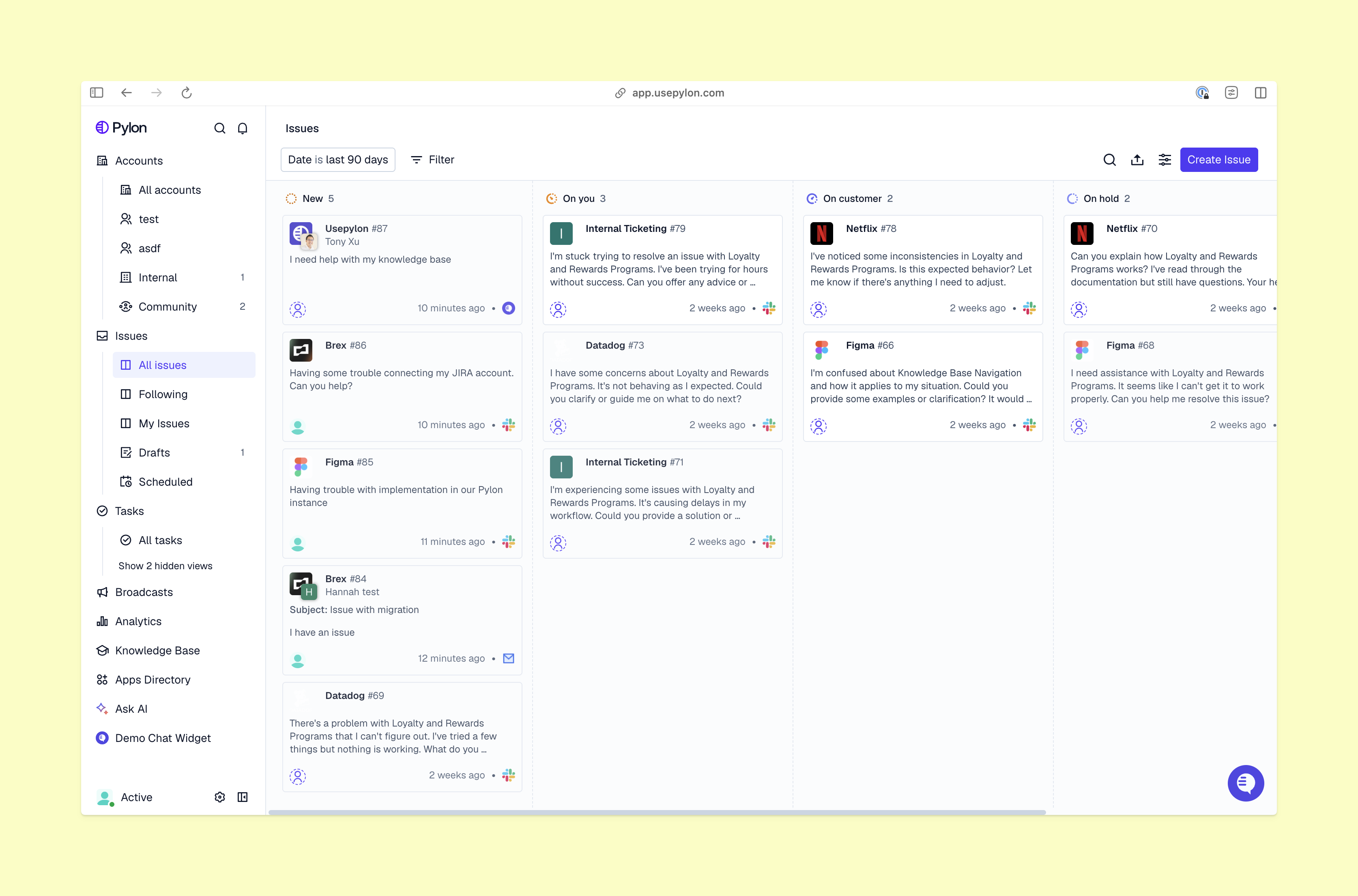
Tiered support helps you scale your team while providing a focused customer support experience. Clearly defined roles, escalation paths, and workflows give your team the structure to resolve issues more efficiently and use performance data to improve over time. Since tiered support crosses multiple teams, getting full visibility into customer context in one place is important.
Pylon is the modern B2B support platform that offers true omnichannel support across Slack, Teams, email, chat, ticket forms, and more. Our AI Agents and Assistants automate busywork and reduce response times. Plus, with Account Intelligence that unifies scattered customer signals to calculate health scores and identify churn risk, we're built for customer success at scale.
Modern support demands a blend of human-centric and technical abilities: critical thinking, emotional intelligence, communication, problem solving, adaptability, and AI proficiency. These skills are essential, especially as AI increasingly automates repetitive tasks like data entry.
Tier 1 customers are customers reaching about basic questions, like login issues, billing questions, or simple troubleshooting.
Tier 3 specialists need to quickly and accurately identify what’s causing serious issues. Specific skills depend on your specific organization and product, but should focus on root cause analysis and debugging complex failures.
Pylon Workforce Management is available now. See it in action with a live demo.