Updated December 12, 2025 | 15 min read
Support teams have to field scattered messages from Slack, email, Teams, and chat—and every time a customer asks, "Did you see my message?", you know your current setup isn't working.
SaaS help desk software consolidates these conversations into one platform where your team can actually track, prioritize, and resolve customer issues without losing context.
This guide covers what SaaS help desk software is, why B2B teams rely on it, and how to choose the right platform based on your channels, team size, and growth plans.
SaaS help desk software is a cloud-based platform that centralizes your customer support operations. It can include a ticketing system, knowledge management, and omnichannel support capabilities.
You access everything through a web browser instead of installing software on your own servers, which means your team can respond to customers from anywhere.
Here's the basic idea: every customer conversation becomes a trackable ticket. When support requests come through email, chat, Slack, Teams, or forms, your help desk converts them into tickets that you can prioritize, assign, and resolve. You get a complete history of each customer interaction in one place instead of scattered across different tools.

Your customers expect fast responses no matter where they reach out. Without a unified system, your team wastes time switching between tools and asking customers to repeat themselves.
When all your customer messages flow into one platform, your team sees everything in a single view. You manage email tickets, Slack threads, Teams conversations, and chat messages without jumping between apps. This cuts response times because your team spends more time actually helping customers and less time hunting for context.
Some help desk platforms like Pylon connect your support interactions directly to customer success signals like health and churn risk. When your support and success teams share the same system, you spot warning signs earlier—like a frustrated account whose contract renewal is coming up—and improve customer retention outcomes.
For example, Pylon's Account Intelligence can help you calculate custom health scores based on support data, so you identify churn risks before it's too late. Your support tickets inform how you drive retention and customer success context helps you provide better support to each account.
Modern help desk software handles repetitive tasks automatically. AI can route tickets to the right team member, tag them by product area, or auto-update knowledge base content.
AI agents reduce ticket volume by autonomously responding to simple customer issues.
AI assistants help your team move faster by drafting responses or suggesting relevant knowledge base articles to send to customers.
Not all help desk platforms work the same way. Here's what separates basic ticketing from tools that actually help your team:
Omnichannel supports means you can communicate with customers across multiple platforms from a single interface. For B2B teams, this typically includes email, Slack Connect, Microsoft Teams, in-app chat, and ticket forms.
Instead of checking five different places for customer messages, your team works from one unified view. Every ticket preserves full conversation context, so you can see complete customer history before responding.
AI agents can answer common product questions or route complex issues to team specialists—all without your team needing to step in. AI assistants work alongside your team by drafting responses, summarizing long threads, and suggesting relevant help articles.
The distinction matters for how you scale. Agents deflect questions before they reach your team, while Assistants help your team work faster on the tickets that do come through.
Your help desk should show you ticket volume trends, average response times, resolution rates by team member, and customer satisfaction scores. This data helps you spot bottlenecks, like one person handling 60% of tickets, and improve your support operations over time.
You should also be able to track SLA compliance to make sure high-priority customers get responses within the timeframes you promised.
Your help desk should connect to your existing tech stack: CRM, project management tools, and communication platforms. These integrations prevent data silos and reduce manual copying between systems.
For example, a help desk that integrates with your CRM will let you see account value and renewal dates alongside customer threads. With help desk that integrate with Linear or Jira, you could create product tickets directly from feature requests—instead of manually copying over the details.
Every support team operates differently. Your help desk should let you configure custom ticket routing (for example, assign tickets from enterprise customers to senior team members), automated responses (like a message that acknowledges receipt within five minutes), and escalation paths (like flagging unresolved tickets after 24 hours).
The workflows should match your specific support processes instead of forcing you to adapt to rigid software.
.png)
The help desk market breaks down into four main categories, each serving different team needs.
Enterprise help desk platforms handle complex support operations for large companies that manage thousands of tickets across multiple teams. Platforms like Pylon, Zendesk, and Salesforce Service Cloud all support larger teams. Teams often choose Pylon for enterprise capabilities without the legacy complexity.
Mid-market solutions balance powerful features with modern usability. Growing teams can get sophisticated tools that scale with them, but are simple enough to deliver value from day one. Pylon, Help Scout, and Freshdesk serve this segment.
AI-native support systems build AI into their core architecture. For example with Pylon, AI Agents and Assistants automate workflows like feature request tracking, ticketing routing, knowledge base updates, and more—so your team can focus on complex customer issues and relationship building.
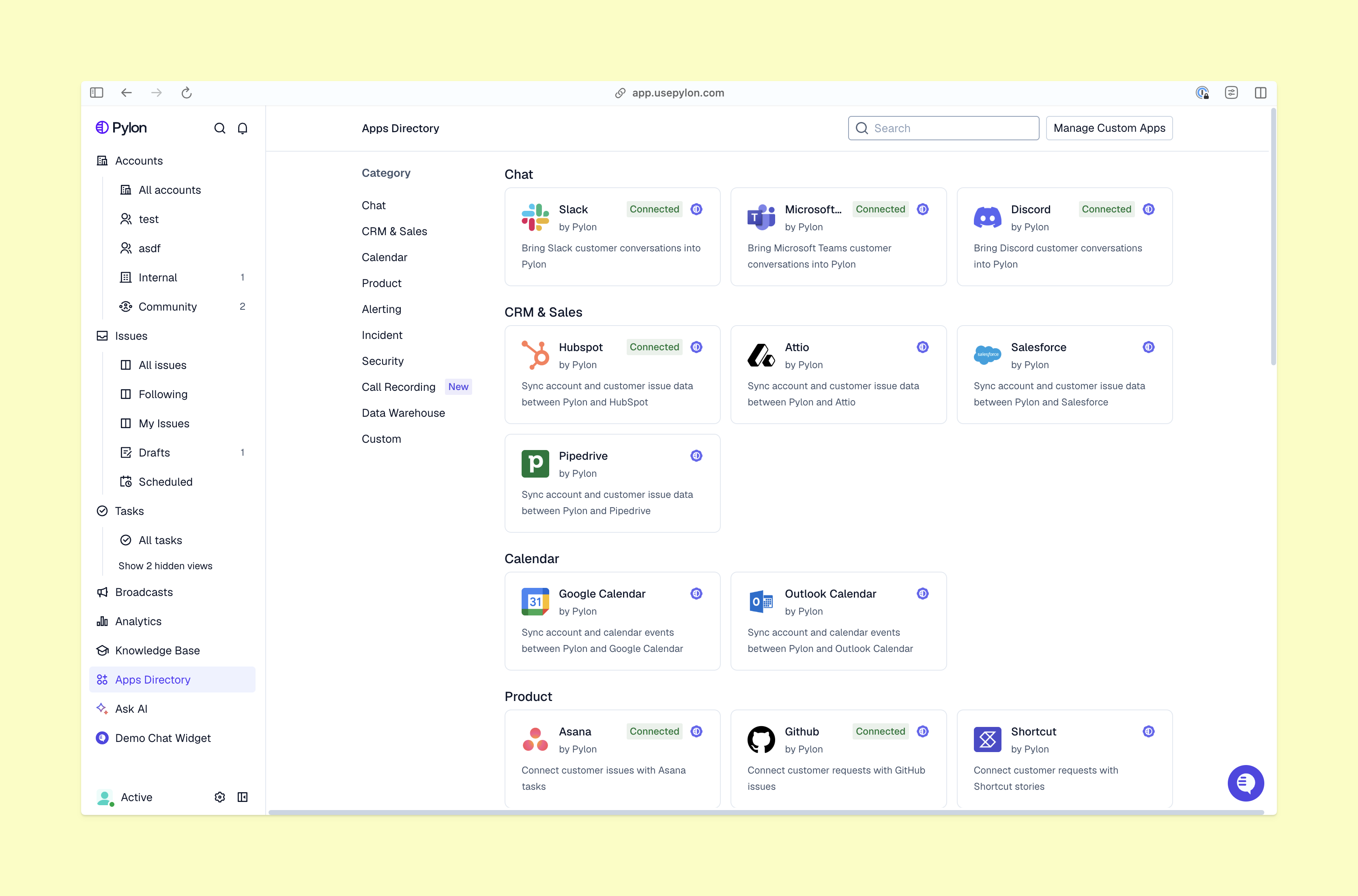
Omnichannel platforms focus on helping you manage customer communications from modern B2B channels like Slack and Microsoft Teams. Look for help desks that natively support the channels you serve most. For example, Pylon is the first platform to offer truly native Slack, Teams, and Discord support.
Picking help desk software can be overwhelming when every platform claims to be the best. Here's a practical process that cuts through the noise.
List where your customers actually reach out: email, Slack Connect, Teams shared channels, in-app chat, or ticket forms. Your help desk needs to support your primary channels natively, instead of through clunky integrations and workarounds.
If 70% of your support happens in Slack, you want a platform that's built for Slack support—like Pylon.
Separate must-haves from nice-to-haves. Do you absolutely need product ticketing integrations? Does your team require custom routing workflows?
Focus your evaluation on platforms that deliver your non-negotiables. Don't get distracted by flashy features you won't use.
Review your existing tools: CRM, project management software, communication platforms, data warehouses. Your help desk should integrate seamlessly with systems you already use. Otherwise, it will create more work for your team to manually sync and update customer data.
Look for native integrations instead of bulky add-ons or Zapier workarounds.
Think about where your support team will be in two years. Will you double your ticket volume? Add new support channels? Expand to new regions?
Choose software that can scale with your growth instead of forcing you to migrate again in 18 months.
Test your top two or three choices with your support team's real workflows, not demo data. Involve your entire team in the trial so you get feedback on usability and how well it integrates with their daily work.
A platform that looks great in a sales demo could feel clunky when your team starts using it for 40 hours a week.
Most help desk platforms charge per seat per month, with pricing tiers based on the different features you need.
Budget-friendly options can start around $15-30/seat/month and cover basic ticketing and email support. Mid-tier plans could start at $50-80/seat/month with additional omnichannel support, advanced reporting, and AI features.
Look out for hidden costs on top of base pricing. Implementation fees, data migration services, training sessions, and premium integrations can add 20-40% to your first-year contract. Some platforms also charge extra for AI features, additional channels, or users above a certain threshold.
Rolling out new help desk software can disrupt your team's daily work. Here's how to minimize friction and get value out of a new platform faster.
Map out how you'll move existing tickets, customer data, and conversation history before you start. Clean up duplicate records and outdated information instead of transferring messy data to your new system.
A clean migration saves hours of cleanup work later and gives your team accurate historical context from day one.
Configure ticket routing, tagging, and assignment rules during your setup phase. This way your team will benefit from automation immediately, instead of having to manually process tickets while they're learning the new platform.
Even basic rules like routing API questions to technical support or tagging urgent tickets from enterprise customers can save your team significant time and effort up front.
Run group training sessions so everyone can learn the same workflows. Create internal documentation for common tasks and edge cases.
When questions come up later, your team has a clear source of truth to reference.
Start with one team or channel, validate that everything works correctly, then expand. Phased rollouts will help you catch configuration issues before they affect your entire support operation.
You might start with email support for two weeks, then add Slack support, then configure in-app chat.
With AI, help desk software goes from a manual ticket management system to a tool that actually accelerates your support operations. Here's what that looks like in practice:
For B2B teams, AI can help you scale support without needing to grow headcount at a proportional rate. When your customer base doubles, your ticket volume might only increase by 40% because AI is automatically helping you field routine questions.
Many teams run into the same pitfalls when they're evaluating help desk software. Here's what to watch out for:
Choosing a platform based on features you won't use. Focus on capabilities that solve real problems for your team, not just impressive feature lists that sound cool in demos.
Ignoring your team's workflow. Software that doesn't match how your team actually works will create extra friction. It won't help your team become more efficient.
Underestimating integration needs. If your help desk software doesn't integrate with other platforms in your team's stack, you'll have to deal with manual data entry and constant context switching between tools.
Skipping the trial period. You can't evaluate daily usability from 30-minute demos. Your team actually needs to try the platform in the context of their real workflows.
Forgetting about customer success and support alignment. Your help desk should make it easy for your entire post-sales team to share customer context—instead of forcing support and customer success to work with siloed systems.
Most teams complete migration in two to four weeks, depending on data volume. Plan for one week of setup, one week of data migration and testing, and two weeks of team training and gradual rollout. That said, some teams implement Pylon within a week.
Help desk software manages support tickets and customer service conversations. CRM software tracks sales pipelines and customer relationships. Many B2B teams use both systems with integrations to share customer context, so your support team can see account value and renewal dates.
Yes. Platforms like Pylon unify support ticketing with customer success features like account-level health scoring and churn risk detection. Both teams access the same customer context instead of working from separate tools with siloed data.
Measure time saved through automation, reduction in average response time, improvement in customer satisfaction scores, and decrease in customer churn. Compare the gains against your software costs and implementation investment.
Look for SOC 2 compliance, data encryption in transit and at rest, role-based access controls (RBAC), and single sign-on (SSO) support. Enterprise teams should also check for GDPR compliance and data residency options.
With omnichannel support, AI and automated workflows, and native integrations with the rest of your tech stack, a help desk platform can become your central hub for post-sales customer interactions. The best platforms unify scattered account data and signals across your support and customer success teams.
Pylon is the modern B2B support platform that offers true omnichannel support across Slack, Teams, email, chat, ticket forms, and more. Our AI Agents & Assistants automate busywork and reduce response times. Plus, with Account Intelligence that unifies scattered customer signals to calculate health scores and identify churn risk, we're built for customer success at scale.
Pylon Workforce Management is available now. See it in action with a live demo.