
Without a dedicated system to capture and organize reports from your customers, their questions end up scattered across inboxes and spreadsheets. And that results in your team spending their time chasing context instead of fixing problems.
An issue tracking system puts every ticket in one place, regardless of how it came in.
In this article, you’ll learn what to look for in issue tracking tools, how they benefit B2B support teams, and which issue tracking system examples are worth evaluating.
Issue tracking software is a centralized platform where your team monitors customer issues from intake to resolution. For support teams, these issues aren’t always problems. They can be anything from product questions and feature requests to integration failures, coming in from multiple channels throughout the day.
Bug tracking, project management, and issue tracking all overlap, but they aren’t the same. Bug tracking is a kind of issue tracking narrowly focused on software defects found during development or QA. Project management tools handle a broader scope, like timelines and milestones. Issue management tools sit in between. They’re designed to capture and resolve any type of customer report.
For support teams, this distinction makes a difference. Issue tracking software is a purpose-built support platform that can handle a volume and variety of customer-reported issues; bug tracking and project management can’t.
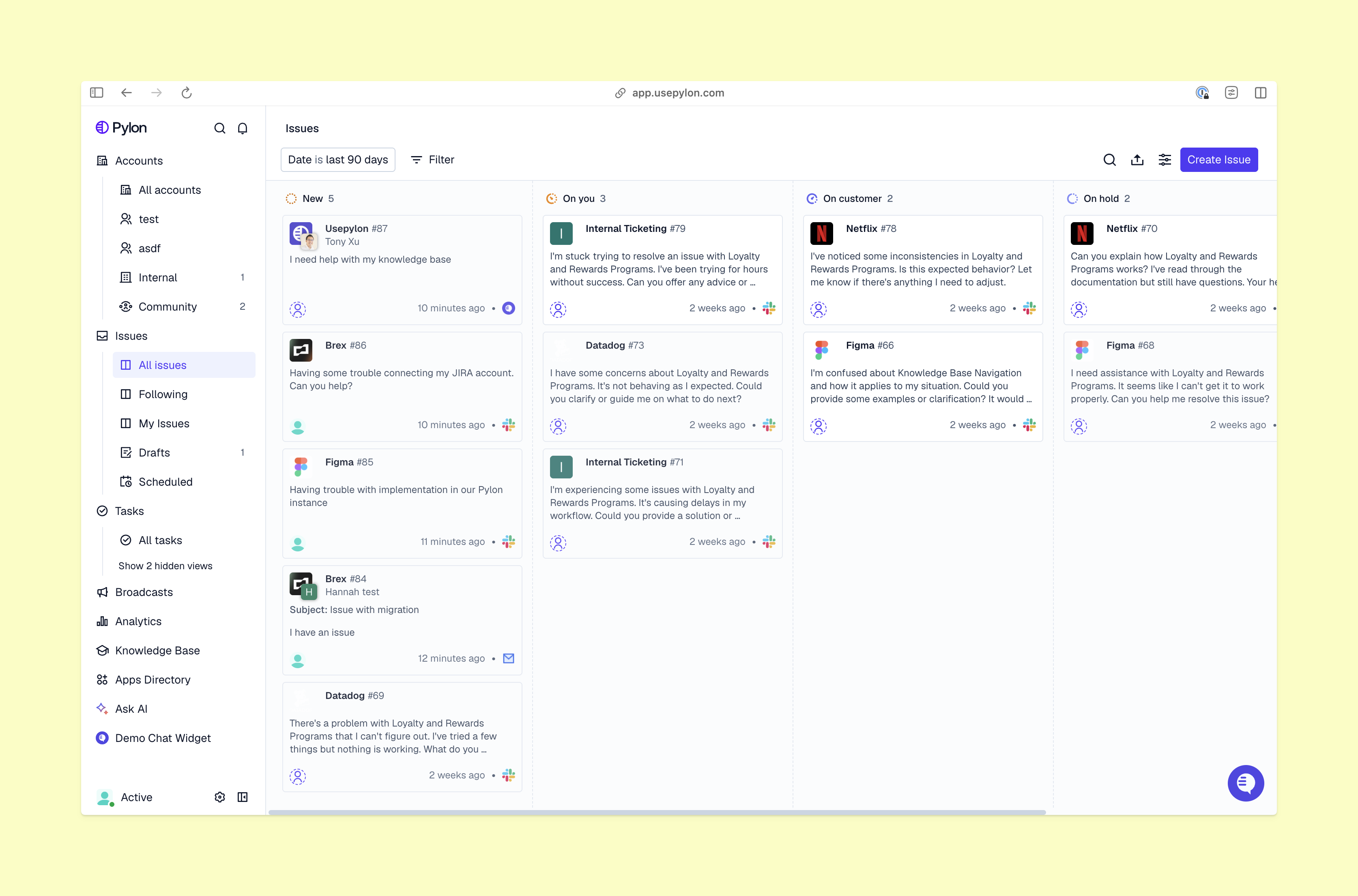
Issue tracking systems can give B2B teams both operational and strategic advantages.
When every issue exists in one system, your team stops losing time to context-switching. For example, when a customer reports a problem via Slack, you rely on team members manually checking threads to notice the message. But with an issue tracking system, that request automatically becomes a ticket with an owner, a priority level, and a deadline.
Centralized tracking also makes responsibilities transparent. When everyone can see who owns what issues, there’s more accountability for those team members to follow through in a timely way. For a support manager running a growing team, that visibility is the difference between discovering a bottleneck on Tuesday morning versus Friday afternoon.
Customers feel the impacts of better tracking, too. When your team can see an issue’s full history, customers don’t have to repeat themselves with every new interaction. They notice context continuity, especially in B2B settings, where the same contacts reach out to your team over a long time. And faster response times from transparent issue ownership can make your team feel more reliable. It all adds up to more long-term customer happiness.
The operational wins of issue tracking systems are immediate, but its longer-term value comes from your own data. Every resolved ticket becomes part of a searchable record. When a similar issue comes in six months later, your team won’t have to start from scratch: They can pull up the previous resolution and adapt it to the current context. This means tracking systems can work like an internal knowledge base your team can reference and learn from over time.
Trend data also feeds back into your product team. If you can show that 40% of your new feature request tickets last quarter were for one integration, then your engineering team knows what to prioritize next. Without structured online issue tracking, those patterns stay buried in individual conversations and never surface as actionable data.
The features that matter most depend on how your support operation runs and how your customers prefer to communicate. But there are a few capabilities that consistently reinforce tool adoption:
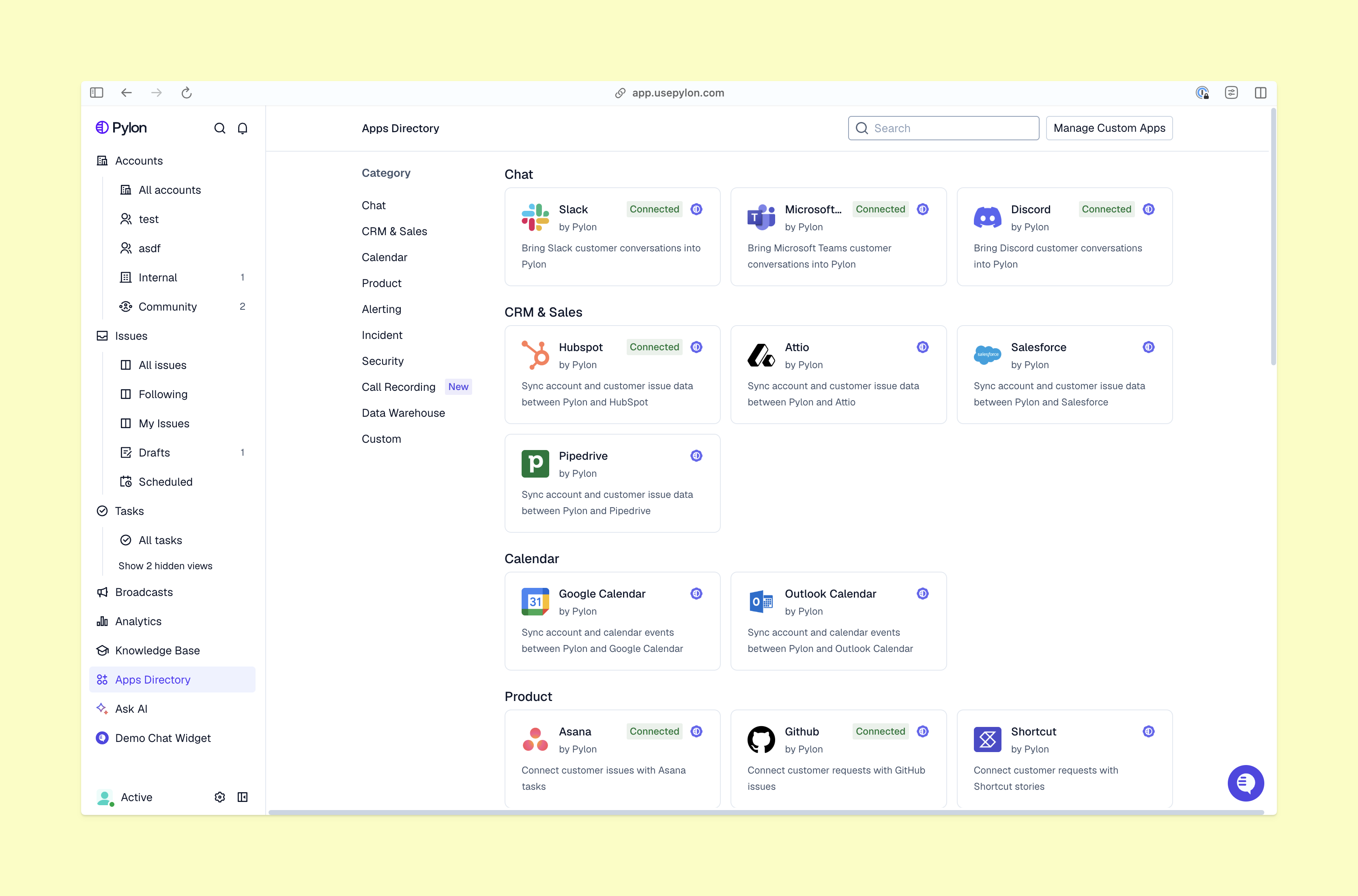
Now that you understand what to look for in a tool, here are six of the most effective tools for online issue tracking.
Where many issue trackers are built from a development or project management perspective, Pylon was made for B2B support teams.
Your team can manage customer issues across channels from Pylon’s omnichannel platform, which automatically turns conversations and new threads into structured tickets. Pylon’s AI agents can handle routine issues autonomously, like answering common questions or updating ticket statuses, while AI assistants help your team investigate and draft responses to more complex problems.
Most project issue tracking tools stop at the ticket. Pylon’s Account Intelligence connects support tickets to broader customer context, which is where the real operational value is for B2B teams. It pulls ticket data, conversation history, and account context into a unified view, so your team can see patterns at the account level. If, for example, a high-value account files multiple issues about the same problem and shows negative sentiment, AI automatically surfaces those signals so you can proactively respond before churn conversations happen.
Jira is the default tool for engineering organizations. Its workflows have a lot of customization options, and its integration ecosystem includes most common dev tools. For support teams, though, its setup complexity can be a barrier. Jira wasn’t designed to handle multi-channel customer conversations, so teams that adopt it for support might need to build workarounds to get customer context into the system.
Trello works for small teams who need visual task management without much setup. Its kanban boards are intuitive for to-do list-style ticket workflows, but its reporting features are limited. Your team will need to input tickets themselves: Trello lacks the automation and triage features that support teams require at scale.
Asana handles cross-functional project coordination through a clean interface. It’s a project management tool at its core, so detailed issue tracking with ticketing workflows isn’t the program’s primary strength. For teams who want to use it for support, the reporting can be too broad for issue-level analysis. But if you’re just looking for internal coordination and collaboration, Asana can put post-sales teams in conversation.
Monday.com offers a visual workspace with customizable boards and automations. It’s flexible enough to adapt to support use cases, but its issue tracking and reporting features are built for general project management. Support-specific needs like SLA tracking and account-level visibility will need custom configurations.
ClickUp is an all-in-one platform with task tracking, time management, and workflow customization options. Its features are impressive, but that often comes at the cost of a significant setup time. Teams that need a focused issue tracking tool may find the learning curve steep, and the number of configuration options can slow down adoption for support teams who want something operational on day one.
The best issue tracking system is one built with customer support teams in mind. An issue tracker that collects tickets from multiple channels with visibility at the account level gives support an advantage. Your team can get from “issue reported” to “issue resolved” quickly, and the data from that resolution can feed back into your broader support strategy faster.
Pylon is the modern B2B support platform that offers true omnichannel support across Slack, Teams, email, chat, ticket forms, and more. Our AI Agents and Assistants automate busywork and reduce response times. Plus, with Account Intelligence that unifies scattered customer signals to calculate health scores and identify churn risk, we're built for customer success at scale.
Start by defining clear severity levels (trivial to critical) and a centralized workflow (New > In Progress > Resolved). Teams that prioritize effectively are more likely to outperform peers.
An issue tracker list (or issue log) is a centralized registry containing every known problem, bug, and request. It acts as a shared timeline to ensure no defect or customer grievance is overlooked during development.
A tracker template is a pre-formatted framework with standardized columns for documenting and delegating issues. Using templates saves hours of setup and ensures team-wide data consistency.
Common synonyms include bug tracking, defect management, incident ticket system, and trouble ticketing. These terms are often used interchangeably, depending on the incident’s focus.
Pylon Workforce Management is available now. See it in action with a live demo.