
In a B2B support team’s early days, customer issues are easy to manage. But as you grow, the trickle of requests becomes a flood. Suddenly, customer chats and data are scattered across Slack channels, email inboxes, support tickets, and random mentions.
A simple issue tracking system helps you stay organized and use customer context to improve dev and retention. And the right issue management software will do all that without adding complexity to your already busy workdays.
In this guide, you’ll learn how issue tracking systems work and how to choose the right tool for your support team.
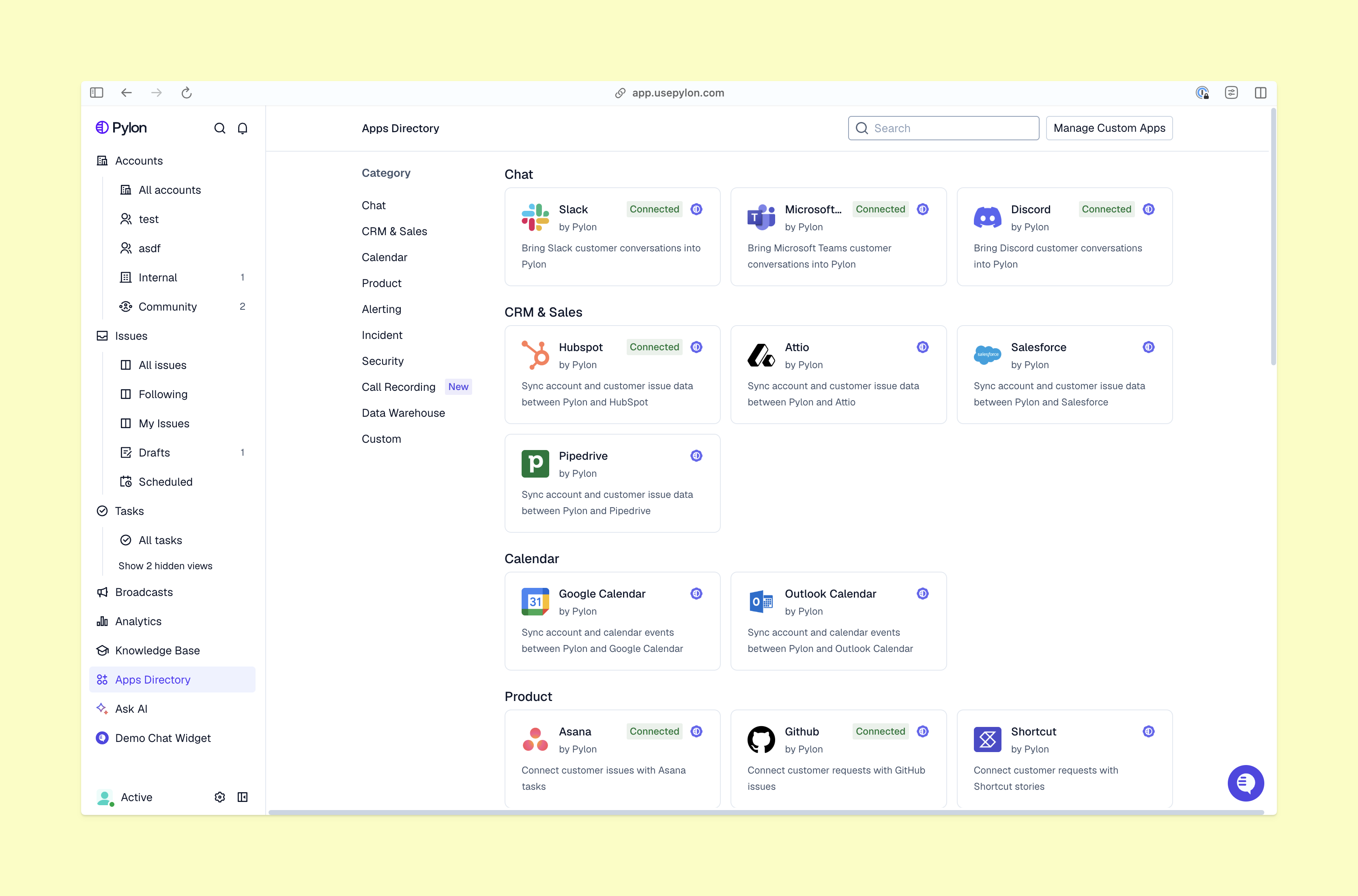
A simple issue tracking system is a hub where you can capture, assign, track, and resolve all customer problems. This centralized process keeps messages organized and helps with accountability through clear tasks and roles. And while your support team still owns resolutions, the entire company gets a front-row seat to the problems customers face.
Say a high-value customer posts this in a shared Slack channel: “Our Salesforce integration is giving us an authentication error.” Your issue tracking software logs the issue as a support ticket with a category and priority, then assigns the ticket to a team member. After that, all back-and-forth with the customer and your team stays connected to the same ticket. When the problem is fixed, the system also documents the solution.
Here are some features any useful issue tracker tool should include.
Customers report issues wherever is most convenient for them, whether that’s Slack, Microsoft Teams, email, or an in-app chat widget. That’s why modern support tools like Pylon offer omnichannel support. An omnichannel system captures all those conversations in a complete customer 360-degree view, which gives your team full context about every account and interaction.
A strong issue tracking system gives you simple forms and structured entry points that turn messy customer complaints into clean, reportable data. By capturing key details upfront, like issue type, priority level, and affected account, you can speed up triage and create reports that show trends.
The best issue tracking systems use AI to automate simple, repetitive tasks that take up too much of your team’s time. For example, when a customer reports a familiar error, your AI agent can automatically execute a set workflow. It could gather more details from the customer and suggest a relevant article from your knowledge base. In this way, AI agents often improve metrics like time to resolution and average response time.
Account intelligence separates B2C-focused tools from B2B support platforms. Your issue tracking system should connect every ticket to a customer account and add context like the account’s health score and recent activity. This account-centric view lets you prioritize issues based on revenue impact and identify at-risk customers before they churn.
A simple issue tracker benefits both your team and customers, because it:
.png)
The next level of issue tracking is investing in a complete customer support and success platform like Pylon. Here's how this kind of solution helps you transform support into a growth driver.
One of the biggest challenges for any growing SaaS company is the disconnect between support and product teams. Customer feedback gets lost in Slack threads, bug reports are manually copied and pasted into Jira, and product managers don’t know about customer pain points. But with native integrations for Jira, Linear, Asana, GitHub Issues, and Shortcut, Pylon links your support conversations directly to your product and engineering workflows.
Next-level issue tracking should help you prevent problems, which means you need info about accounts outside of support chats. Pylon’s Account Intelligence unifies scattered customer signals from your issue tracker, CRM, call recordings, and calendar into a single, actionable view of account health.
Instead of just seeing a list of tickets, you can spot specific issues, like a high-value account with a spike in support requests combined with low product engagement. Your success team can intervene right away, and hopefully stop the customer from churning.
Modern support tools often use AI to reduce response times and improve customer satisfaction scores. For example, Pylon’s AI Agents can handle complex, multi-step tasks autonomously. When a customer reports a common issue, your AI agent can ask the customer for key details and reference internal docs to find a fix. This frees up your support team to focus on harder problems, and it gives you space to invest more time in training and performance review.
Simple issue tracking is the foundation for quality customer support — this kind of tool gives you a clear and robust process so you can fix issues fast. But if you want to go above and beyond for customers and scale support smoothly, you’ll need a complete support solution with powerful AI and automation.
Pylon is the modern B2B support platform that offers true omnichannel support across Slack, Teams, email, chat, ticket forms, and more. Our AI Agents and Assistants automate busywork and reduce response times. Plus, with Account Intelligence that unifies scattered customer signals to calculate health scores and identify churn risk, we're built for customer success at scale.
It’s a software tool that captures, organizes, and manages customer queries or technical problems from report to resolution, ensuring that no task is overlooked.
Bug tracking focuses specifically on fixing software code errors, while issue tracking is broader, covering customer requests, tasks, and general inquiries.
Evaluate tools based on user interface, integration capabilities, automation features, scalability, and whether the pricing aligns with your team's specific size.
It uses automation to route tickets to the right agents and provides centralized data, allowing teams to identify bottlenecks and resolve common queries faster.
Essential fields include a descriptive title, issue type, priority level, reporter contact info, and a detailed description with steps to reproduce the problem.
Pylon Workforce Management is available now. See it in action with a live demo.