
The math of B2B support breaks down as you scale. If you add more team members to answer the same questions, it destroys your unit economics. And when companies ignore those questions, customer trust weakens and churn increases.
That’s why companies use AI for customer support. They deploy an operational layer that handles repetitive inquiries automatically. This gives their human team the bandwidth to manage complex, relationship-heavy issues. AI also turns each interaction into account intelligence that reveals churn risk and product friction.
In this article, you’ll learn how companies clear their queues with AI and how you can turn your support tickets into a powerful dataset that improves customer experience and higher retention.
B2B AI needs a different approach than consumer chatbots. A generic bot that frustrates a high-value enterprise account creates more work for your team and is often worse than no bot at all.
Modern support teams rely on three core AI functions to scale effectively:
When deployed correctly, these tools reduce median response time and route conversations to the right channel. Highly technical questions from VIP accounts go straight to engineers, while basic billing questions resolve autonomously.
When your company leverages AI-powered customer support, your internal teams save minutes on every interaction. That time and data compound, which improves CSAT, retention, and your bottom line even as you scale.

Here are real-world examples of companies that use AI to scale support operations.
Amazon’s approach to generative AI offers a solid blueprint for B2B teams. When companies force customers through rigid decision trees, frustration rises. Instead, support teams use generative AI to instantly surface relevant information, draft suggested responses, and summarize long interaction histories. This approach ensures Amazon’s support team has the context it needs to resolve complex issues faster and avoids unnecessary time spent on documentation search while the customer waits.
Writer offers an AI-powered platform for enterprise accounts. As their customer base grew, the company needed a support infrastructure that could handle sophisticated requirements and integrate deeply with Slack. They migrated to Pylon’s omnichannel platform and transferred six months of historical data without the loss of customer context.
AI-powered ticket categorization eliminated the need to manually tag every issue and now operates at 90% accuracy. This automation, combined with intelligent Slack notifications, changed monthly reporting from a multi-hour manual process to a report generated automatically in seconds.
AssemblyAI provides advanced speech-to-text APIs to developers. Their support team was overwhelmed with repetitive Level 1 technical questions spread across several channels. To solve this, they deployed one of Pylon’s AI Agents powered by runbooks to handle chat inquiries. AssemblyAI now resolves 50% of eligible support inquiries without human intervention.
Findigs operates an AI-native resident screening platform. As monthly ticket volume surged, their current Salesforce Service Cloud deployment required extensive engineering resources just to maintain basic workflows. When they transitioned to Pylon’s modern support platform, non-technical teams could configure workflows in minutes instead of days. Findigs’ new workflows reduced total ticket volume by 30% and now triage up to 15% of tickets before they ever reach one of their human team members.
Shopify’s merchants need instant answers to complex questions about store configurations and API integrations. Users who need to test and ship features rapidly shouldn’t have to wait hours for an email reply. The company deployed AI-powered customer support solutions that instantly parse its massive documentation library. The chatbot now also assists with product page design and coding widgets. These capabilities turned their AI-powered customer support into a need-to-have feature for their user base.
A generic chatbot that can answer a few basic FAQs will fail when it supports enterprise accounts, complex API integrations, and multi-user deployments. The most effective AI customer support solutions for B2B build on a foundation of deep context and smooth handoffs.
To evaluate the best conversational AI platforms for customer support, B2B founders should focus on these key capabilities:
Every support conversation is a piece of data. When analyzed with AI, you can identify churn risk before the renewal date. You can also spot expansion opportunities when a customer asks about a premium feature and prioritize your product roadmap based on actual user feedback. That’s how support shifts from a reactive function to a strategic growth engine.
The biggest gap in current AI customer support tools is fragmentation. You have one tool for email, another for Slack, a separate CRM, and a disconnected knowledge base. Most tools can’t connect to all of these data sources, so your AI lacks the account-level visibility needed to be effective in a B2B setting.
Pylon offers an AI ticketing system for modern teams. It centralizes conversations across every channel. This unified inbox gives AI agents and your support team complete visibility into each account.
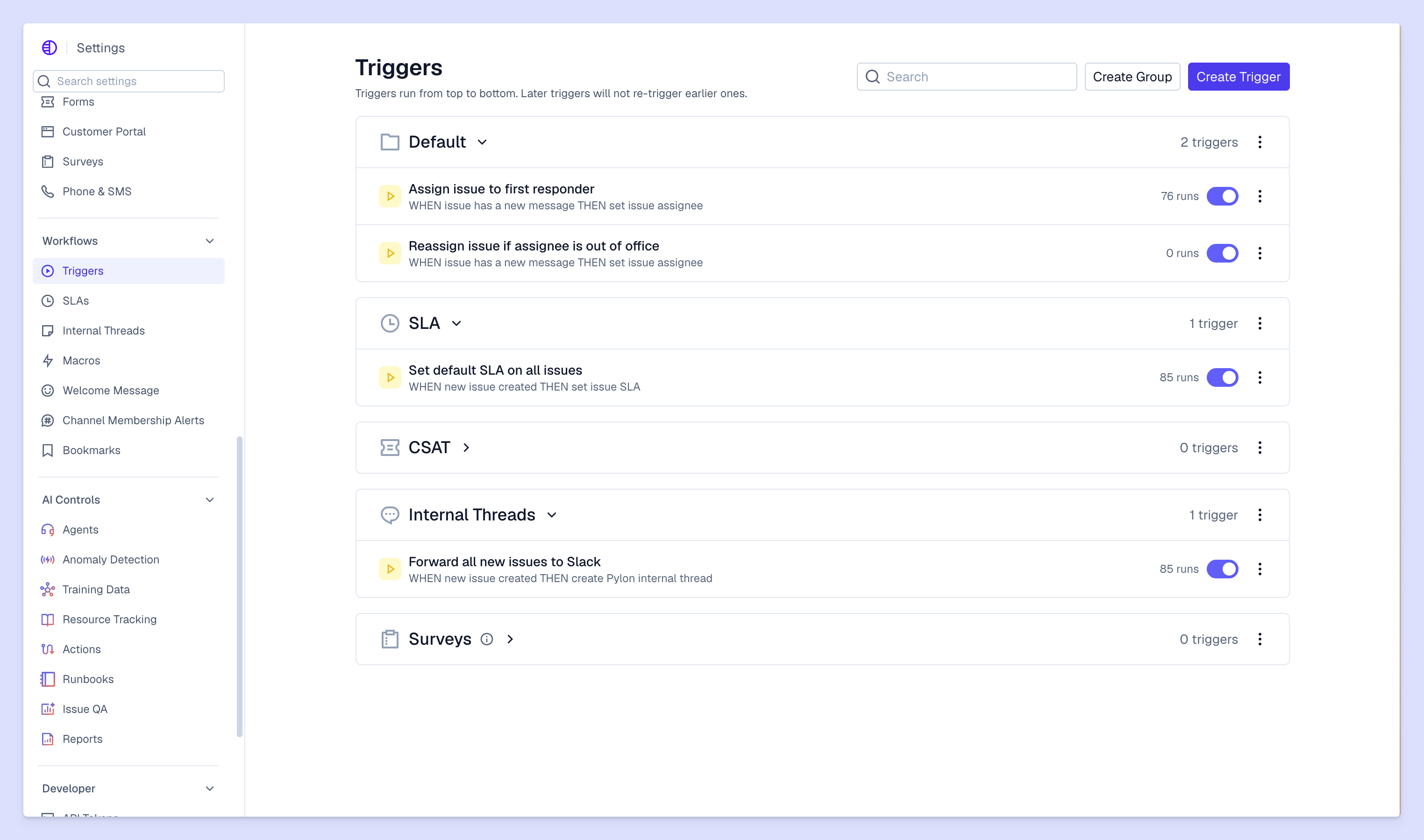
From there, Pylon deploys agentic AI customer support and AI assistants to automate your support workflows. Agents handle repetitive tasks autonomously, while assistants draft suggested replies for your human team members to review. This ensures speed and doesn’t sacrifice the accuracy or the personal touch required for high-value accounts.
Pylon’s Account Intelligence analyzes all your support tickets, CRM data, and product usage to generate real-time insights for your customer success and operations teams. You can actively identify churn risk, calculate health scores, and spot expansion opportunities — and still close tickets faster.
The shift from reactive ticketing to proactive account intelligence is already in progress. Companies that use AI for customer support understand how customer understanding drives retention and expansion.
Pylon is the modern B2B support platform that offers true omnichannel support across Slack, Teams, email, chat, ticket forms, and more. Our AI Agents and Assistants automate busywork and reduce response times. Plus, with Account Intelligence that unifies scattered customer signals to calculate health scores and identify churn risk, we're built for customer success at scale.
No. In B2B support, AI handles repetitive work and assists teams, while people still own complex issues, judgment calls, and relationship-heavy conversations.
B2B support teams use conversational, task-automation, and learning agents to triage requests, answer common questions, and enable faster handoffs.
The best fit for B2B combines AI Agents for self-serve and prework with AI Assistants that help teams route, summarize, and resolve issues faster.
Many companies, like Amazon, use generative AI to assist agents, improve self-service, and deliver faster, more tailored support experiences.
Pylon Workforce Management is available now. See it in action with a live demo.