Updated December 24, 2025 | 16 min read
For a lot of customer success teams, account-level context is scattered across platforms like Slack, Google Sheets, CRMs, and more. But CSM tools fix this by unifying customer data, automating workflows, and predicting churn before it happens.
We've compared 15 platforms across features, pricing, and use cases. Plus, learn what to look for when you're evaluating options for your team.
CSM tools are software platforms that help B2B teams manage customer relationships post-sales. They focus on keeping customers successful, engaged, and growing — so your support and success teams aren't just reacting to incoming tickets.
Here's what makes them different from CRMs or help desks: CSM platforms pull data together across your CRM, support system, product analytics, and communication tools to create a complete view of each customer. This lets you spot issues and revenue opportunities early.
Think of it this way: Your CRM tracks the sales process, your support tool helps you handle incoming issues, and CSM platforms help you proactively manage the customer relationship.

These 3 types of platforms constantly get mixed up, but they solve for different parts of the customer journey.
Most teams try to force their CRM or help desk to do customer success work. But since most of those platforms weren't built to handle account-level context, you end up with customer data that's scattered across 5 systems.
Managing 20 customer accounts in spreadsheets works fine, but 200 is a different story. At some point, manual check-ins and scattered data break down.
You're probably spending hours each week on repetitive tasks: updating customer data in spreadsheets, sending renewal reminders, or copying data between systems.
CSM platforms automate these workflows for you. When product usage drops, the system creates a follow-up task or flags the account. When a renewal date is coming up, it reminds you to check on your account. When customers hit an onboarding milestone, AI kicks off the next project. Your team focuses on relationship work instead of administrative busywork.
You can calculate health scores that factor in customer engagement, product usage, and support interactions. This way you can refer to a single risk indicator for each account. Instead of learning that a customer is unhappy right when they churn, you spot the warning signs weeks earlier.
AI can also analyze patterns across your entire customer base. The system learns which behaviors typically happen before churn — like declining account activity and more support tickets — and flags accounts that are showing those patterns. This gives you time to intervene.
Each member of your CS team can only support so many customers sustainably. CSM software extends your capacity by automating routine touchpoints and surfacing the accounts that actually need your team's attention.
A single customer success manager can handle hundreds of accounts effectively — which is impossible with manual processes.
Your customer information lives everywhere: your support tickets, Slack conversations with customers, spreadsheets, and CRM.
CSM platforms like Pylon bring all these data sources together. Your team gets a complete customer 360 without context switching.
And when support and customer success can live in same tool, you catch problems faster and can deliver more personalized customer experiences.
We evaluated platforms across company size, feature depth, and use cases. Each brings different strengths to the table.
| Platform | Best for | Key strength |
|---|---|---|
| Pylon | Unified support + customer success | Omnichannel support combined with account-level intelligence |
| Gainsight | Traditional enterprises | Comprehensive feature set |
| ChurnZero | Mid-market SaaS | Real-time churn detection |
| Planhat | Data-focused teams | Flexible customization |
| Totango | Custom workflows | Playbook builder |
| ClientSuccess | Startups | Fast implementation |
| Vitally | Product-led growth | Product adoption focus |
| Custify | Small B2B teams | Straightforward platform |
| Catalyst | Collaborative teams | Workspace approach |
| Akita | Small operations | Essential features only |
| SmartKarrot | Journey mapping | Sentiment analysis |
| ZapScale | AI-first teams | Predictive analytics |
| EverAfter | Client collaboration | Customer portals |
| UserGuiding | Product adoption | In-app guidance |
| Freshdesk CS | Freshworks users | Native Freshdesk integration |
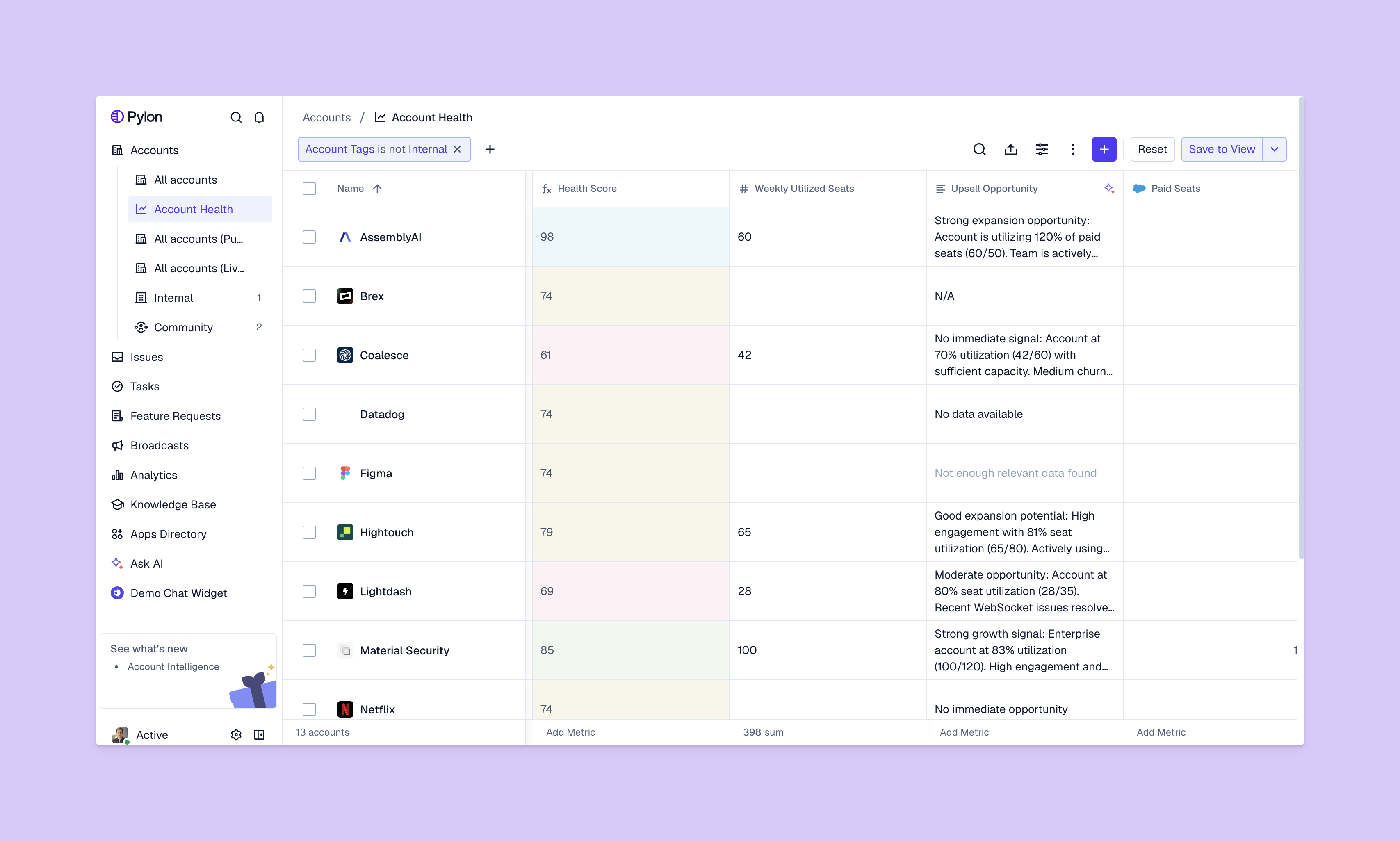
Pylon is specifically built for B2B teams — it unifies support and customer success into one platform. Your support conversations inform retention strategy, and your customer success work helps you provide personalized support.
With Pylon, you get:
And because it's in all-in-one platform that both your support and success teams can live in, all your account context is already connected.
Book a demo to see how Pylon connects your entire post-sales operations, from day-to-day ticketing to helping teams proactively support thousands of accounts.
Gainsight is a traditional enterprise platform with a deep feature set. You get health scoring, journey orchestration, product analytics, and customer community management in one system. The platform handles complex use cases and large customer portfolios.
But implementation for Gainsight takes longer and the learning curve is step. And unlike, Gainsight isn't natively built on top of a support system — so you still have buy a separate ticketing help desk and do extra work to connect customer data across both platforms.
ChurnZero focuses on real-time churn detection for mid-market SaaS companies. The platform is great at customer segmentation and automated playbooks that trigger based on usage patterns. Teams also find ChurnZero's interface more intuitive than traditional platforms like Gainsight.
That said, similar to Gainsight, ChurnZero is only for customer success. To unify your post-sales data across teams, you'll have to connect it to your separate support system.
Planhat emphasizes flexible data models for teams with unique requirements. You can map your specific customer journey, create health scores based on your metrics, and build dashboards that surface exactly what matters.
Totango gives you customizable workflows so you can build processes that match your approach. SuccessBLOCs are pre-built templates for common scenarios like onboarding and renewal — you can use them as they come or modify them. Totango works well when you want to design your own customer success methodology.
ClientSuccess offers a simpler interface and faster implementation than enterprise platforms. You get essential health scoring, task management, and customer communication without complexity that slows down small teams. Implementation typically takes days or weeks instead of months.
Vitally focuses on product adoption and collaborative playbooks for cross-functional teams. The platform brings product managers, customer success managers, and support teams into shared workflows. Product usage tracking is particularly strong, making it a good fit for product-led growth companies.
Custify provides a straightforward platform for small to mid-market B2B SaaS teams. You get core customer success features (health scores, automated workflows, customer communication) in a clean interface that's easy to learn. Works well when you're building your first dedicated customer success program.
Catalyst takes a workspace approach that brings customer context into your daily workflow. Instead of jumping between tools, you work in Catalyst's collaborative environment where data, tasks, and communications live together. Emphasizes cross-functional coordination.
Akita provides essential health scoring and automation for smaller teams. The platform focuses on fundamentals (tracking customer health, automating check-ins, alerting your team to risks) without overwhelming features. Pricing and simplicity make it accessible for early-stage companies.
SmartKarrot emphasizes customer journey mapping and sentiment analysis. The platform analyzes communication patterns and feedback to identify satisfaction trends and potential problems. Works well when you prioritize understanding customer sentiment alongside usage metrics.
ZapScale uses AI-powered insights and predictive analytics to forecast customer health and identify expansion opportunities. Machine learning models analyze patterns across your customer base to surface accounts likely to churn or expand. Fits teams that want AI-driven decision making.
EverAfter creates customer-facing portals for collaborative onboarding and ongoing engagement. Your customers log in to see project status, access resources, and communicate with your team. That transparency works well for complex onboarding processes.
UserGuiding specializes in product adoption through in-app guidance. You can create interactive walkthroughs, tooltips, and checklists that guide users through your product without writing code. While not a full CSM platform, it complements your stack by improving product adoption.
Freshdesk Customer Success extends the Freshdesk support platform with customer success capabilities. You get health scoring and lifecycle management that integrates with your support tickets. Works well if you're already using Freshworks products.
Not all CSM platforms offer the same capabilities. Here's what to look for.
Health scores indicate whether an account is at risk or ready for expansion. Your platform tracks engagement, product usage, support interactions, and other signals to create a single indicator.
Good health scoring systems let you customize the metrics that matter to your team. Look for platforms where you can define custom formulas.
AI analyzes patterns across your customer base to identify early warning signs. The system learns which combinations of behaviors typically precede churn (like declining usage along with increased support tickets) and flags accounts showing those patterns. You get weeks or months to step in and get your customer back on track.
Automated workflows can help you:
A platform with strong automation should free up your team from administrative tasks, so they can focus more on building long-term partnerships with customers.
CSM platforms typically connect with your CRM, product analytics, communication platforms, and support tools. Your post-sales team needs unified customer context to drive success outcomes.
Check which integrations are native, and which will require your team to use middleware or an API. Native integrations typically sync data reliably, bidirectionally, and in real-time.
Some platforms like Pylon have a support system and customer success management product in a single place — so your support data and other account context are already integrated, and you get a more complete customer view.
Dashboards surface customer journey insights, risk indicators, and team performance metrics. You can filter by customer segment, time period, or health score to understand which cohorts need attention. Real-time data means you're working with current information instead of stale reports.
Look for platforms where you can build custom dashboards and track exactly what matters for your post-sales org.
Ideally, you want to choose a tool that your team won't abandon in the next year. Here's how to evaluate all the different options.
Identify key touchpoints from onboarding through renewal. What happens in the first week after a customer signs up? When do you typically see adoption milestones? What triggers renewal conversations?
Your journey map will determine which features you actually need. If your biggest challenge is onboarding, prioritize platforms with strong playbook automations. If it's identifying churn risk, focus on health scoring or AI tracking.
List all the existing tools your post-sales function uses: CRM, support system, product analytics, communication tools, data warehouses, call recorders. Check which CSM platforms natively integrate with them. A platform that doesn't connect to your core systems will create gaps in your customer view, or put extra work on your plate to manually connect the context.
Also consider whether you want to consolidate tools. Many teams prefer an all-in-one platform like Pylon, where support and customer success can work out of the same place, instead of managing separate point solutions.
Decide what you'll measure to evaluate whether the platform works. Common metrics include:
Make sure the platforms you're evaluating can track your metrics and surface them in custom dashboards. If a platform can't report on what matters to your business, it won't help you improve.
Consider your company size, number of customer accounts, and team size when evaluating pricing. Startup-friendly platforms might cost a few hundred dollars per month. Enterprise solutions run into 5 or 6 figures annually.
Calculate potential ROI by estimating the value of reducing churn by even a few percentage points. For most B2B companies, preventing just a few customers from churning already pays for the platform in itself. Also factor in implementation costs and the time your team will spend getting set up.
Test the platform with a subset of accounts before rolling it out to your entire customer base. A 2 to 4-week pilot can expose whether the interface actually works for your team's daily workflow and whether promised features actually deliver value in practice.
Most CSM platforms use per-seat pricing, per-account pricing, or tiered plans based on customer volume and features. Startup-friendly options typically start around $200-500 per month. Mid-market platforms range from $1,000-5,000 monthly. Enterprise solutions require custom quotes.
Many vendors don't publish pricing publicly because it genuinely varies based on whether you're managing 100 customers or 10,000 — and which features you need. Expect to get a demo and trial the platform to get an accurate quote for your team.
AI is changing how customer success teams work by automating analysis that used to take hours. Sentiment analysis scans customer interactions to identify frustration or satisfaction. Automated health scoring processes thousands of data points to calculate risk. Predictive churn models forecast which accounts need attention before problems bubble up to the surface.
Plus, AI agents can now handle routine customer requests. With Pylon for example, AI can help you track feature requests on customer calls or draft follow-up messages after a meeting. This helps your team focus on strategic relationship work for every single account, even when your book of business is expanding quickly.
The key is using AI to accelerate your team in the right places — manual bottlenecks or repetitive work — instead of replacing their expertise on important or nuanced customer decisions.
Most platforms take 2 to 8 weeks depending on the complexity of your data migration and integration requirements. Simpler tools can be up and running in days if you have clean customer data. Enterprise implementations with custom workflows might take several months.
Some teams have migrated to Pylon in as little as one week.
CSM tools complement your CRM, but they don't necessarily replace it. They pull data from your CRM to add health scoring and lifecycle management on top of deal information. Your CRM still owns the sales pipeline and account records.
Most teams see measurable improvements in churn reduction and team efficiency within 3 to six 6 after full adoption. The timeline depends on how quickly you implement the platform and how effectively your team adopts new processes.
While CSM tools are built for customer success teams, support teams and account managers can also benefit from health scoring and workflow automations. If you don't have dedicated customer success managers yet, a CSM platform can provide support teams with proactive customer insights.
Enterprise CSM platforms typically offer SOC 2 compliance, data encryption, role-based access controls, and GDPR compliance features. Check each platform's security documentation and certifications to make sure they meet your company's requirements.
The best customer success operations run on unified platforms instead of disconnected point solutions. When your support tickets, customer call recordings, health scores, and retention data all live in the same system, you can quickly catch problems before they escalate.
Your tech stack shouldn't create silos between support and customer success. By connecting the tools for your entire post-sales team, you turn every customer interaction into an opportunity to strengthen relationships.
Pylon is the modern B2B support platform that offers true omnichannel support across Slack, Teams, email, chat, ticket forms, and more. Our AI Agents & Assistants automate busywork and reduce response times. Plus, with Account Intelligence that unifies scattered customer signals to calculate health scores and identify churn risk, we're built for customer success at scale.
Pylon Workforce Management is available now. See it in action with a live demo.