Register for our upcoming webinar → How Haus Analytics rebuilt its support automation



The customer acquisition process doesn’t end when your sales team closes a deal. For B2B teams, a smooth onboarding experience and friendly, accessible support are just as important to form long-term partnerships.
In this article, we’ll explore the different stages of the customer acquisition process and look at successful tactics to acquire customers and retain them. We’ll also cover how AI-powered support improves acquisition outcomes for B2B companies.
For B2B SaaS companies, customer acquisition starts the first time your company talks to a prospect and continues as long as the relationship runs. Here are the major stages of that process:
Successful onboarding and early customer support are just as important as marketing campaigns for acquisition. If you focus too much on pre-sales processes, you’ll end up with a “leaky bucket” problem. Your pre-sales teams work hard to acquire customers, who then struggle to adopt or can’t find value in your product and churn before they renew.
To measure how well your customer acquisition process actually works, pay attention to these metrics:
Smooth onboarding, fast activation, and efficient support boost these metrics. When customers quickly see value from your offering, you’re more likely to retain them and expand the relationship, leading to a higher LTV and a faster CAC payback period.
Here are some of the ways you can use AI in your scalable customer support model to improve your acquisition process.
Customers have lots of questions during onboarding, and conversational AI tools can answer them quickly or point customers to knowledge base articles that walk through solutions. This saves your support team time and 61% of consumers say they’d rather use self-service solutions to solve small problems. This automation speeds up the path to product adoption and helps your customers see value from your products faster.
AI-powered omnichannel support lets you manage conversations on all your channels from a single dashboard. A central dashboard limits how many tickets get lost and reduces delays, and by increasing transparency and providing customer context, your team can give new customers a consistent experience from day one.
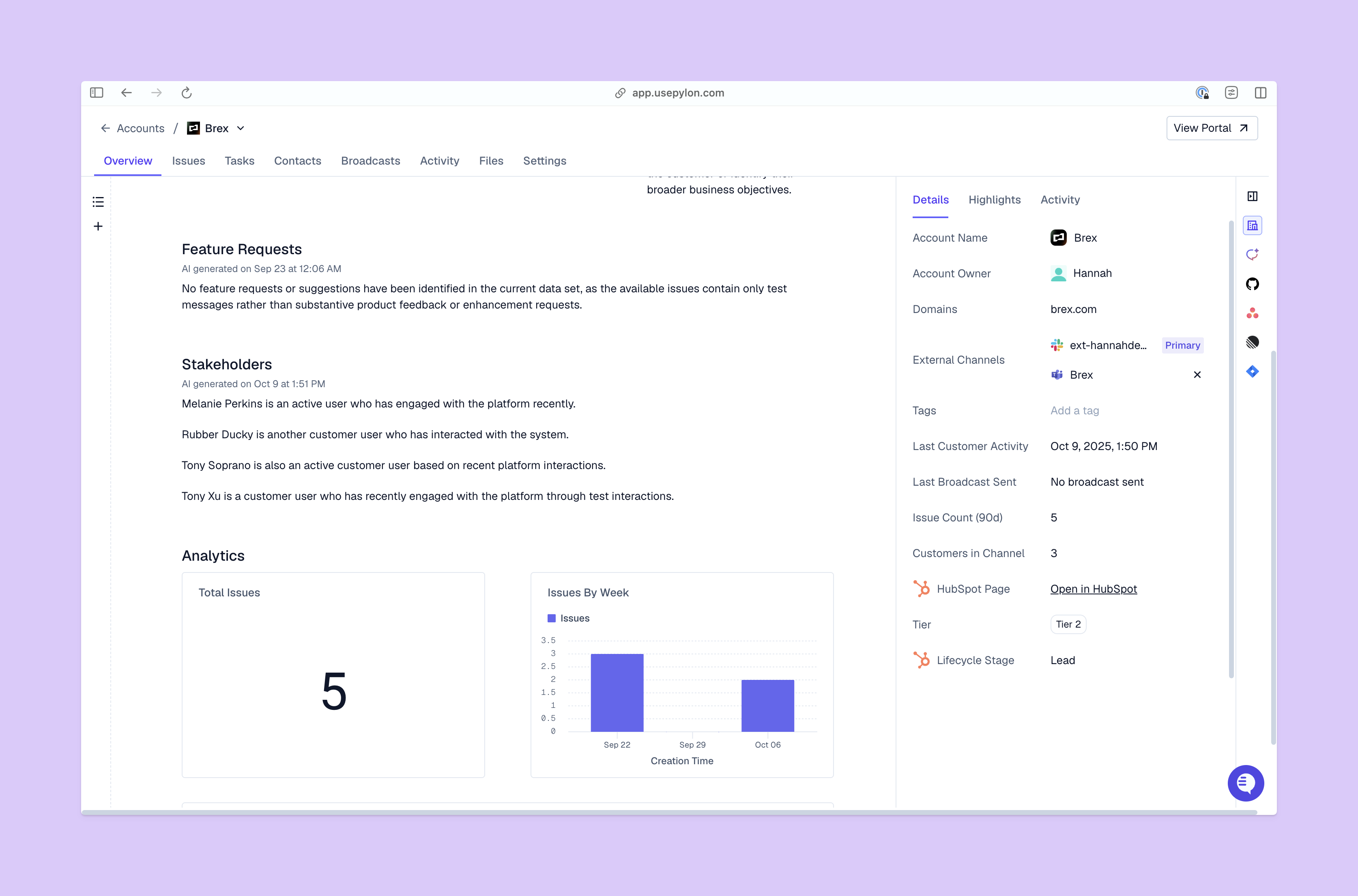
You need to identify problems and flag at-risk accounts as early as possible in the onboarding and activation stages to avoid issues that lead to churn. Pylon’s AI Account Intelligence analyzes conversations to generate account summaries and run automated playbooks based on customer signals. This automation helps your customer support and success teams step in proactively and smooth over any friction.
When you use AI tools to speed up the onboarding process, customers get up and running more quickly. The faster customers can start using your product or service, you’re more likely to see happy customers that renew their contracts. This leads to a shorter CAC payback period. Your support team can also resolve tickets and build relationships more efficiently, so it’s easier to scale support without steep hiring costs.
Today’s B2B companies are expanding beyond traditional acquisition channels and including other teams for a more holistic approach. Here are some tactics you can use to build well-rounded acquisition processes.
Look for ways your support team can reduce friction in early product usage during the onboarding stage. Breaking complex processes into small steps helps customers quickly reach simple wins and see your product’s value for their work faster. By offering proactive support, like bundling self-service articles for each onboarding step and sending them to the customer as they progress, your team can guide them with the goal of total independence as soon as possible.
Your support team is the first place customers go when they have problems, so they’re most likely to see gaps in onboarding documentation or moments where the process breaks down. When they feed those insights back to the product team, you can make changes to create a better experience.
For example, if customers still have questions about a feature after checking knowledge base guides and help desk answers, you might loop in your engineering team to make a UX fix. This feedback loop supports both acquisition and customer success by helping existing customers and making the product more attractive to prospects.
When your support team does a good job building connections and helping customers learn your product, those customers are more likely to renew their contracts and increase your LTV. They’re also more likely to refer you to their colleagues, boosting your sales and driving new customer acquisition at a low CAC.
Customer support platforms provide useful data: where your accounts drop off, when onboarding slows, what you tend to get more tickets about, etc. Shape your onboarding and activation processes with these support KPIs in mind, and you’re more likely to see stronger customer acquisition metrics in response. Your success team should monitor these metrics regularly and look for opportunities to refine the customer experience.
Customer acquisition efforts aren’t just about marketing campaigns. The post-sales stages (onboarding, activation, and retention) are just as important, and you need the right tools to support them. With an AI-powered B2B support platform like Pylon, you’ll have plenty of resources to create a sustainable account acquisition strategy.
Pylon is the modern B2B support platform that offers true omnichannel support across Slack, Teams, email, chat, ticket forms, and more. Our AI Agents and Assistants automate busywork and reduce response times. Plus, with Account Intelligence that unifies scattered customer signals to calculate health scores and identify churn risk, we're built for customer success at scale.
The process involves six phases: awareness, consideration, decision, onboarding, activation, and retention. Customers learn about your company, learn more about you, then decide to sign a contract. Once they’ve committed, post-sales teams help with onboarding and product use, then help them get the most out of the product so they’ll renew.
Customer acquisition cost (CAC) is the cost of gaining a new account. It’s calculated by dividing the sum of all marketing and sales costs by the number of new customers acquired.
Common errors include ignoring the customer’s lifetime value (LTV) context, failing to track data through integrated CRM or customer success tools, and focusing on lead quantity over high-intent quality leads.
Pylon Workforce Management is available now. See it in action with a live demo.